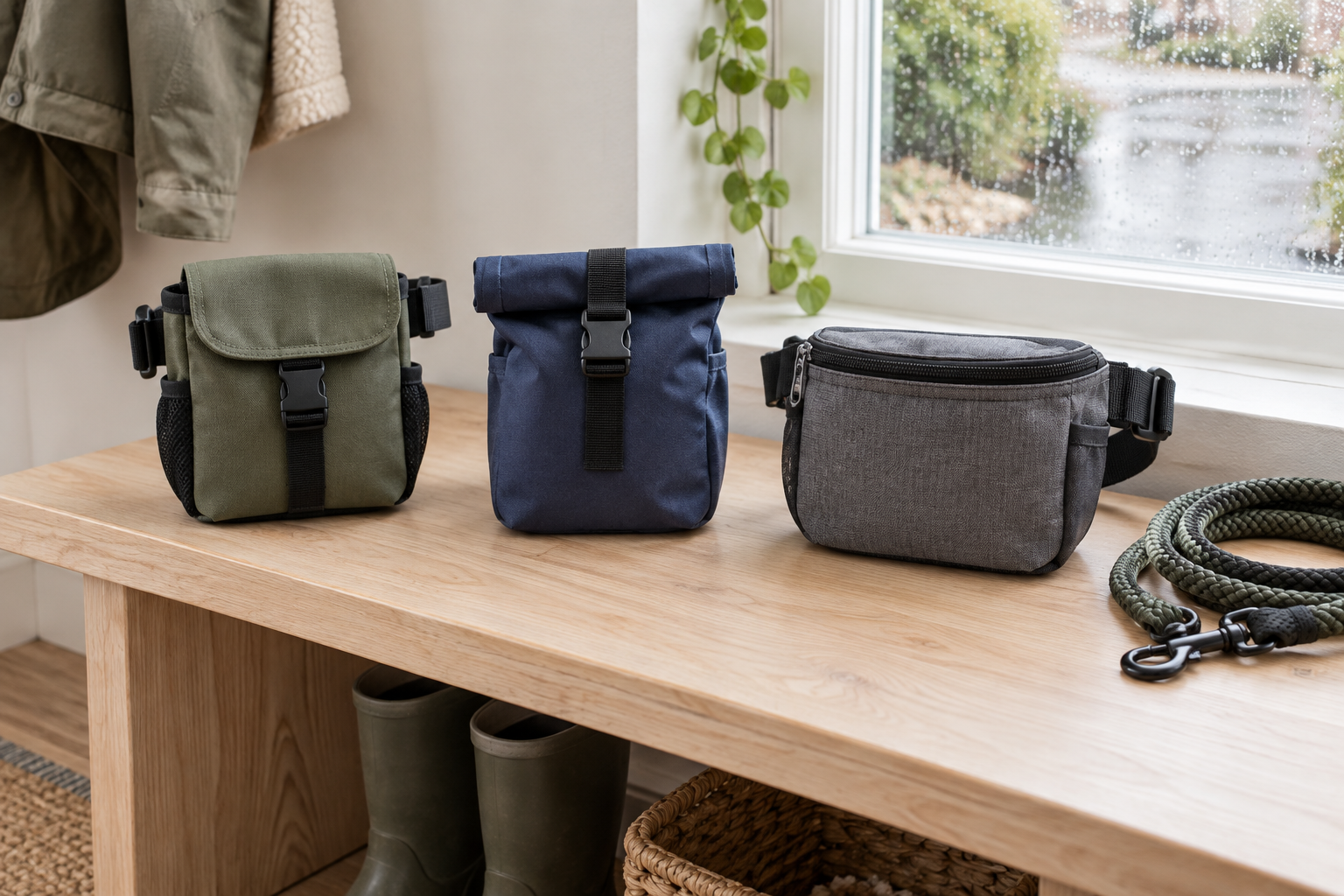
This is a carrying-accessory guide, not a training plan or weather-safety guarantee. A pouch can organize rewards, but it cannot fix fear, pulling, reactivity, or unsafe walking conditions. Use professional guidance when behavior feels difficult or unsafe, and change or end the walk when weather makes the route unsuitable.
Quick Comparison
Flap-top: usually the simplest lidded format to reach into, but gaps around the flap and seams still matter. Roll-top: places a folded section above the opening, but opening it can interrupt reward timing. Zip-top: closes around more of the opening, but a small pull or stiff zipper may be awkward with wet hands or gloves.
None of those closure names establishes waterproofness. Look for a specific maker declaration if water resistance matters, then read its limitations and care directions. Keep treats in a separate inner container when the food's storage instructions or your cleanup routine calls for one.
Check the Routine Before You Shop
- Access: practice the motion you need—steadying the leash, opening the pouch, taking one treat, and closing it again.
- Attachment: compare belt, waist strap, and clip options with the raincoat or layers you wear. The pouch should not swing into the leash path.
- Opening: check usable width, not only overall dimensions. Your fingers still need space when damp or gloved.
- Lining: favor a smooth, reachable compartment with care directions you can follow. Deep corners collect crumbs.
- Other gear: keys, waste bags, and a phone belong away from loose treats and damp residue.
- Pet access: position the pouch where the dog cannot nose it open, grab it, or chew the strap.
When a Flap-Top Pouch Fits
A structured flap can suit short routes where you need frequent one-hand access and want a cover over the opening between rewards. Check whether the flap falls closed on its own or needs a buckle, snap, hook-and-loop patch, or magnet. Each option changes the access motion.
Inspect the side gaps, hinge seam, edge binding, and attachment point. A wide flap may shield the opening from direct drops while still leaving exposed seams. Skip any design whose closure is difficult to confirm by touch or whose hardware catches a leash, sleeve, or treat bag.
When a Roll-Top Pouch Fits
A roll-top can suit owners who carry treats for occasional rather than rapid access. Compare the opening width, stiffness, required folds, buckle position, and how much usable capacity remains after rolling. A tall pouch can become surprisingly small once the top is folded.
This format is less appealing when reward timing depends on repeated fast access. It can also be awkward if the rolled section has to be held open. Try the movement with the clothing and hand mobility you normally have before deciding that the extra closure step is worthwhile.
When a Zip-Top Waist Pack Fits
A zip-top waist pack can suit a fuller walking kit when treats have their own cleanable compartment. Check the zipper-pull size, opening arc, interior dividers, belt adjustment, and whether the pouch stays level as you move. A covered zipper or coated fabric still needs an explicit maker label before you infer weather performance.
Zippers can trap crumbs or grit. Inspect the teeth and fabric around the track, and stop using a pouch if the zipper no longer closes reliably. Do not force a jammed zipper while managing a dog near traffic or another distraction.
Cleaning, Drying, and Storage
Empty leftover treats after the outing and follow both the pouch maker's care directions and the treat maker's storage guidance. Brush out crumbs, clean accessible surfaces as directed, and open every compartment so the pouch can dry fully. Pay special attention to folded tops, zipper tape, flap hinges, edge binding, and strap attachment points.
Do not seal a damp pouch in a walking bag or car. Store it open in a dry place pets cannot reach. Inspect for odor, residue, torn lining, loose clips, damaged stitching, stiff closures, or peeling coatings before the next use.
Who Should Skip a Lidded Pouch?
Skip it if an existing jacket pocket or your current pouch stays dry enough for short routes, if the extra closure slows access too much, or if you rarely walk in damp weather. A simple removable treat cup inside a larger walking bag may be easier to clean and replace.
Skip a visible waist pouch if your dog fixates on, jumps at, or tries to steal it. If walks involve fear, lunging, guarding, escape attempts, or handling that feels unsafe, ask a certified trainer or qualified behavior professional for help. A different pouch is not a behavior solution.
Bottom Line
Choose a flap-top pouch for faster covered access, a roll-top for occasional access with a folded closure, or a zip-top waist pack when a fully closing opening and separate compartments fit better. Verify dimensions, labels, attachment, cleaning, and drying rather than treating “lidded” as a waterproof claim.
For the broader decision—including magnetic, drawstring, silicone, and clip-on formats—use the dog treat pouch guide. For rainy outings that need towels, waste bags, wipes, and spare gear, build a compact pet outing kit.