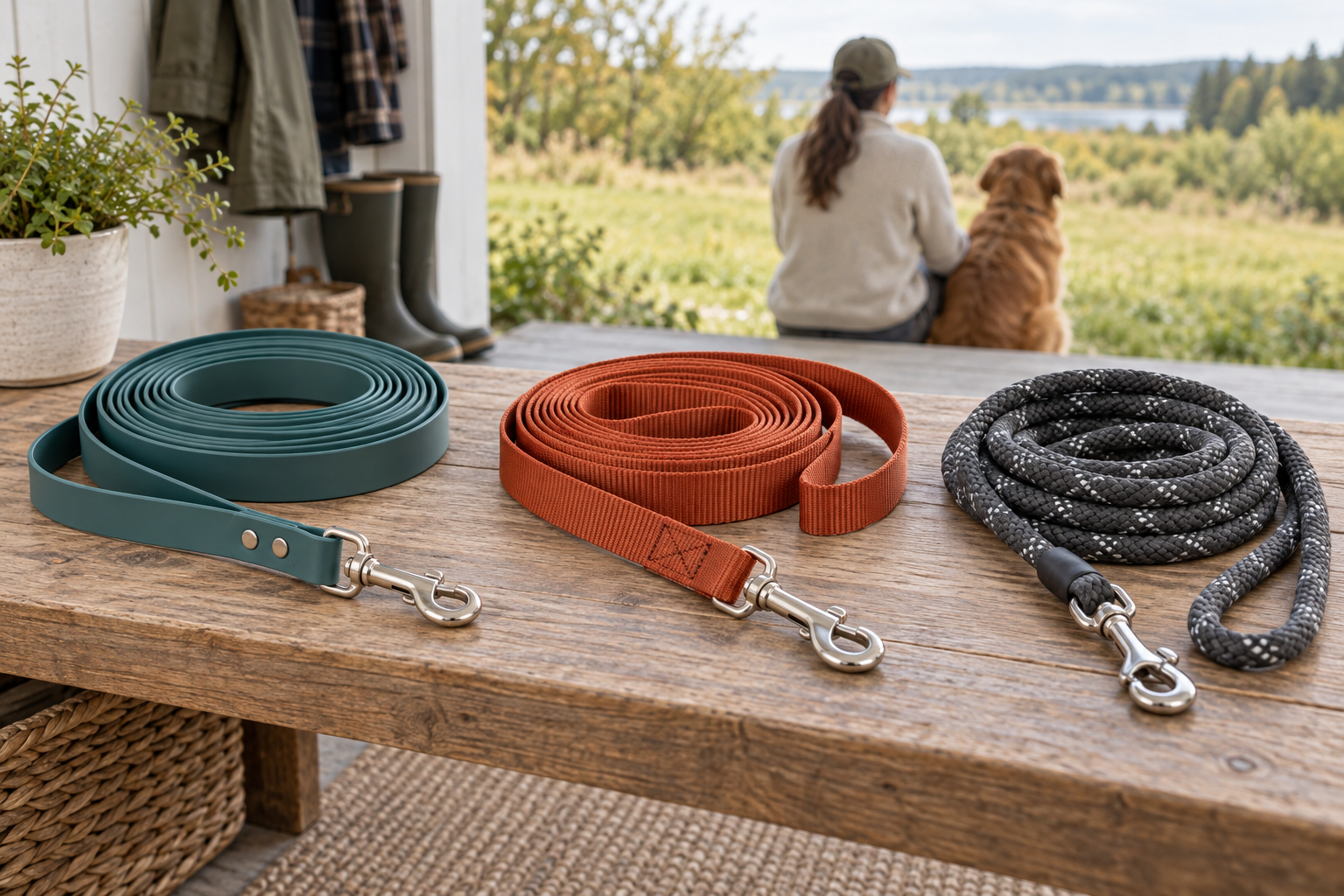
Quick Answer
Choose coated strap when wet grass, mud, and wipe-down care are routine concerns, provided its surface, width, flexibility, and clip suit the handler and dog.
Choose flat webbing when you prefer a familiar leash-like strap that folds readily and can be washed and dried as directed.
Choose round rope when a rounded line feels easier to gather and its diameter, weight, texture, coil size, and hardware work for the setup.
Material alone does not make a line safe. A long line can tangle around people, dogs, plants, and fixed objects, and it can gain speed before reaching its limit. Use one only where the handler can actively supervise, manage slack, and stay clear of traffic, crowds, drop-offs, fragile habitat, and other hazards. Ask a qualified reward-based trainer for individual handling help.
Check the Location and Routine Before Buying
Confirm that dogs and long lines are permitted, then note path width, sight lines, surface, roads, cyclists, children, wildlife, other dogs, fences, water, steep ground, and vegetation that can catch a line. An open field can still be unsuitable when other users appear unpredictably.
Choose only as much line as the location and handler can manage. More length adds reach, ground contact, gathering time, storage bulk, and opportunities for tangling. If you cannot organize the loose line without wrapping it around a hand or body, use a shorter setup or a standard leash.
A long line does not create recall, stop chasing, prevent escape, or make an off-leash location appropriate. If your dog lunges, bolts, panics, guards space, redirects, or is difficult for you to hold, use a simpler setup and consult a certified trainer or qualified behavior professional. Sudden behavior changes, pain, coughing, breathing difficulty, limping, or exercise intolerance belong with a veterinarian.
How the Three Materials Differ
Coated strap
A coated strap generally absorbs less surface water than plain textile webbing and can be easier to wipe after wet grass. Compare the exact coating, edge feel, temperature flexibility, wet grip, and care directions. A smooth surface may slide quickly through a hand, so it is not automatically easier to control.
Flat woven webbing
Webbing feels familiar to many leash users and lies relatively flat when folded. It can collect water, grit, seeds, and burrs. Check edge finish, stitching, width, drying directions, and whether the color stays visible against the usual ground.
Round rope
Rope offers a rounded hand profile and coils differently from flat strap. Compare diameter, surface texture, weight, splices or stitching, and stored size. Thin is not automatically appropriate for a small dog, and thick is not automatically safer for a large dog; follow maker guidance for the whole line and clip.
Buying Criteria That Matter
- Usable length: Confirm whether the measurement includes handle and clip, then choose only as much reach as you can manage.
- Width or diameter: Compare hand feel, bulk, weight, and maker dog-size guidance.
- Clip and connection: Check clip type, opening, swivel, finish, stitching or splice, and compatibility with the maker-approved attachment point.
- Handle design: A terminal loop can help with carrying but can catch on vegetation when dragged. Handle-free lines require a deliberate handling plan.
- Visibility: Choose a color that contrasts with the usual grass, dirt, leaves, sand, or snow. Bright color does not make a route safe.
- Ground drag: Consider water, grit, burrs, debris, and how easily the material moves across the intended surface.
- Care: Follow the label and plan where to clean, fully dry, and inspect both sides.
- Storage: Keep the whole line in a loose, untangled coil in a dry place away from pets and children.
- Return terms: Inspect indoors so you can reject rough edges, sticky hardware, damaged coating, frayed fibers, poor stitching, or impractical weight.
Ignore vague claims such as escape-proof, tangle-free, indestructible, or suitable for every dog. No material removes the need for active handling, appropriate fit, inspection, and location judgment.
A Calm Handling, Cleaning, and Storage Routine
Read the maker’s directions before the first outing and ask a qualified trainer to demonstrate line handling if it is unfamiliar. Keep the line organized in loose folds or coils without wrapping it around fingers, hands, wrists, legs, or the body. Wear appropriate footwear and stop before slack runs through the hands at speed.
Do not attach the line to a fixed object, moving vehicle, bicycle, waist belt, or improvised anchor unless the exact maker supports that use and a qualified professional has confirmed the setup. Never leave a dog unattended. Avoid letting the line cross another dog or person, and end the session if it repeatedly catches or becomes difficult to gather.
Afterward, remove grit and plant debris as the label allows. Dry the line away from direct heat unless instructed otherwise. Inspect the full length, connection, coating, handle, and clip. Retire it according to maker guidance if fibers fray, coating splits, stitching loosens, the clip sticks, or metal bends or cracks.
Who Should Skip a Long Line?
Skip it for sidewalks, parking areas, crowded parks, shared narrow paths, or anywhere near traffic. A standard fixed-length leash keeps the working radius easier to predict.
Skip it when the handler cannot actively manage slack. Limited grip, balance, mobility, or line-handling experience may make a shorter ordinary leash more practical.
Skip it as the solution to pulling, bolting, reactivity, aggression, panic, or unreliable recall. Equipment cannot diagnose or resolve those concerns. Seek appropriate professional guidance.
Skip it when the location is not clearly suitable. Local rules, wildlife, fragile habitat, other users, water, steep ground, and poor visibility override the appeal of extra range.
Related Walking Guides
For close-range routes, compare a standard leash with a retractable leash. If hands-free carrying is the real goal, use the hands-free leash guide. Choose attachment equipment separately with the everyday dog harness guide, and carry cleanup supplies in a dog walking bag.
Bottom Line
The best long line is the shortest practical length in a material the handler can see, gather, clean, inspect, and store reliably. Compare coated strap, flat webbing, and round rope by the real route and routine, then use the line only with direct supervision and professional guidance when needed.