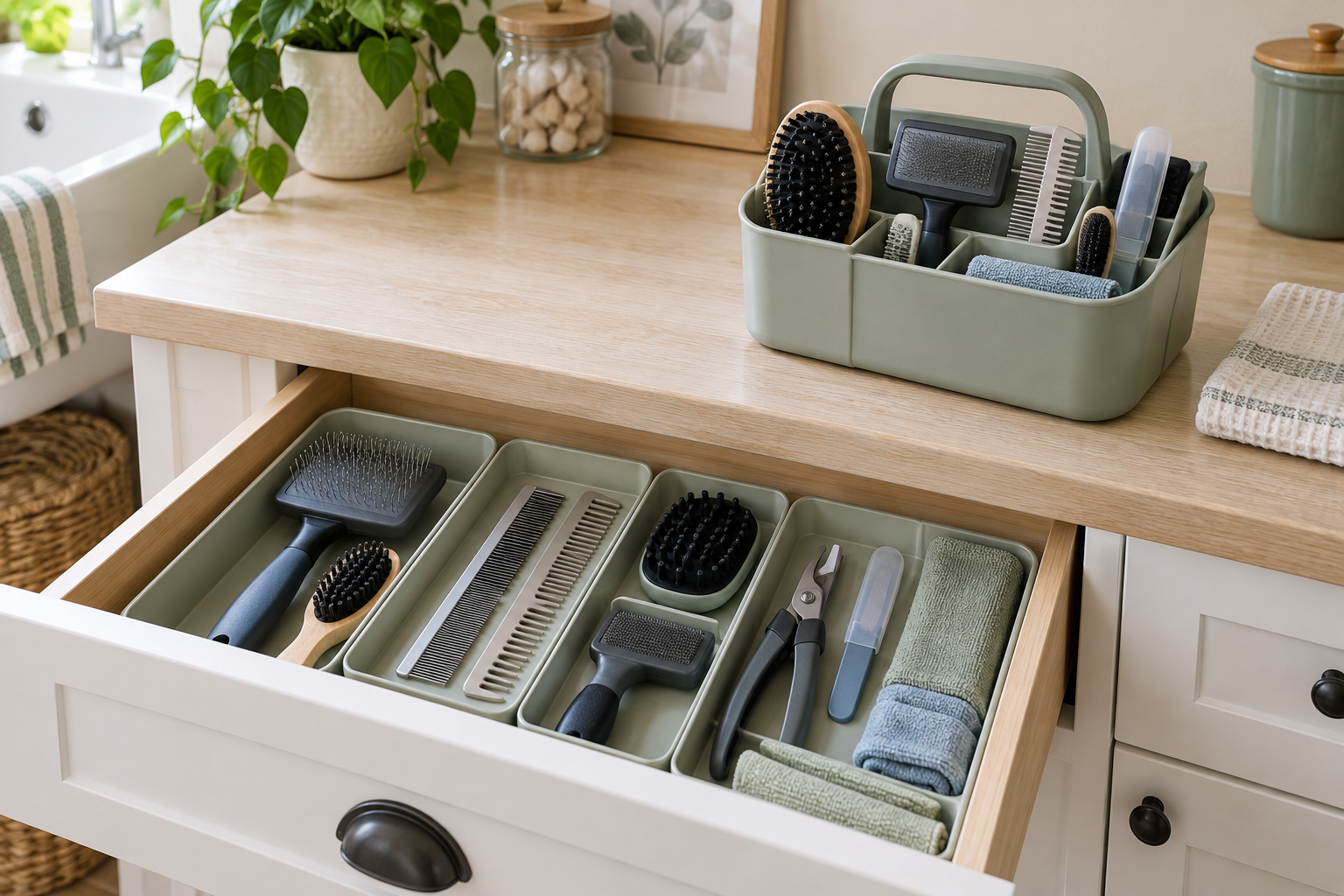
This is a storage comparison, not grooming instruction or a health solution. Keep scissors, blades, clippers, cords, medication, concentrated products, and small parts secured according to their directions and inaccessible to pets and children. Ask a veterinarian or qualified groomer about pain, skin changes, severe matting, wounds, or a routine that feels unsafe.
Quick Decision
- Choose a drawer organizer when tools stay in one room, a suitable drawer closes fully, and the layout makes each dry item easy to find.
- Choose a countertop caddy when ordinary compatible tools travel together and the caddy has a stable temporary work spot plus secure storage afterward.
- Choose closed storage when pet access, children, sharp items, cords, liquids, or small parts make an open organizer unsuitable.
- Skip both when an existing washable pouch or box already fits the measured kit and routine.
Compare the Real Footprint
A drawer uses hidden horizontal space but needs clearance above the tallest tool and around the tray. Measure inside width, depth, and height with hinges, runners, drawer sides, and handles in mind. Confirm that brushes lie flat without jamming the drawer or catching bristles.
A caddy occupies visible counter space while in use. Measure its base, not just its top rim, and check whether the handle adds height inside the cabinet where it will be parked. An open caddy should not become permanent accessible storage simply because it fits the counter.
Visibility, Access, and Routine Speed
Divided drawer trays make tools visible when the drawer opens and keep the counter clear when it closes. Deep or crowded drawers can still bury small items, so use compartments sized to the inventory rather than stacking tools.
A countertop caddy keeps the whole kit together and can reduce repeated trips between rooms. The tradeoff is exposure: curious pets may nose into compartments, pull cloths, or chew handles. Carry the caddy only by the method described by its maker, and return it to inaccessible storage after the routine.
Tool Fit and Separation
Measure the longest comb or brush and the widest brush head. Check usable compartment dimensions rather than overall organizer size. Narrow slots may bend bristles, while deep compartments can hide small guards or caps. Avoid crowding cutting edges or electrical tools against ordinary brushes.
Separate clean, dry brushes from damp cloths and leaking containers. Items that require guards, caps, original packaging, or specific storage should keep those protections in either format. An organizer does not override the tool maker's directions.
Cleaning and Moisture
Loose fur can collect in tray corners, divider tracks, handle joints, and textured bases. Removable trays may be easier to empty, but confirm their care instructions before washing. Wipe the drawer itself and let both organizer and tools dry completely before closing them away.
A caddy may be easy to carry to a sink, but appearance does not prove dishwasher safety, water resistance, or compatibility with cleaners. Follow the complete product directions. Dry wet tools separately; neither an open caddy nor a closed drawer is automatically a drying rack.
Stability and Secure Storage
A drawer tray should stay level and leave the drawer able to open and close without force. A caddy needs a stable base on the actual work surface and balanced loading below the rim. Do not put either organizer where it can fall, block a walkway, or be reached by a pet.
Open storage is inappropriate for sharp tools, blades, medication, concentrated grooming products, batteries, cords, or small detachable pieces. Use closed inaccessible storage that follows the relevant directions, even if that means keeping those items separate from the convenient everyday kit.
Who Should Skip Each Format?
Skip a drawer organizer when no suitable drawer closes freely, damp items routinely enter the kit, or household members need to carry the same tools between rooms. Skip a countertop caddy when counter space is tight, the pet investigates open containers, the loaded base tips, or there is no secure cabinet or shelf for storage after use.
Skip buying either when the existing container fits, can be cleaned, and keeps the appropriate tools secured. If the main problem is fear, pain, matting, or difficult handling, another organizer will not solve it; pause and seek qualified help.
Bottom Line
Drawer organizers suit fixed routines, clear counters, and dry tools that fit below a closing drawer. Countertop caddies suit a small room-to-room kit when carrying, cleaning, stability, and secure parking all work. Choose from measurements and actual access needs, not from how tidy an organizer looks when empty.
For a broader set of storage choices, use the pet grooming organizer guide for small bathrooms. If portability itself is still uncertain, start with the grooming caddy worth-it test.