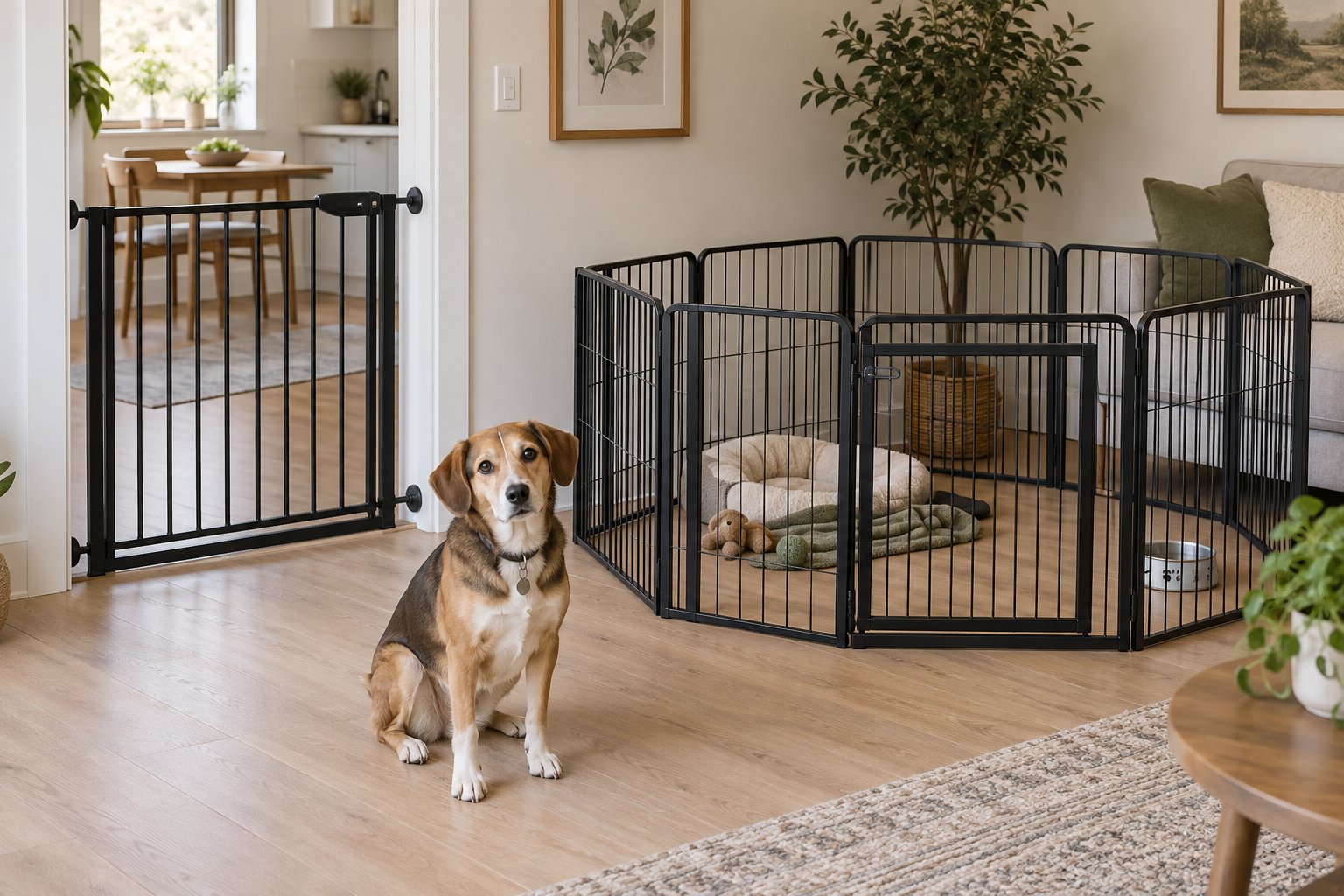
This is a product-category decision guide, not a guarantee that either barrier will contain a particular pet. Neither format replaces supervision, gradual familiarization, or professional help when a pet is distressed.
Gate vs Pen at a Glance
- Use of space: a gate borrows a doorway; a pen claims a measured patch of floor.
- Boundary: a gate blocks one route; a pen creates a zone with multiple sides.
- Access: a walk-through gate uses a latch; a pen needs a suitable door or a safe panel-opening routine.
- Portability: some gates move, but repeated installation takes checking; folding pens can relocate, though they are bulky and may be heavy.
- Cleaning: gates add contact points at a doorway; pens add rails, connectors, and floor edges around a larger footprint.
- Pet fit: both require suitable height, gap spacing, construction, and a pet that does not climb, jump, chew, push, or panic at the barrier.
Choose a Pet Gate for One Clear Doorway Job
A gate is usually the more space-efficient answer when you need to keep a pet out of one compatible room during a brief routine. A walk-through door is useful in a high-traffic opening because people do not have to step over the frame. Measure the opening at more than one height, note baseboards and trim, and check which mounting surfaces and extensions the maker permits.
Pressure-mounted gates depend on even contact and compatible placement. Hardware-mounted gates require appropriate structure and installation. Do not assume any gate is approved for stairs, children, outdoor use, or a particular pet simply because its width fits.
Choose an Exercise Pen for a Defined Floor Zone
A pen can make more sense when a doorway does not define the area you need, or when the setup must include room for an appropriate bed, water, and calm movement. Its cost in a small home is footprint: measure the proposed configuration, not just one panel, and leave ordinary paths, doors, cabinets, vents, cords, and exits clear.
Check panel height and spacing, connection hardware, the access-door opening, floor contact, folded dimensions, complete weight, and the maker's configuration rules. Avoid improvised shapes that the instructions do not support. A mat beneath a pen may simplify floor care only if it lies flat, does not become chewable, and does not destabilize the panels.
Measure the Setup Before Shopping
- Mark the exact doorway or floor outline with removable tape.
- Measure width, height, trim, baseboards, door swing, and nearby furniture for a gate.
- Measure the entire configured perimeter and usable interior floor area for a pen.
- Keep exits and household walking routes open; include the space needed to operate each door and latch.
- Compare the pet's body size and observed habits with the maker's current spacing, height, and use limits.
- Plan where the folded or removed equipment will go.
A listed weight limit alone does not establish fit or suitability. Gap spacing, climbing or jumping behavior, hardware access, and the individual pet's response still matter.
Daily Access, Cleaning, and Storage
For a gate, test whether every household member can operate the latch and pass without awkward stepping. Keep fur and debris away from contact points and hinges, and regularly check wall cups, tension indicators, fasteners, feet, and the latch according to the maker's directions.
For a pen, check connectors and feet before each setup, wipe rails and joints, clean the floor beneath it, and dry all parts before folding. Store folded panels where they cannot tip or be accessed by pets. Stop using either format if parts are bent, loose, sharp, chewed, or no longer latch as intended.
Who Should Skip Both for Now
Pause the purchase if your pet climbs, jumps, squeezes through, pushes barriers, chews metal or fabric, catches a collar or jaw near openings, or becomes fearful or frantic during separation. A taller barrier is not automatically the right response. A qualified trainer or behavior professional can help assess the setup; contact a veterinarian when the behavior is sudden, severe, or may be connected to pain or illness.
Also skip both when the only placement blocks an exit, creates a serious trip point, crowds essential mobility space, or conflicts with the manufacturer's instructions. An existing closed door and direct supervision may be the simpler option for short routines.
Bottom Line
In a small home, a pet gate wins on floor efficiency when one suitable doorway defines the boundary. An exercise pen wins on flexibility when you need a measured freestanding zone and can spare the full footprint. Choose only after checking the exact product directions, the room, daily access, cleaning, storage, and the pet's calm response.
For the larger setup, use Starter Pet Supplies That Actually Help. If a doorway gate is the likely fit, continue with the small-space pet gate guide.