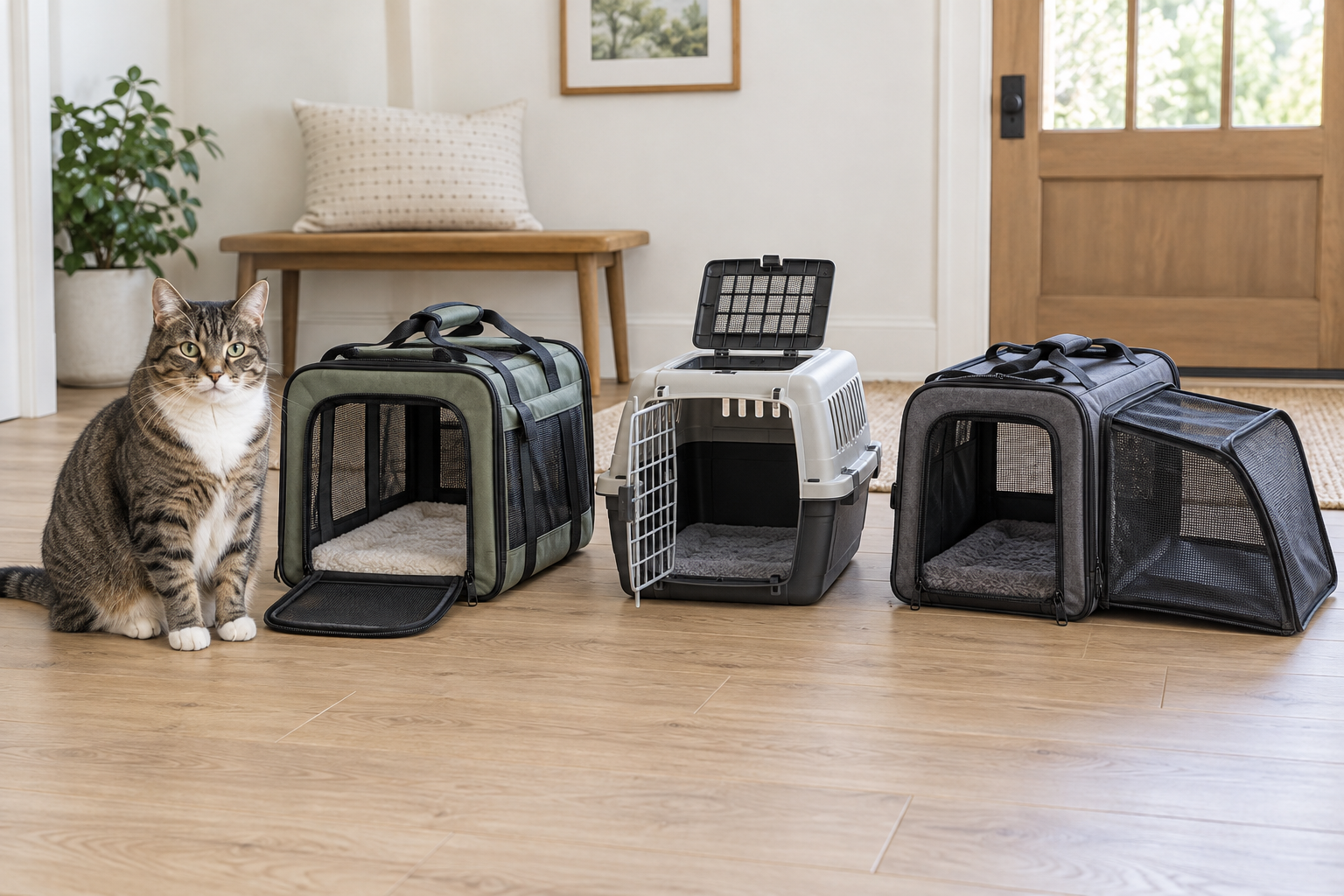
Quick Comparison
Reinforced soft-sided: lighter, but structure varies
A structured soft carrier may be easier to carry and store than a rigid shell. Check whether the base remains level, the walls preserve usable space, and the handles and strap anchors connect to load-bearing seams. A high stated limit does not prove that a broad or tall cat fits inside.
Rigid top-and-front-door: stable walls and direct access
A rigid shell preserves its shape and usually offers wipe-clean surfaces. A top door can create another loading route, but its opening, hinges, latches, and frame still need to clear the measured cat. The shell may be bulky to store and heavier before the cat is added.
Expandable soft-sided: extra set-down space, not extra transport fit
An expansion panel can provide more room only after the carrier is placed as the maker directs. It does not make an undersized closed compartment suitable for carrying. Check which panels may be open, when they may be used, and whether the floor remains supported.
Measure the Cat and the Usable Interior
- Follow the maker's method: use the exact standing length, height, or other measurements requested by the carrier maker rather than inventing a universal allowance.
- Compare interior dimensions: exterior length can include pockets, handles, sloped walls, hinges, and frames. Look for usable interior length, width, and height.
- Check every opening: compare the clear front, top, or side opening with the cat's body and your loading routine. Do not force a cat through a narrow frame.
- Add the empty weight: combine the cat's current weight with the complete carrier, liner, and necessary trip items to judge whether you can lift, carry, turn, and set it down steadily.
- Preserve the return option: review current terms and keep the packaging while confirming fit without forcing the cat into the carrier.
If the cat cannot use the carrier in the posture and manner shown in its instructions, choose another size or format. Ask a licensed veterinarian for transport guidance when pain, breathing difficulty, limited mobility, recovery, or marked distress affects necessary travel.
Selection Criteria That Matter
- Usable floor area: require enough measured length and width after the base board, liner, and wall curves are accounted for.
- Interior height: a domed or tapered top may offer less usable height at the edges than the exterior number suggests.
- Stated load: stay within the maker's current limit, but treat it as a structural ceiling rather than proof of body fit.
- Base support: compare whether the floor insert spans the occupied area, stays level during a careful lift, and can be removed or cleaned as directed.
- Door geometry: check clear opening dimensions, hinge travel, latch access, and whether bedding blocks the door from closing correctly.
- Ventilation clearance: confirm that mesh or vents remain open when the carrier is held, placed beside you, or positioned according to instructions.
- Closures and attachment points: inspect zipper tracks, clips, latches, screws, handles, and strap anchors before each use.
- Owner handling: wide carriers can bump doors and legs. Make sure your route and grip let you keep the base controlled without swinging or tilting.
- Cleaning: compare removable liners, sealed versus joined shell surfaces, mesh care, and the drying time required before storage.
- Storage: allow room for a rigid shell, or confirm that a folding soft carrier returns to its intended structure before the next trip.
Handling, Cleaning, and Routine Use
Set the carrier on a stable surface before opening it. Keep one hand available to steady the carrier during short lifts, and do not lift by a decorative pocket, mesh panel, or door. Follow the maker's directions for handles, shoulder straps, internal tethers, and vehicle placement; a carrier is not proven crash protection unless supported by current evidence specific to that exact model and use.
Use only liners that preserve the required floor space, ventilation, and door closure. Clean accidents by the carrier and liner labels, allow every part to dry fully, and check for split seams, bent doors, damaged mesh, loose fasteners, cracked plastic, unreliable latches, or a warped base. Replace a carrier that cannot be restored to its intended condition.
Help the cat become familiar with the carrier through calm, ordinary access at home when practical. This guide does not provide behavior modification or medical advice. If loading or travel causes persistent severe distress, ask a veterinarian or qualified feline-behavior professional for an appropriate plan.
Who Should Skip Each Type?
Skip a soft-sided carrier when the walls collapse into the measured interior, the base bows, the cat damages mesh or closures, or the handles do not keep the occupied carrier controlled. Skip a rigid carrier when the available size is too small, the combined load is unmanageable, the doors do not provide suitable clearance, or storage and transport cannot accommodate the shell.
Skip an expandable carrier when the cat does not fit the closed compartment, the trip offers no safe place to deploy the panel as directed, or the expanded floor lacks full support. Skip any carrier with missing interior measurements, unclear load or handling instructions, unreliable closures, blocked ventilation, or a return policy that prevents a careful fit check.
Bottom Line
For a large cat, choose by measured usable interior space and your ability to handle the complete occupied carrier—not by an extra-large label alone. A reinforced soft carrier prioritizes lower shell weight, a rigid two-door carrier prioritizes stable walls and access, and an expandable carrier adds temporary set-down room only after the closed transport fit is correct.