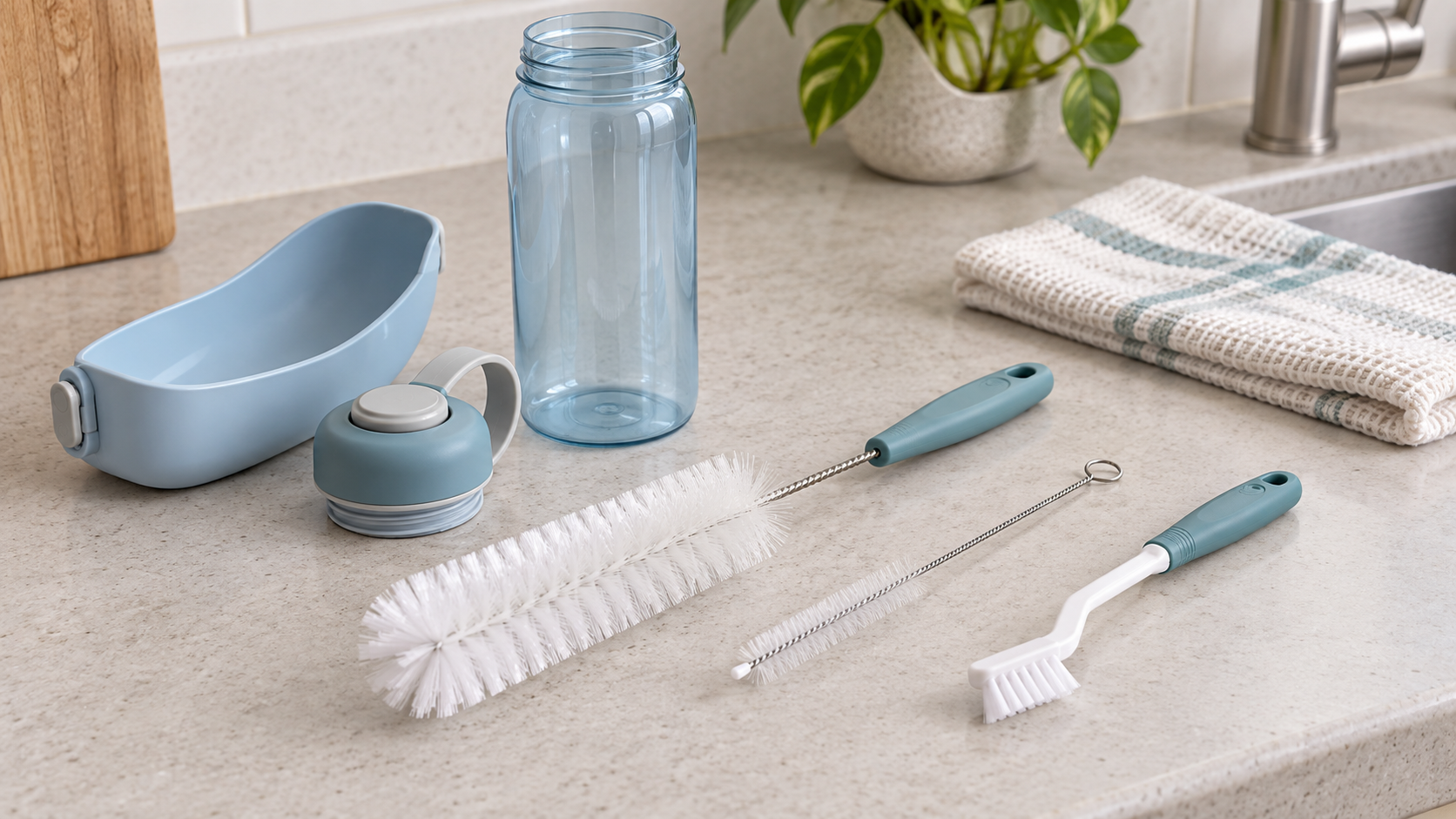
This is a buying framework for mechanical cleaning tools, not a sanitation protocol or health recommendation. Follow the travel-bottle maker's instructions for disassembly, washing, rinsing, drying, and reassembly. Do not put a brush into a sealed valve, spring assembly, or other component the manufacturer does not identify as removable or cleanable.
Quick Comparison: Match the Brush to the Geometry
Long bottle brushes: chamber coverage
A long brush works when its head passes through the neck and its bristles contact the bottom and sidewall without wedging. Compare useful bristled length—not only total handle length—and look for a finished tip that will not scrape the base.
Flexible tube brushes: narrow reach
A slim flexible shaft may suit a removable channel, spout, or straw-like piece. It should be longer than the passage, narrow enough to move freely, and capped or rounded at the wire end. Never force it around an unknown bend or into a one-way valve.
Angled detail brushes: controlled side contact
A compact angled head can reach open trough corners, cap threads, button surrounds, and shallow recesses that a large round head skips. It is useful only when the part is accessible and the bristles are compatible with its surface and seals.
Measure Before You Shop
Take the bottle apart only as its instructions allow. Measure the bottle-neck opening, interior depth, removable tube or channel diameter, and the width of open cap and trough recesses. Note the materials used for the chamber, seals, trough, and cap; a tool appropriate for stainless steel may be too stiff for soft plastic or silicone.
List the tools already included with the bottle. If one small brush already reaches the only narrow area, replacing that brush may be more sensible than buying a large set. A travel-bottle kit should solve travel-bottle geometry, not duplicate a fountain brush kit designed for pumps and fountain tubing.
Selection Criteria That Matter
- Head diameter: It must pass through the measured opening with room for the bristles to move.
- Useful reach: The bristled section and handle should reach the full chamber or removable passage without burying your hand in the opening.
- Head shape: Round heads suit chambers; slim cylindrical heads suit straight narrow passages; angled heads suit open corners.
- Bristle stiffness: Follow the bottle maker's surface guidance and avoid bristles likely to scratch soft plastic or damage seals.
- Wire and tip finish: Twisted-wire brushes need a protected end with no sharp point exposed.
- Handle control: A modest non-slip grip is easier to guide around a cap than a bulky handle.
- Care directions: Check how the brush maker says to wash, rinse, and dry each tool; do not assume every part is dishwasher-safe.
- Storage: Favor a hanging loop or ventilated holder that lets every brush dry without touching household-cleaning tools.
Clean, Dry, and Inspect the Brushes
Empty the bottle and disassemble it according to its manual. Use gentle pressure and stop if a brush catches. Clean each tool as its maker directs, rinse it thoroughly, shake out retained water, and let it dry in a ventilated place away from pet access. Keep these brushes dedicated to the pet bottle rather than moving them between unrelated cleaning jobs.
Replace a brush if bristles shed or flatten, wire kinks, rust appears, the tip cap loosens, or the handle cracks. Inspect bottle seals and closures during reassembly, and retire a damaged bottle according to its maker's directions. A brush cannot restore a cracked chamber, degraded seal, stuck mechanism, or leaking closure.
Who Should Skip a Brush Set
Skip a multi-piece set when your bottle has a wide opening, few removable parts, and an ordinary dedicated dish brush already reaches every maker-approved surface. Also skip a generic set when the manufacturer specifies a model-specific tool, says a component should not be opened, or provides a replacement cleaning brush that fits exactly.
A cleaning set is a convenience item, not a water-quality or health solution. If a pet suddenly changes drinking habits, refuses water, vomits, seems lethargic, or otherwise appears unwell, contact a licensed veterinarian rather than assuming a different bottle or brush will address the cause.
The Bottom Line
Choose by measured geometry: a long narrow brush for the main chamber, a flexible slim brush for maker-approved removable passages, and an angled detail brush for accessible cap and trough recesses. Correct fit, protected tips, surface-compatible bristles, complete drying, and easy inspection matter more than a high tool count.
For the larger purchase decision, compare whether a pet travel water bottle is worth it or consider a collapsible bowl used with water carried from home.