Quick Answer
Choose a rigid flirt pole when you prefer predictable, direct movement and have enough measured clearance for the assembled pole, cord, lure, handler, and dog.
Choose a flexible pole when controlled flex feels more comfortable in your hands and you are prepared to inspect the shaft closely for cracks, splinters, bends, or other damage.
Choose a collapsible pole when closet or vehicle storage is the main constraint, provided its joints lock firmly and repeated assembly will not make the routine a nuisance.
A flirt pole is an interactive, supervised toy—not a chew toy, tether, training guarantee, or substitute for professional advice. If your dog has pain, mobility limitations, a recent injury, extreme arousal around moving objects, or uncertain suitability for quick turns, ask your veterinarian or a qualified reward-based trainer before using one.
Measure the Whole Play Envelope
Do not judge fit from pole length alone. Add the assembled pole, cord, and lure lengths, then allow space for your arm movement and the dog’s path. The usable area should be level, enclosed where appropriate, and clear of furniture, garden tools, steps, holes, hard edges, people, and other animals.
Longer is not automatically better. Extra reach can make a lure harder to place predictably in a compact yard. A very short setup can bring the dog uncomfortably close to the handler. Compare the maker’s dimensions with the actual clear area rather than relying on “backyard” or “large dog” labels.
Plan a storage route too. The toy should be put away after the session, with the cord untangled and dry. If a full-length rigid pole has nowhere protected to go, a securely locking collapsible format may be more realistic.
How the Three Formats Differ
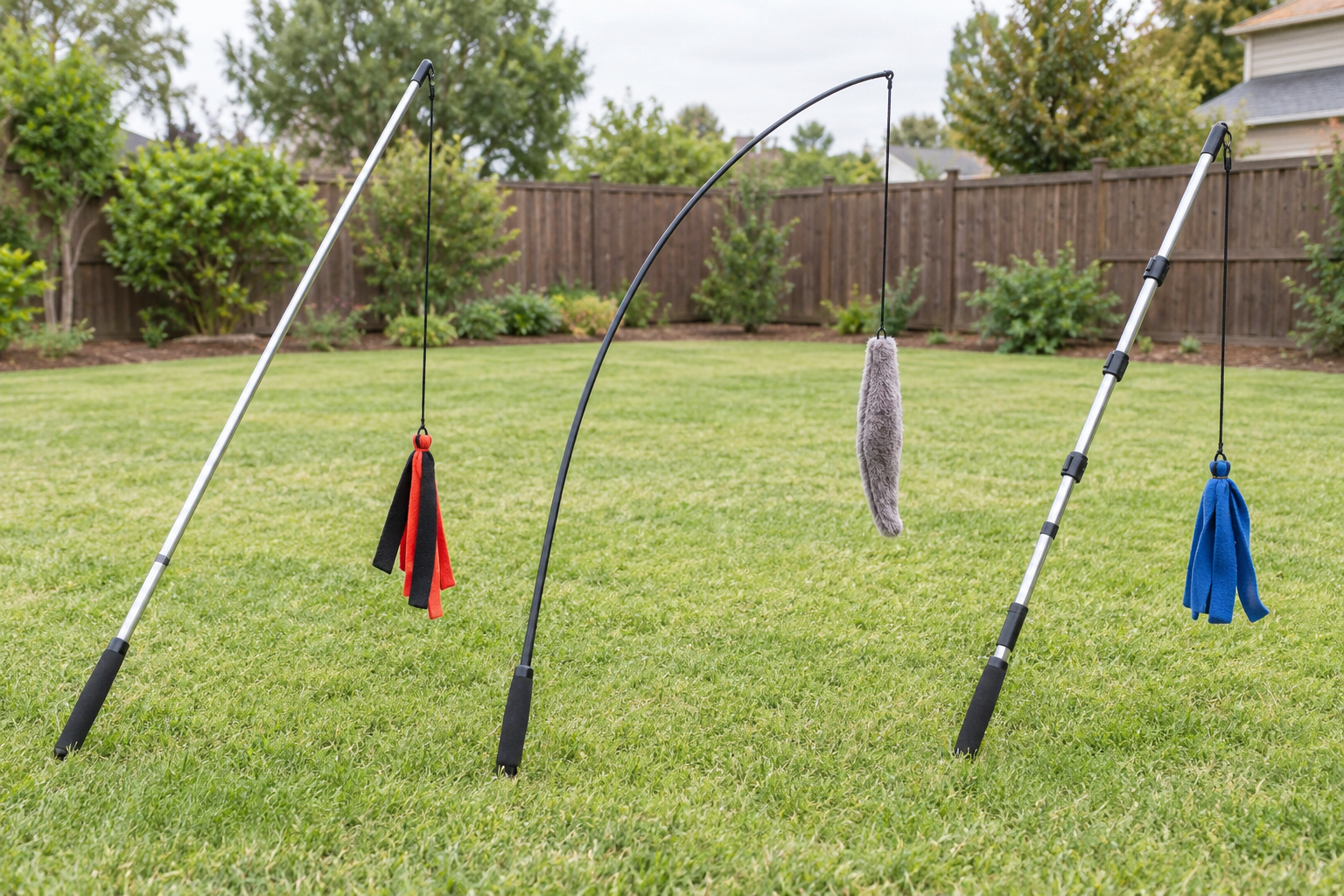
Rigid poles
A rigid shaft transfers small hand movements directly to the cord. Compare shaft material, total weight, grip length, and balance. Check how the cord attaches at both ends and whether the maker sells compatible replacement lures or cord assemblies. Skip a design whose connector leaves a sharp, exposed, or poorly finished edge.
Flexible poles
A flexible shaft bends during movement, so the experience at the handle differs from a stiff tube. Flex does not make a toy automatically gentler or safer. Check the manufacturer’s use and size limits, and inspect the full shaft before every session. Retire it if it no longer returns predictably or shows cracking, fraying, splintering, or a loose tip.
Collapsible poles
Telescoping or segmented poles trade quick storage for more connections. Compare assembled length, collapsed length, joint count, locking method, and whether the cord can be stored without tight kinks. Assemble it exactly as directed and confirm every section is secure before bringing the dog into the play area.
Selection Criteria That Matter
- Measured total reach: Use pole plus cord dimensions, not a photo or category label.
- Manufacturer fit guidance: Confirm current dog-size and use limits for the exact item.
- Grip and balance: The handle should be comfortable without a strained wrist or two-handed improvisation.
- Lure connection: Look for a clear replacement method and no exposed sharp hardware.
- Replaceable parts: A defined replacement-lure route can extend useful life, but only with compatible parts.
- Inspection access: You should be able to see and feel the pole, cord, knots, joints, and lure seams.
- Cleaning and drying: Follow material-specific directions and dry every component before closed storage.
- Stored size: Confirm the pole and loose cord fit a secure place inaccessible to the dog.
Do not use price, ratings, or an “indestructible” label as a substitute for fit and inspection. No lure, cord, pole, or connector is damage-proof.
Supervision, Inspection, and Storage
Inspect before each use. Run your eyes and hands along the pole, joints, cord, attachment points, and lure. Stop if anything is loose, cracked, frayed, sharp, or behaving differently. Keep fingers away from a dog’s mouth and do not wrap the cord around hands, body parts, the dog, or fixed objects.
Keep movement controlled and within the clear area. Do not jerk the lure upward to encourage jumping, force tight pivots, or use the toy to provoke contact with fencing or obstacles. End the interaction if the dog cannot disengage comfortably, the handler loses control of the tool, or the setup shifts or tangles.
The lure is not a leave-out chew. Put the whole pole away after the interaction, clean it according to its materials, and let damp fabric and cord dry fully. Replace compatible components when wear appears; retire the complete toy when its structure cannot be restored predictably.
Who Should Skip a Flirt Pole?
Skip it when the space is not truly clear. A cramped patio, shared yard, slippery surface, or area crowded with obstacles is a poor match for a long pole-and-cord toy.
Skip it when the dog’s physical fit is uncertain. Ask a veterinarian about pain, limping, injury, mobility limitations, or medical restrictions instead of using product advice as clearance.
Skip it when chase play escalates beyond easy supervision. A qualified reward-based trainer can help assess an appropriate activity; a particular pole does not teach impulse control or solve behavior concerns.
Skip a flexible pole if you dislike delayed movement or cannot inspect the material closely. Skip a collapsible pole if you will not verify every lock. Skip a rigid pole if its stored or working length overwhelms the available space.
Skip buying one if fetch, tug, sniffing games, or a familiar supervised toy already fits the dog and setting. Variety can be useful, but another product is not required for a worthwhile routine.
Related Enrichment Guides
Start with how to choose toys for supervised enrichment for a broader framework. Compare dog tug toys with separated handles for close interactive play, or manual ball launchers for small yards when measured fetch space is the better fit.
Bottom Line
The best flirt-pole format is the one you can handle comfortably, inspect completely, store securely, and use in genuinely clear space. Choose rigidity, flex, or collapsibility as a practical tradeoff—not as a promise about exercise, training, or safety—and verify the current maker’s dimensions and instructions before buying.