This is a product-category buying framework, not a named-product ranking. “Best” means the format that fits your hands, your dog's size and play style, and your cleanup routine—not a claim that any tug is indestructible, universally safe, or able to change behavior.
Quick Comparison: Which Tug Format Fits?
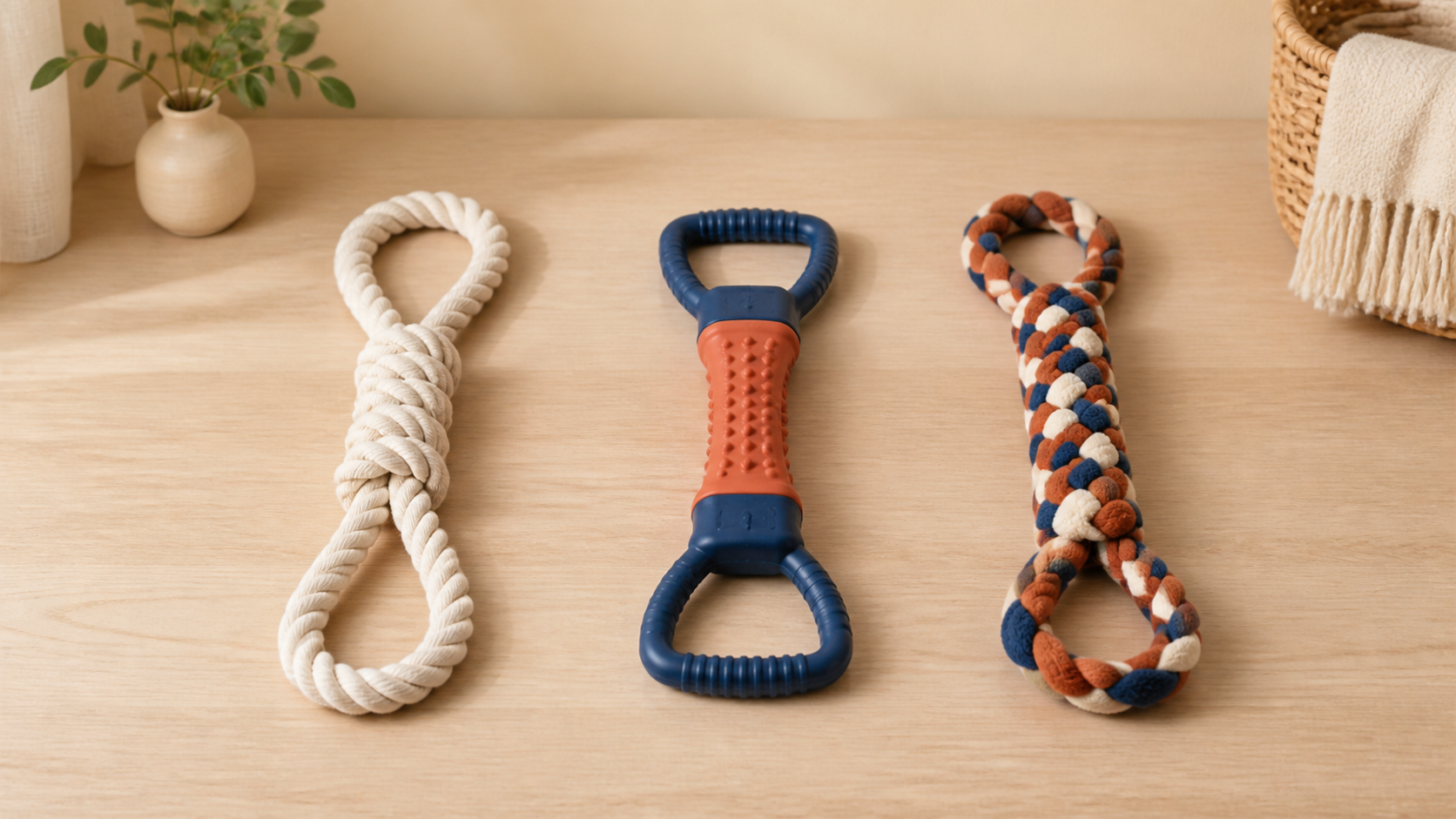
Double-loop rope: roomy grips with more fiber inspection
Large end loops can create obvious places for both hands while the center knot or braid gives the dog a separate mouth area. Rope absorbs saliva and dirt, and damaged fibers can loosen. Choose only a size the maker identifies for your dog, follow its cleaning directions, and retire the toy when strands pull free.
Two-handle rubber: defined hand and mouth zones
A molded rubber design can make the grip zones easy to identify and may be simpler to wipe or rinse. Check that both handle openings comfortably fit your hands without pinching and that the center is long enough to keep hands away from the dog's mouth during ordinary movement. Deep tooth cuts, splits, stickiness, or missing material are replacement cues.
Braided fleece: softer grip with laundry tradeoffs
A long fleece braid can feel softer in the hands and may be machine washable when the maker allows it. Fabric can hold moisture, collect debris, and develop loose strips or weakened stitching. Confirm wash and dry instructions, and store it only after it is fully dry.
Selection Criteria That Matter
- Overall length: Look for enough distance between your two grips and the dog's mouth area. Product photos alone are not measurements.
- Usable handles: Compare the interior opening, strap width, edge finish, and whether each grip remains distinct when the toy flexes.
- Mouth area and sizing: Follow the maker's pet-size guidance. Skip toys that could be swallowed, fit too deeply in the mouth, or require the dog to bite near your hands.
- Material: Rope and fleece need fiber checks; rubber needs checks for cracks, gouges, and texture changes. No material makes a tug chew-proof.
- Seams and knots: Inspect stitched junctions, molded seams, knots, and braid ends before and after every game.
- Cleaning: Follow the listed wash method, rinse away residue, and dry completely. Replace a toy that cannot be cleaned as directed.
- Storage: Put the tug away after play so it does not become an unsupervised chew toy.
A Simple Two-Handed Comparison Framework
First, measure the space you need for both hands. Second, compare the toy's published overall length with the usable handle openings rather than counting decorative tails or knots. Third, identify where the dog is meant to grip and confirm that area stays separated from both hands as the toy bends. Finally, choose the material whose cleaning and inspection routine you will actually maintain.
During play, keep movements controlled and close to the dog's natural head height. Do not lift, swing, drag, or force the dog, and do not wrap a loop around your hand or wrist. End the game if teeth move toward a hand, the toy begins to fail, the dog cannot disengage calmly, or either participant needs a break.
Inspection and Replacement
Under good light, check every grip, seam, knot, braid, and molded edge. Remove the toy if you find loose strings, torn fabric, stretched loops, cracked rubber, deep cuts, missing pieces, exposed internal material, or a change in shape or texture. Do not glue, tape, knot over, or trim a damaged tug for continued play.
If a piece may have been swallowed, contact a veterinarian promptly. A toy is entertainment equipment, not a health or behavior solution.
Who Should Skip a Tug Toy?
Skip tug toys for dogs that swallow fibers or rubber, immediately settle down to shred toys, guard objects, redirect their mouth toward hands, or become difficult to interrupt. A qualified trainer can help with play and handling concerns; this buying guide does not provide behavior-modification advice or imply that tug causes or fixes aggression.
Also skip the purchase if an intact, correctly sized toy already gives you clear grip separation and is easy to inspect and clean. For dogs with dental, jaw, neck, pain, mobility, or other health concerns, ask a veterinarian whether tug play is appropriate before choosing equipment.
The Bottom Line
Choose a double-loop rope tug for roomy grips when you can monitor fibers closely, a two-handle rubber tug for distinct wipe-clean zones, or a long braided fleece tug for a softer washable format. Prioritize measured handle separation, pet-appropriate size, easy inspection, and a supervised routine over durability language.