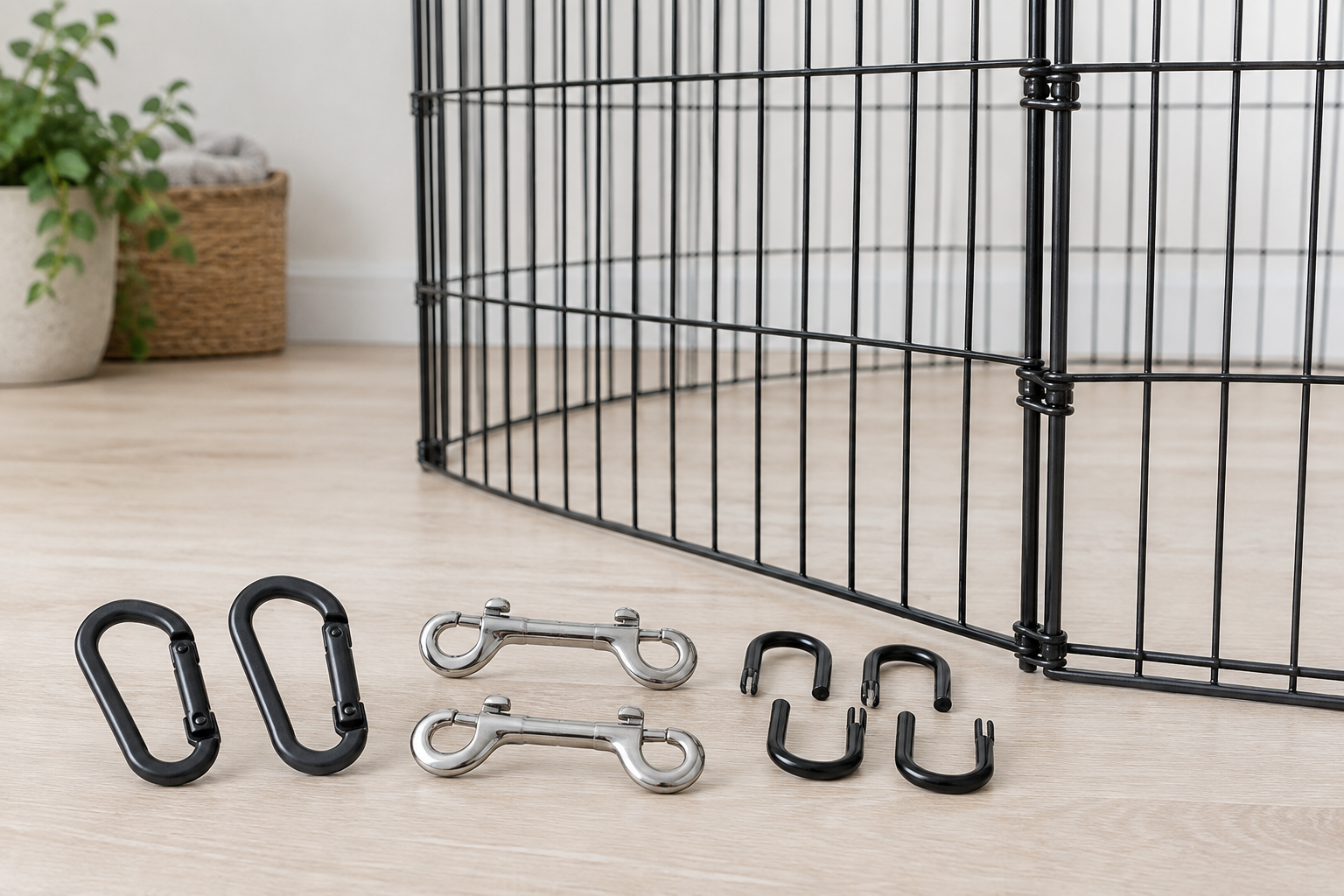
Inspect the Pen Before Shopping
Find the brand, model, manual, and parts information first. Confirm that the maker permits owners to replace the removable clip and identify the approved connector. A clip is not a repair for bent wire, cracked welds, damaged hinges, distorted panels, corroded structure, or missing fixed hardware.
Stop using a damaged or unstable pen and contact its manufacturer. If the structure cannot be restored under maker guidance, replace the pen. A generic clip cannot restore a load rating or guarantee containment.
Quick Comparison
Maker-specific panel clip: the clearest starting point when a documented part exists. Locking connector: may resist casual opening, but only if the closed dimensions and mechanism are approved and stay clear of the pet. Double-ended snap: can be quick to attach, but both gates, openings, and overall length must match the specified setup. Choose none: when approval or exact compatibility cannot be confirmed.
Selection Criteria That Matter
- Model compatibility: match the exact pen brand, model, and connection point to current manufacturer guidance.
- Closed opening: measure the wire, loop, or panel joint and confirm the connector closes completely without forcing or spreading parts.
- Overall length: a connector that is too long may create extra panel movement; one that is too short may bind or fail to close.
- Closure: check that springs, gates, sleeves, or locks operate smoothly and cannot sit partly open.
- Material and finish: reject rough edges, peeling finish, rust, cracks, deformation, or burrs.
- Clearance: keep the connector away from the pet's mouth, paws, collar, bedding, and normal gate movement; inspect for pinch or snag points.
- Count and placement: replace the required number in the specified locations rather than assuming one clip is enough.
Setup and Ongoing Inspection
Install the connector only as the pen maker directs, then inspect the pen empty. Every gate and panel should align, closures should seat fully, and the pen should stand on the approved surface without rocking or a widened gap. Recheck after moving, folding, cleaning, or storing the pen.
Before each use, look for an open gate, stretched spring, loosened sleeve, corrosion, rough edge, bending, or a changed panel gap. Stop using a connector that no longer closes predictably. Supervise according to the pen maker's directions, and do not treat any exercise pen as escape-proof or as a solution for distress, aggression, or another behavior concern. Ask a qualified trainer or veterinarian when containment is causing repeated panic or injury risk.
Who Should Skip Replacement Clips?
Skip a clip purchase when the pen maker prohibits substitutions, the model cannot be identified, the required dimensions are unclear, or the intended part is fixed rather than removable. Retire the pen when panels, welds, hinges, gates, or other structural parts are damaged. Also skip any connector your pet can mouth, paw, unlatch, snag a collar on, or contact through the normal setup.
Related Guides
If the whole setup is still undecided, compare a pet gate with an exercise pen. Review small-space pet gate formats when a doorway boundary may fit better, or return to the new-pet essentials guide for the broader setup.
Bottom Line
The best replacement is the maker-permitted clip for the exact intact pen model and connection point. Verify dimensions, closure, material, clearance, and placement from current instructions. If you cannot confirm compatibility—or any structural part is damaged—do not improvise with generic hardware.