Quick Answer
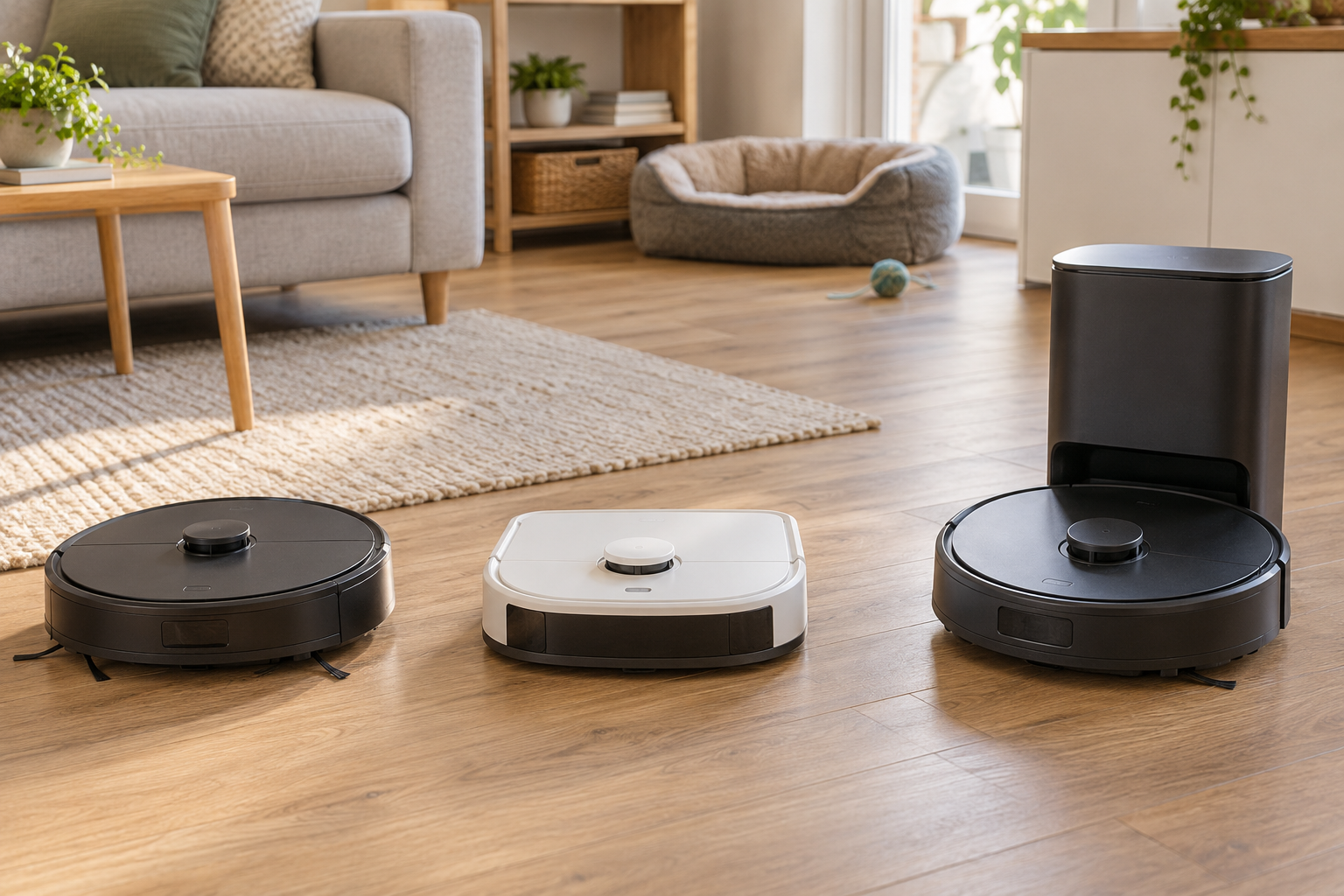
Choose a low-profile round robot when a compact dock and measured furniture clearance are the main constraints, and you are willing to empty its onboard bin as directed.
Choose a D-shaped robot when the written design and brush layout fit your wall-edge priorities and the body can turn through the room’s narrow points.
Choose a self-empty setup when less frequent onboard-bin handling is worth a taller, deeper dock, extra noise during emptying, replacement supplies, and more parts to maintain.
If you have not decided whether automation fits at all, start with our robot versus cordless vacuum comparison. This guide assumes a robot already suits the basic cleanup routine.
Measure the Whole Route Before Shopping
Measure the machine’s route rather than only the room. Record the narrowest passage between furniture, the lowest under-furniture clearance, threshold height, rug edge, and open floor around the planned dock. Use the maker’s complete dimensions for the exact robot, including any raised sensor housing, and its documented dock-clearance requirements.
A small floor plan can be harder than a large open one. Chair legs, floor lamps, pet bowls, toy baskets, cords, curtains, and lightweight rugs create repeated interruptions. Make a short pre-run checklist for anything that must move. If clearing the route every time is unrealistic, a directed cordless or handheld tool may be the more useful purchase.
Map stairs and drops as well. Follow the manufacturer’s setup and boundary instructions; do not treat obstacle detection or drop sensors as permission to ignore the route. Block access where the documented setup requires it, especially during initial runs.
How the Three Formats Differ
Low-profile round robots
This straightforward format can fit beneath measured furniture and return to a relatively small charging dock. Compare total height, diameter, bin removal direction, brush access, wheel access, and whether the listed floor types match your home. “Low profile” is not a standard measurement, so compare numbers rather than labels.
A compact charging dock does not empty the robot for you. In a shedding home, the bin, filters, intake, brushes, and wheels may need frequent inspection according to the manual. Skip this format if handling a small onboard bin will make the routine impractical.
D-shaped edge-focused robots
A flat front may change how the machine approaches walls and corners, but shape alone does not establish pickup performance. Compare the documented brush layout, body width, turning behavior, boundary tools, and navigation features of the exact model. A wider front can also be awkward between closely spaced furniture legs.
This variety makes the most sense when edge access is the unresolved layout problem and the route has been measured. It is not automatically better for every small room or every kind of pet hair.
Robots with self-empty docks
A service dock transfers debris from the robot’s onboard bin into a larger bag or container on supported models. That can reduce how often the small bin is handled, but it does not eliminate brush, sensor, wheel, filter, dock, or debris-path care.
Measure the complete dock, the required open approach, overhead access for lids or bags, and nearby power placement. Check how emptying starts, whether it can be scheduled or disabled, what replacement supplies are required, and how loud the cycle may be. A compact home can make the dock more intrusive than the robot.
Plan the Run Around the Pet
Clear pet waste, liquid, cords, toys, loose bedding, feeding items, and lightweight objects before every run. A robot vacuum is for compatible dry floor debris under its instructions; it is not a safe way to discover or spread an accident. Keep bowls and water-fountain cords outside the route unless the setup documentation provides a suitable arrangement.
Give every pet a quiet way to leave the area. Do not use the moving machine to chase, exercise, or “get a pet used to” noise. Supervise initial runs and stop if a pet is distressed, fixated, likely to interfere, or unable to move away. Ask a veterinarian or qualified behavior professional for individual guidance when reactions are persistent or intense.
Hair length and quantity can change maintenance frequency, but a “pet” label does not prove that a model fits your floors or routine. Inspect brushes and moving parts as directed, with the machine powered down according to the manual, and never reach into a running mechanism.
Compare Maintenance, Controls, and Ownership Cost
- Debris path: Check how the bin, intake, main brush, side brush, wheels, and dock path open for inspection.
- Filters and supplies: Identify current part numbers, replacement guidance, and whether a self-empty dock uses bags or a washable container.
- Controls: Decide whether physical controls are sufficient or whether the features you want require Wi-Fi, an account, an app, or a subscription.
- Mapping and privacy: Read current documentation for stored maps, cameras or sensors, account deletion, guest access, and supported network requirements.
- Charging: Use the supplied charging equipment in the location and clearances specified by the maker. Do not place a dock where pets can chew its cord or block its approach.
- Repairability: Look for documented replacement brushes, filters, bags, batteries, and service options before treating the machine as a long-term purchase.
Budget for the complete routine, not only the machine. Replacement consumables, time spent clearing floors, brush and wheel care, app support, and the space lost to a dock are all part of ownership. Current prices and availability change, so verify them directly rather than relying on a roundup.
Who Should Skip Each Format?
Skip a low-profile basic robot when frequent onboard-bin emptying is difficult, furniture clearance is too tight, or the route needs repeated rescue from clutter and thresholds.
Skip a D-shaped robot when the measured body and turning room do not fit the layout, or when you are choosing it only because its shape sounds better without model-specific documentation.
Skip a self-empty setup when the dock blocks a walkway, its emptying cycle would disrupt the household, replacement supplies add unwanted cost, or extra parts make care less realistic.
Skip a robot vacuum altogether when pet accidents may be present, cords and toys cannot be cleared reliably, stairs or thresholds conflict with setup guidance, the pet cannot remain comfortable, or direct visual control is essential. Keep an existing vacuum or use the cordless vacuum guide for hard floors instead.
Related Cleanup Guides
Compare the larger format decision in Robot Vacuum vs Cordless Vacuum for Pet Hair. For upholstery and stairs, use the handheld vacuum guide. Browse the cleanup guide hub for manual and powered alternatives.
Bottom Line
In a small pet home, choose the robot-vacuum format that fits the measured route and the maintenance you will actually do. A low-profile round robot suits compact clearance, a D-shaped format offers a different wall approach, and a self-empty dock reduces onboard-bin handling at the cost of space, supplies, and complexity. Verify the exact model’s dimensions, instructions, controls, and replacement parts before buying.