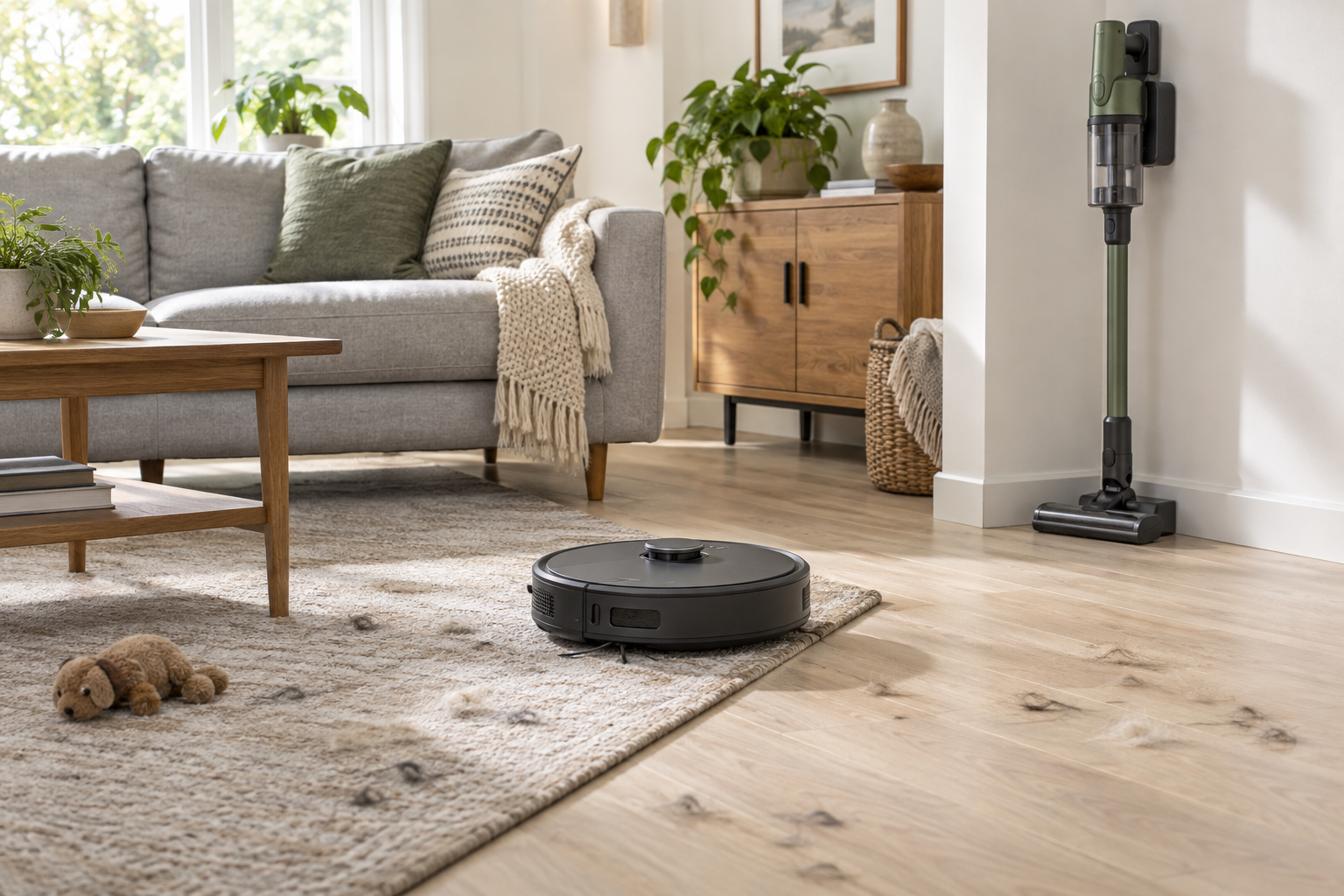
A vacuum is a cleanup convenience, not an allergen, air-quality, health, or pet-behavior solution. Keep pets away from a machine if they chase it, chew it, block it, or show distress. Follow the exact maker's operating and maintenance directions.
Quick comparison
- Coverage: a robot follows a configured floor route; a cordless vacuum goes only where you direct it.
- Obstacles: a robot depends on clearance, boundary settings, and its documented navigation behavior; a person can stop or redirect a cordless tool immediately.
- Reach: a robot stays on accessible floor areas, while a convertible cordless vacuum may reach stairs, edges, furniture, and a vehicle with compatible tools.
- Maintenance: both need bin, brush, wheel or floor-head, filter, sensor, and debris-path care as specified by the maker.
- Storage and charging: a robot needs a clear dock approach; a cordless needs a secure dock or storage position and an appropriate charging location.
When a robot vacuum fits
A robot is most useful when loose hair, crumbs, or tracked litter return across broad, mostly open floors and a repeated route can reach those areas. Measure the machine's full height against furniture clearance, check thresholds and rug guidance, and identify stairs, cords, curtains, tassels, toys, bowls, and other obstacles before shopping.
Automation does not remove preparation. Inspect the route before each run for pet waste, liquid, fragile objects, small parts, cords, or anything the machine should not contact. Follow current maker guidance for mapping, boundaries, stairs, docking, and operation around pets. Run and observe initial routes until you understand how the exact machine handles the home.
When a cordless vacuum fits
A cordless stick is the stronger format when the mess is concentrated, appears unpredictably, or sits near stairs, corners, baseboards, furniture, feeding areas, or litter-box edges. You choose the route and can lift the head away from a questionable object instead of relying on navigation.
The tradeoff is hands-on time and carrying. Compare total operating weight, steering, floor-head width, handheld balance, bin release, charging instructions, stated runtime conditions, and replacement-battery availability. A listed maximum runtime is not a promise for every power mode, tool, surface, battery age, or temperature.
Map the real cleaning route
Sketch the areas where hair accumulates for one week. Mark open hard floor, low-pile rugs, thick rugs, thresholds, stairs, furniture with low clearance, charging locations, and rooms that should remain closed. This separates a broad repeat route from small targeted zones.
If most marks form one accessible loop, a robot may earn its dock space. If the marks cluster on stairs, sofa edges, under movable chairs, or in several small areas, a cordless tool may provide more useful control. Mixed homes may benefit from both formats, but only if each solves a separate repeated job and both maintenance routines fit the household.
Surface and obstacle tradeoffs
Check the manufacturer guidance for every floor and rug in the planned route. Do not assume a machine crosses every threshold, avoids every object, or cleans every edge. Rug fringe, cables, lightweight mats, floor vents, reflective surfaces, dark transitions, and low furniture can affect particular designs differently.
With a cordless vacuum, confirm the floor head and setting suit the floor maker's instructions. The operator still needs to avoid wet debris, large objects, cords, and delicate surfaces unless the exact machine is designed and approved for them. Neither format should be judged by the word “pet” in a listing alone.
Maintenance and ownership cost
Before buying, find the current manual and identify every recurring task. A robot may add drive-wheel, caster, side-brush, sensor, charging-contact, and dock cleaning to ordinary bin, main-brush, and filter care. A cordless may require floor-head, brush-roll, bin, wand, filter, battery, and dock checks.
Look up replacement filters, brushes, bags if used, batteries, floor heads, and other wear parts for the exact model number. Compare the storage footprint and the time needed to empty hair, remove wrap, wash only maker-approved parts, and let washable components dry completely. Stop using damaged equipment and follow the maker's service guidance for unusual heat, odor, sound, battery changes, or charging problems.
Noise, pets, and household timing
Published sound specifications, when provided, are only one part of pet fit. Movement, changing direction, contact with furniture, and unpredictable start times can matter too. Give pets a comfortable way to leave the area and do not use either machine to force exposure or promise acclimation.
A manually controlled cordless vacuum makes it easier to wait until the pet is elsewhere and stop at once. A scheduled robot can run consistently, but a schedule should not override route inspection or the needs of a pet who is distressed, likely to chase it, or unable to move away. Ask a qualified trainer or veterinarian for individualized guidance when noise or movement causes persistent distress.
Who should skip each format?
Skip a robot vacuum when floors require constant obstacle pickup, pet waste accidents are possible in the route, thresholds or stairs conflict with current guidance, furniture clearance is insufficient, there is no suitable dock location, or the pet cannot be kept comfortable around moving equipment.
Skip a cordless vacuum when carrying and steering it makes the routine unrealistic, the battery cannot cover the intended sessions under documented conditions, there is no safe charging location, or replacement batteries and filters do not fit the ownership budget.
Skip both when your existing tool already handles the area, the unresolved problem is embedded hair on one fabric surface, or you first need to simplify cords and floor clutter. For rugs and hard floors, compare rubber broom formats; for stairs and vehicles, consider the handheld vacuum guide.
The bottom line
A robot vacuum trades direct control for repeat floor coverage and adds route preparation, navigation checks, and dock maintenance. A cordless vacuum trades automation for immediate control and broader targeted reach, while adding carrying, charging, and battery planning. Choose from the map of your actual mess—not a promise that either format handles every pet home.