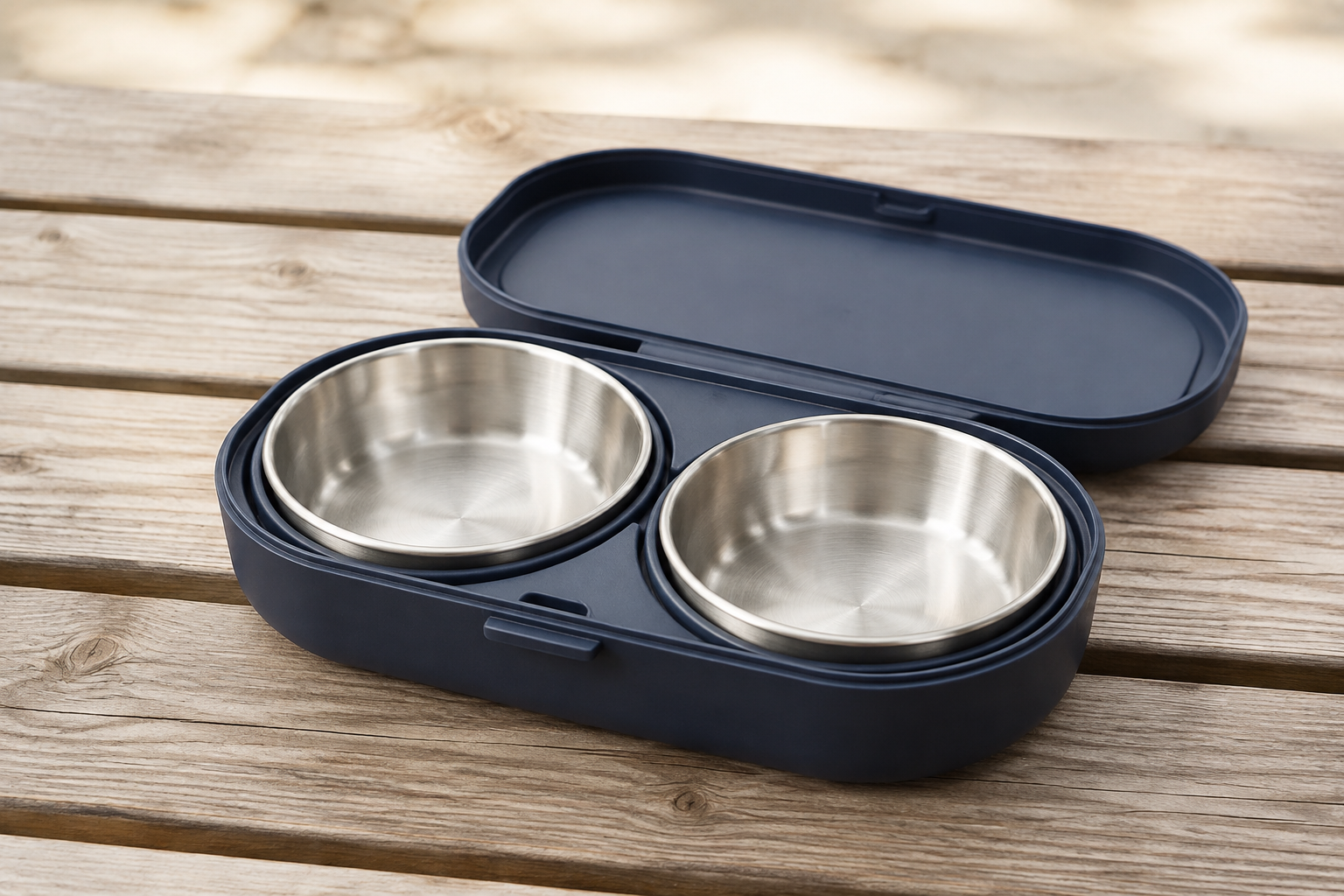
 Nested two-bowl sets with cases
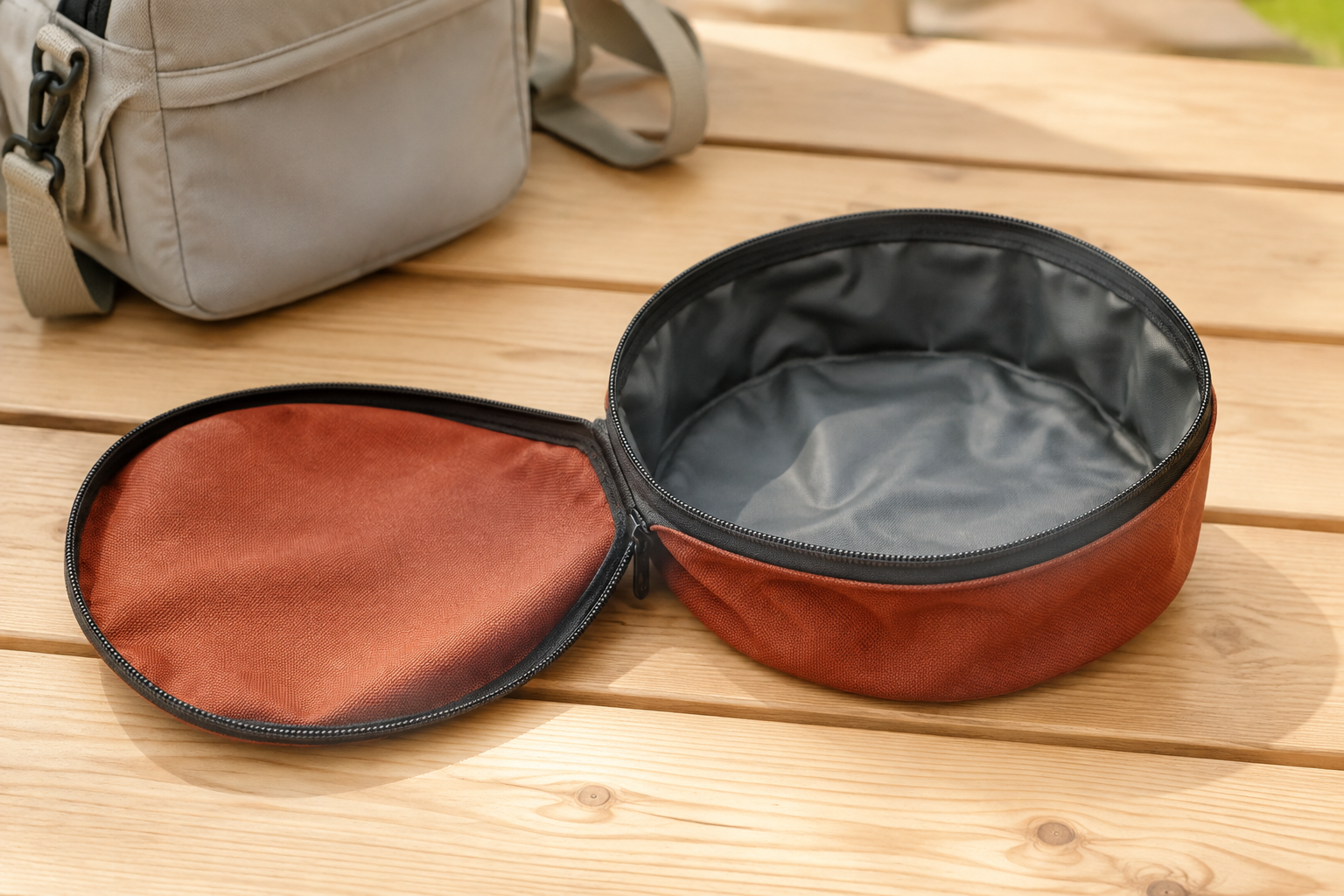 Zip-covered fabric travel bowls
A lid or cover is an organization feature, not proof that a bowl is leakproof, insulated, or suitable for long-term food storage. Do not carry water in a closed bowl unless the maker explicitly designs it for that use. Keep water in a separate secure bottle and open the bowl only at a safe stopping place.
Choose the job before the closure
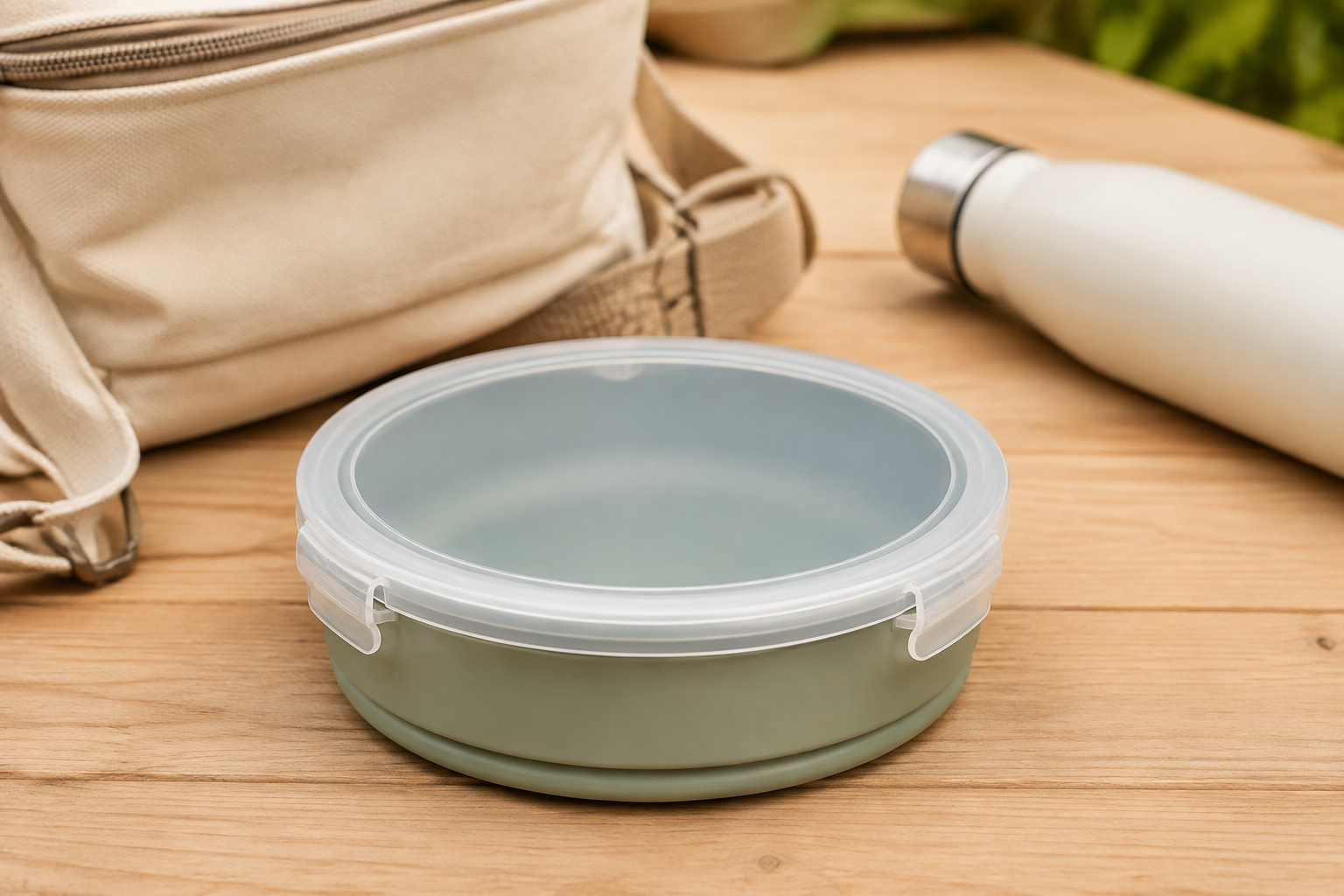
For a packed portion of dry food, a rigid bowl with its own fitted lid is the simplest format: remove the lid and the container becomes the eating bowl. Confirm that the product is intended to contact and carry pet food, and do not assume an ordinary dust cover creates an airtight or leakproof seal.
If you want one vessel for food and another for water, a nested pair in a rigid case keeps the pieces together. The tradeoff is bulk and more surfaces to wash. A zip-covered fabric bowl packs flatter and keeps the drinking surface folded inward, but seams and zippers demand more careful rinsing, inspection, and drying.
Quick comparison framework
- Rigid snap-lid bowl: start here for a measured dry meal and a stable eating surface.
- Nested two-bowl case: choose it when separate food and water bowls matter more than minimal packed size.
- Zip-covered fabric bowl: choose it for a compact empty bowl when you can manage seams and longer drying.
- Ordinary rigid bowl in a washable pouch: use what you own when the lid would add no useful food-packing function.
- Collapsible bowl: choose a simple collapsible format when fast water stops and small packed size are the real priorities.
Selection criteria that matter
- Usable capacity: compare the bowl's open dimensions and documented capacity with the portion or water stop you plan to offer.
- Closure purpose: determine whether the lid holds food for transport, merely protects an empty bowl, or serves as a carrying case.
- Seal wording: treat “lidded,” “spill-resistant,” “leak-resistant,” and “leakproof” as different claims. Verify the maker's exact wording and intended orientation.
- Stable base: a broad rigid base is useful on a picnic table or level ground; very light fabric bowls may shift as a pet eats or drinks.
- Materials: rely on current manufacturer information for food-contact and care claims. Replace cracked, sticky, peeling, rusting, or damaged parts.
- Cleaning access: inspect lid channels, gaskets, hinges, seams, and zipper tape. A closure is useful only if every food-contact area can be washed and dried.
- Packed shape: check the full closed dimensions. A nested set can save loose space while still occupying more volume than one flat bowl.
- Pet fit: choose an opening your pet can use without crushing soft sides or struggling against a deep, narrow rim.
Pack food and water separately
Use a closed bowl for food only when its instructions permit it, and keep it upright in an easy-to-clean section of the bag. Carry fresh water in a dedicated bottle. At a stop, offer only what your pet is likely to use; do not pour used water back into the clean bottle or close a wet bowl around leftover food.
If you pack wet or perishable food, follow its label and your veterinarian's feeding guidance, including any temperature and time limits. A fitted lid does not provide refrigeration. For planned meals or diet questions, use the feeding instructions you already follow rather than changing portions for the trip.
Cleaning and drying can decide the winner
A simple rigid bowl and removable lid are usually easier to inspect than a hinged case, gasketed channel, or fabric zipper. Wash every component according to its instructions, open or separate the pieces, and let them dry fully before nesting or closing them. Store the dry set where it will not collect residue from used towels or cleanup tools.
During the outing, a washable pouch can isolate a damp bowl without pretending to seal it indefinitely. Empty the bowl first, keep the pouch away from clean food items, and unpack it promptly at home.
Who should skip a lidded travel bowl
Skip one if a regular bowl already rides securely in your car or tote and a washable pouch handles the return trip. Also skip a lidded format if the closure is hard to clean, the bowl is too small for comfortable use, or the closed set consumes more space than the organization benefit is worth.
A dedicated lidded bowl is also a poor match for a pet likely to chew the lid, gasket, zipper, or soft lining. Supervise every food and water stop and pack the set away afterward. This is a convenience product, not a hydration or health solution. Contact a licensed veterinarian if your pet's eating or drinking changes suddenly, or if your pet appears unwell during an outing.
The bottom line
A rigid snap-lid travel bowl is the strongest starting format for carrying a measured dry meal. A nested two-bowl case better separates food and water, while a zip-covered fabric bowl prioritizes compact empty storage. Choose the simplest closure that performs a real job, verify its intended use, and make cleaning and full drying part of the trip routine.