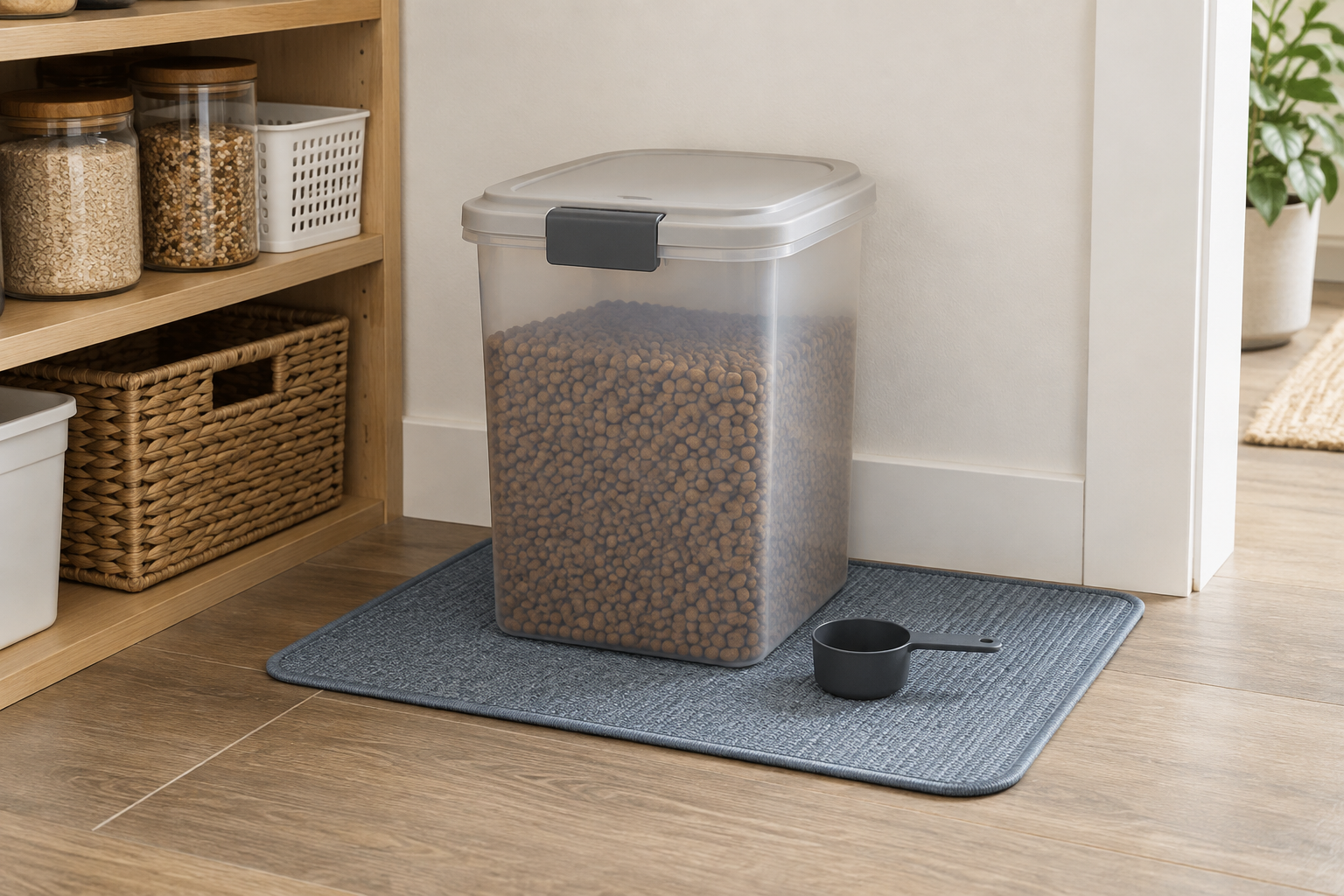
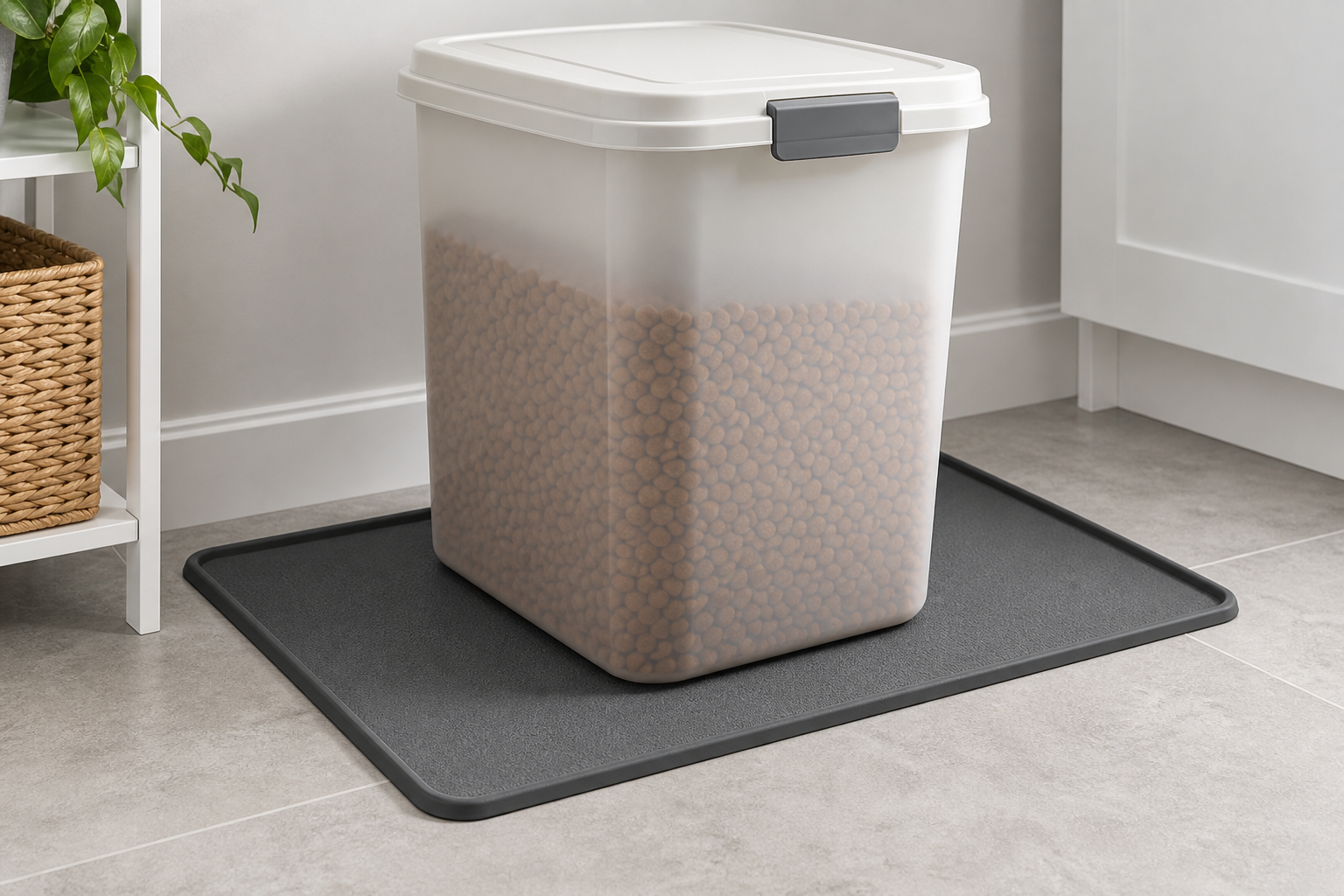
 Low-lipped washable barrier mat
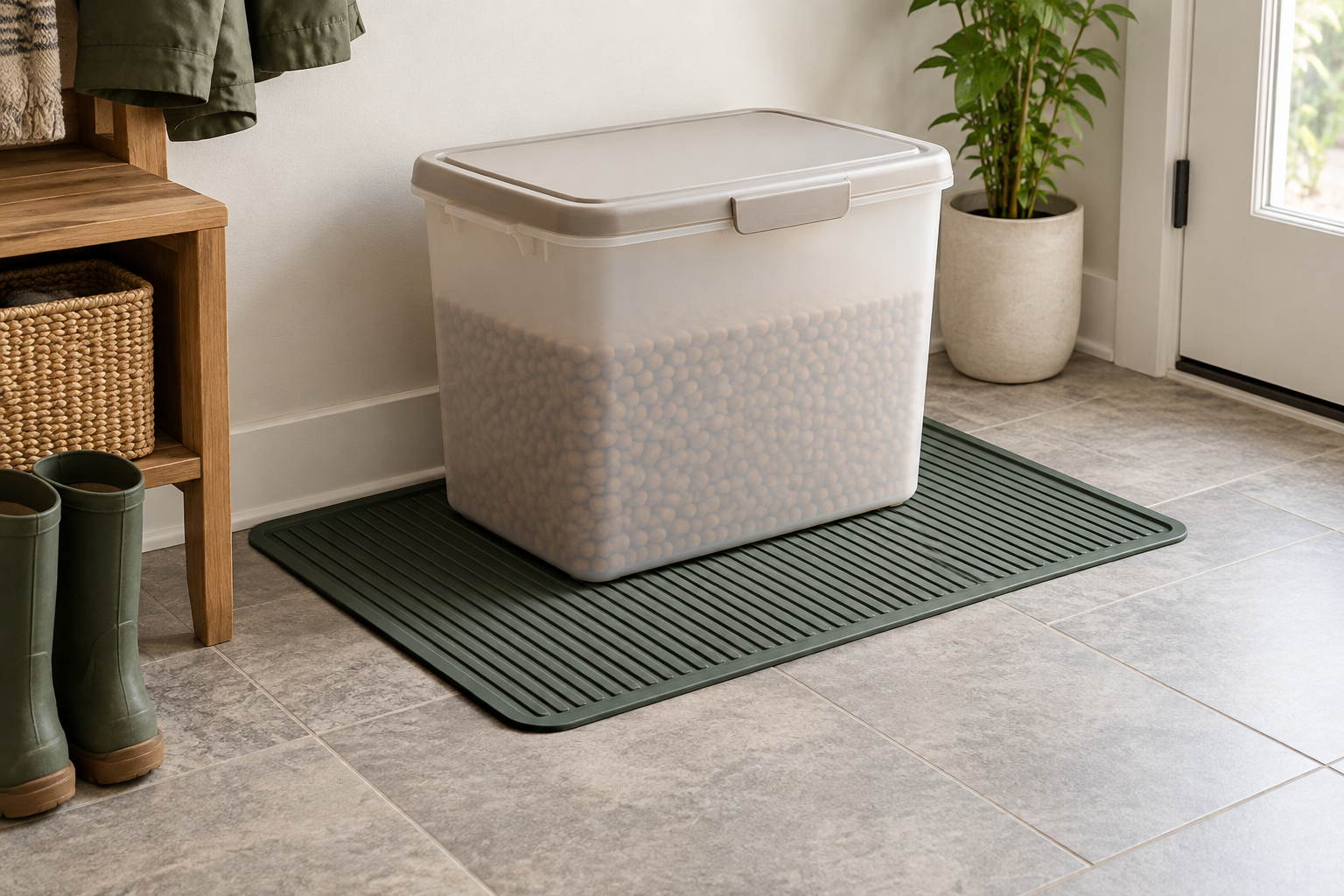 Ribbed rubber utility mat
This guide covers the floor layer beneath a stationary storage bin, not a feeding mat for bowls. A mat can make crumbs easier to gather and protect a defined cleanup zone, but it cannot correct a damaged bin, preserve food by itself, or replace storage and handling directions on the food package.
Measure the storage spot before the mat
Measure the bin at its widest and deepest points, including wheels, handles, lid hinges, and any base that flares outward. Then measure the available floor area and door clearance. A practical mat extends beyond every contact point so crumbs do not collect immediately at its edge, but it should not curl into a walkway or stop a pantry door from closing.
If the bin rolls, check whether a raised edge blocks the wheels. If you slide the bin forward to scoop, make sure the mat stays flat during that movement. A stationary bin and a frequently moved bin create different demands.
Compare three mat formats
Absorbent washable fabric
This format suits small dry-food crumbs and occasional light drips. Look for bound edges, a backing approved for your floor, and a size that fits your washer. Its tradeoff is drying time: putting a damp mat back under a heavy bin can trap moisture.
Low-lipped washable barrier
A shallow perimeter can keep debris inside a defined area and make wipe-up straightforward. Check that the bin rests on a broad, level surface rather than partly on the lip. This style is less convenient if the bin must roll across the edge every day.
Ribbed rubber utility mat
A flexible rubber-style mat may work in a pantry, utility room, or mudroom where sweeping, wiping, or rinsing is practical. Confirm the listing's care method and floor compatibility. Grooves can hold crumbs well, but they also take more attention to clean than a smooth surface.
Match the mat to the floor
Backing matters as much as the top surface. Some rubber, vinyl, or dyed backings may not suit every sealed wood, laminate, vinyl, or stone floor. Follow both the mat maker's floor guidance and your flooring manufacturer's care instructions. Lift the mat periodically to inspect the floor rather than assuming the covered area stays dry.
- Hard floors: prioritize a flat backing that does not skate, curl, stain, or trap dampness.
- Grout lines: choose enough structure that the loaded bin stays level across uneven joints.
- Carpet: a soft washable mat may bunch under wheels; a stable approved surface or different location may work better.
- Rental homes: inspect often and avoid adhesive-backed products unless removal and floor compatibility are explicit.
Plan the full cleaning and drying cycle
A “washable” label is only useful when the item fits your equipment and routine. Check whether the current product is machine washable, hand washable, wipe-clean, or rinse-only. Confirm temperature limits and drying directions on the listing or care label; do not assume a dryer is appropriate.
Empty or safely relocate the bin before pulling out the mat. Sweep loose food first, clean the mat as directed, clean and dry the exposed floor, and let both surfaces dry fully before reassembly. If lifting a full bin is awkward, reduce the load or ask for help rather than twisting or dragging it.
Check stability and pet access
Set the loaded bin on the flat center of the mat and press gently at each corner to check for rocking. Casters should lock if the bin provides that feature, and no foot or wheel should sit on a raised border. Keep loose edges away from pets that chew, scratch, or pull fabric.
The food should remain in its original packaging when practical, or the package should be retained so lot codes, dates, and manufacturer directions stay available. A floor mat is a cleanup convenience, not pest control or a food-safety solution. If pests, damaged packaging, unusual food odor, or a recall is involved, address that issue directly.
Who should skip a separate mat
Skip a mat when the bin already sits in an easy-clean tray, added thickness makes it unstable, the mat blocks a doorway, or you cannot lift the bin for regular drying and floor inspection. An existing washable utility mat can be enough if its materials, dimensions, and backing suit the location.
If most mess happens at the bowls rather than under storage, use a purpose-sized pet feeding mat instead. For a cramped pantry, start with the small-kitchen storage guide; changing the container footprint may solve more than adding a floor layer.
The bottom line
Start with the bin footprint, the floor manufacturer's guidance, and the mess you actually find. Choose absorbent fabric for easy laundering of light mess, a low-lipped barrier for contained wipe-up, or ribbed rubber when an approved rinseable utility surface fits the room. Whatever the format, keep it flat, extend it beyond the bin, and lift it often enough to clean and dry both sides.