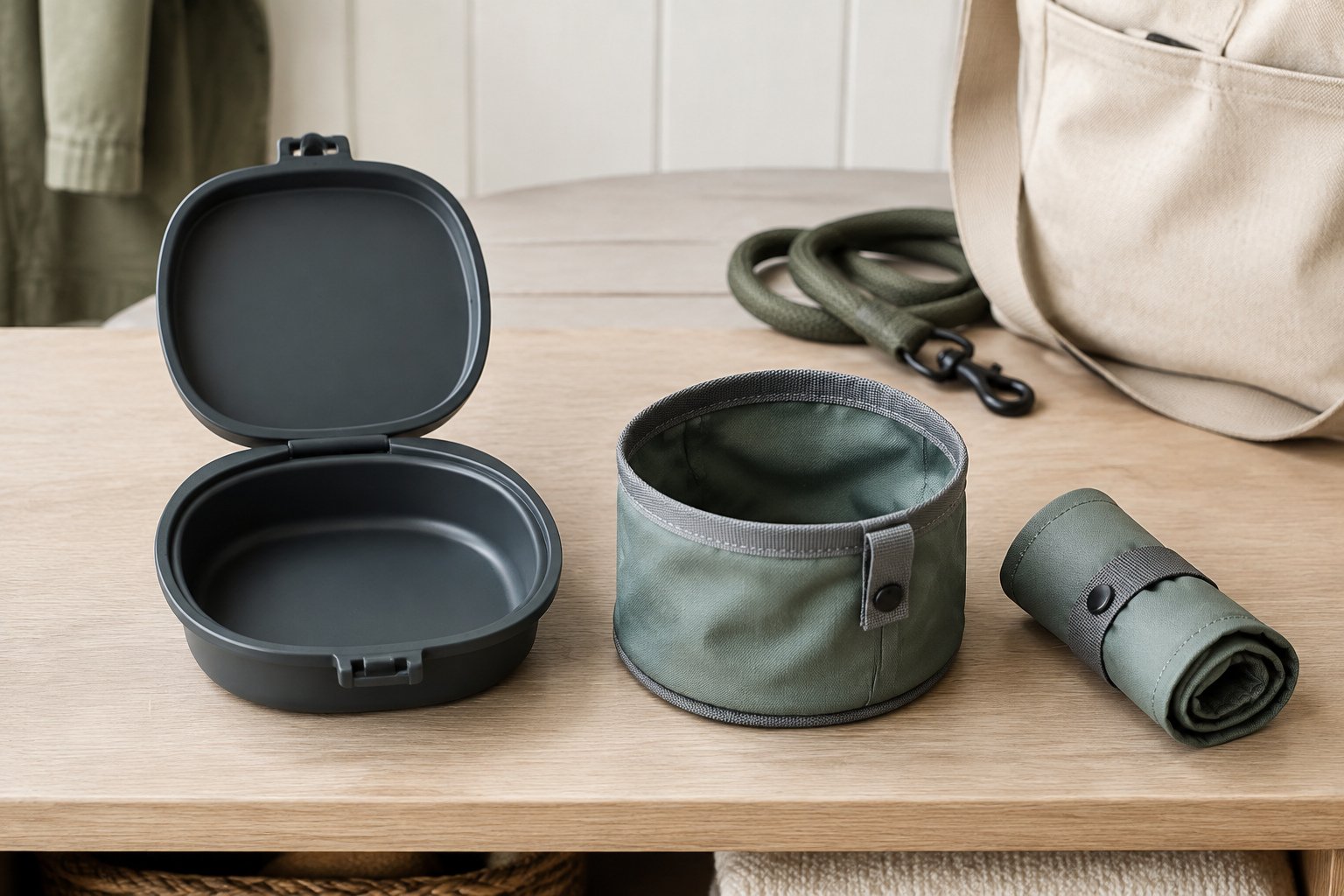
Both formats are convenience items for ordinary stops, not health solutions. Neither replaces planning enough fresh water for the dog, route, weather, and activity. Follow the bowl maker's directions, offer water appropriately, and contact a licensed veterinarian if your dog refuses water, drinks much more or less than usual, vomits, seems overheated, or appears unwell.
Quick comparison
- Setup: a clamshell opens along a hinge or zipper; a roll-up bowl needs to be unfastened, unrolled, and shaped.
- Ground contact: clamshell designs often create a defined base, while fabric roll-up bowls can conform to uneven ground but may fold when nudged.
- Packed shape: a clamshell keeps a predictable footprint; a roll-up bowl forms a narrow bundle that can fit beside a bottle or towel.
- Wet storage: a closing clamshell can contain its used surface temporarily, while a rolled bowl may need a separate washable pouch. Neither should remain packed wet.
- Cleaning: inspect clamshell hinges, zipper tracks, and corners; turn a roll-up bowl out as the maker permits so seams and lining can be washed and dried.
Who a clamshell bowl fits
Choose the clamshell format when you want a repeatable packed shape in a structured tote, car organizer, or backpack pocket. Its case-like construction can keep the drinking surface away from other gear between a stop and the trip home. A defined bottom can also be easier to place on pavement or a flat bench.
The tradeoff is hardware and thickness. Hinges, zippers, snaps, and folded corners all require inspection and cleaning. Check the actual open capacity and depth: a broad-looking shell can still create a shallow usable bowl. Make sure the closure cannot pinch, pop open in the bag, or sit where the dog can chew it.
Who a roll-up bowl fits
Choose a roll-up bowl when storage is irregular or narrow—for example, beside a water bottle in an outing bag or inside a jacket pocket. Flexible fabric can pack around other supplies, and the fastening strap may provide a simple attachment point when the manufacturer permits it.
The compromise is structure. A light bowl may shift, sag, or narrow as the dog drinks, especially on gravel or a slope. Seams and multilayer fabric can take longer to dry than a smooth open surface. Check whether the maker allows the bowl to be turned inside out and whether the rolled bundle fits only when the bowl is compressed more tightly than is practical after use.
Capacity and stability matter more than the label
Compare usable open length, width, depth, and capacity rather than relying on “portable,” “large,” or “one size.” A dog needs room to drink without constantly folding the rim inward. Match the bowl to the amount of water you carry and expect that a small bowl may need several refills.
Place either format on the flattest clean surface available. A broad base, reinforced rim, and low center of gravity can reduce tipping, but no soft travel bowl is spill-proof. Pour a modest amount at a time, steady the bowl if the instructions allow, and do not return used water to the clean bottle.
Setup and packing tradeoffs
Practice opening, shaping, emptying, and closing the bowl at home. A clamshell is a poor fit if its closure is fiddly with cold or wet hands. A roll-up design is a poor fit if the fastening strap drags through the bowl or the bundle springs open in your pocket. Weigh the empty bowl as part of the complete kit, and check that clips or loose straps cannot snag or be chewed.
For car trips, keep the packed bowl where it cannot roll under pedals or become a loose distraction. For walks, carrying the damp bowl inside a small washable pouch is usually cleaner than clipping it outside where it can collect grit. Neither format should be used as an unattended everyday bowl unless the manufacturer explicitly supports that use and it suits the dog.
Cleaning and maintenance
After each use, empty the bowl and rinse away saliva and food residue. Wash it according to the current care label, paying attention to seams, folds, fasteners, hinges, and zipper channels. Open it fully and let every layer dry before closing or rolling it for storage.
Inspect the lining, edge binding, base, stitching, closure, and attachment point before packing. Replace the bowl if it becomes cracked, sticky, split, frayed, difficult to clean, or unreliable when open. Do not improvise a repair that leaves adhesive, loose threads, or small hardware accessible to the dog.
Who should skip each format?
Skip a clamshell if its fixed packed footprint wastes the only usable pocket, its hardware is awkward to clean, or the opened base is too shallow for your dog. Skip a roll-up bowl if your dog pushes flexible sides flat, you cannot fully clean and dry its seams, or you need a bowl that sets up with one simple motion.
Skip both if a familiar lightweight rigid bowl already fits your vehicle or tote, if the dog chews flexible gear, or if the trip setup does not let you clean and dry the bowl afterward. For a simpler pop-open category, see the collapsible bowl buying guide. For a one-piece bottle-and-trough setup, compare travel water bottles.
The bottom line
A clamshell bowl fits an organized bag and an owner who wants a defined base and enclosed packed surface. A roll-up bowl fits a narrow or irregular pocket and an owner willing to manage flexible sides, seams, and longer drying. The better purchase is the one with enough usable capacity, stable placement, manageable cleaning, and a packed shape that works in your actual outing kit.