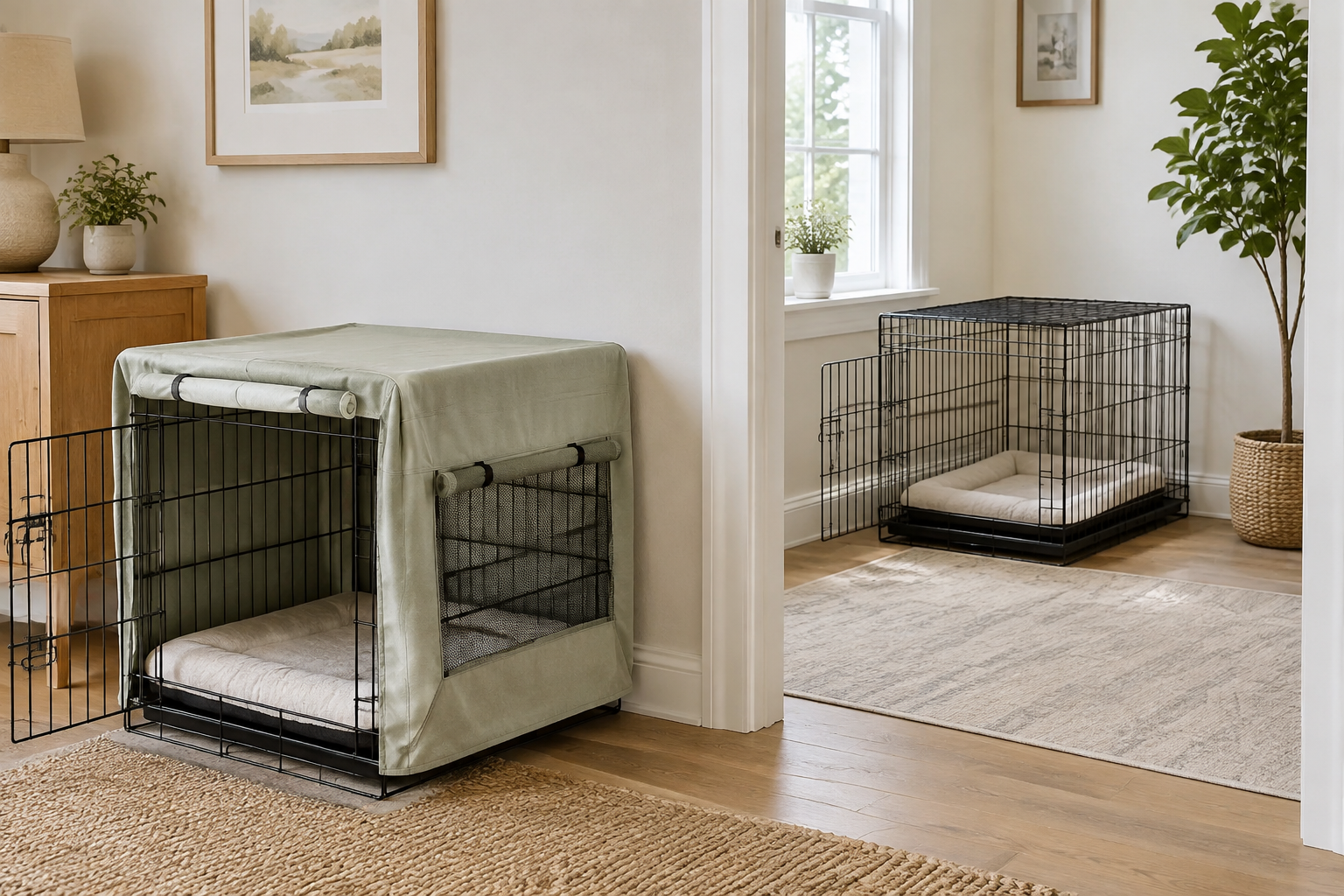
This is a home-setup comparison, not veterinary or training advice. Neither option treats anxiety, stops barking, guarantees rest, or makes confinement suitable. Persistent distress, repeated escape attempts, self-injury, sudden behavior changes, or a new inability to tolerate the crate warrant help from a licensed veterinarian or qualified trainer.
Quick Comparison
Choose a fitted crate cover when the crate must remain in a moderately active room, the dog is comfortable with reduced views, and you can preserve airflow, access, observation, and fabric clearance.
Choose an uncovered crate in a quiet room when a genuinely lower-traffic location is available and moving the setup does not create isolation, temperature, access, or supervision problems.
Skip changing the setup for now when the current arrangement works or when distress—not ordinary household activity—is the actual concern. Changing equipment can obscure a problem that needs professional assessment.
Option A: A Fitted Dog Crate Cover
A cover lets an owner change visual exposure without relocating the crate. Independently opening panels are more adaptable than a loose blanket because doors and selected sides can remain open. Exact fit matters: fabric should not bunch at latches, drag on the floor, or hang within reach through the wire.
When a cover may fit
- The assembled crate must stay near ordinary household movement.
- All exterior dimensions and door positions match a fitted cover.
- The room remains comfortably ventilated and away from heaters, vents, flames, and strong direct sun.
- The dog does not pull, chew, or swallow fabric and remains comfortable as panels are adjusted.
Cover tradeoffs
A cover adds laundry, inspection, and setup tasks. It can trap more warmth, hide a water spill or damaged item, block a door, or become a chew target. Darker is not automatically better. Keep enough open area to monitor the dog and follow both crate and cover instructions.
Option B: An Uncovered Crate in a Quiet Room
Room placement reduces the source of visual traffic rather than adding fabric to the crate. It avoids cover fit and chewing issues, but “quiet” should still mean comfortable, accessible, and appropriately supervised—not shut away where the household cannot check the dog.
When room placement may fit
- A lower-traffic room has stable temperature, airflow, and enough clearance around the crate.
- The location avoids doors, busy walkways, appliance noise, cords, direct sun, and heating equipment.
- The owner can still hear, see, and routinely check the dog.
- Moving the crate does not disrupt a familiar routine more than the household activity itself.
Quiet-room tradeoffs
A spare room may become hot, cold, stuffy, or cluttered when the door closes. It may also be less convenient for observation and daily cleaning. Measure the whole footprint with doors open and keep exits, closets, vents, and furniture access clear.
Compare the Setup Before Buying
- Traffic: Note the actual trigger—passing feet, television movement, windows, visitors, or general noise—without assuming what the dog feels.
- Air and temperature: Check the room under normal conditions and after any cover panel is lowered.
- Access: Open every crate door fully and operate each latch with the proposed setup in place.
- Visibility: Preserve a practical sightline for routine observation.
- Fabric reach: Do not use a cover if the dog can pull material, straps, or fasteners through the bars.
- Cleaning: Plan how covers, bedding, the tray, and the surrounding floor will be cleaned and fully dried.
- Household fit: Avoid blocked walkways, doors, vents, cords, and emergency access.
A Low-Commitment Trial
Before buying, test the room-placement idea by observing the existing uncovered crate in the proposed lower-traffic location during a normal, brief part of the established routine. Do not extend crate time to run the comparison. If relocation is impractical and a cover remains appropriate, start with panels open and change only one panel at a time while present.
Stop the trial if the dog pants unexpectedly in a comfortable room, chews or pulls fabric, repeatedly tries to escape, vocalizes in a way that concerns you, or shows other distress. Remove unsafe materials and seek veterinary or qualified training guidance rather than escalating coverage or isolation.
Who Should Skip Each Option?
Skip a cover when fabric is reachable, ventilation or temperature is hard to judge, the cover does not align with the doors, or reduced visibility appears to make the routine harder.
Skip the quiet-room move when the only room has poor climate control, household hazards, limited observation, or insufficient clearance. An ordinary low-traffic corner in a shared room may be more practical.
Skip both as a behavior fix. A product or room change cannot diagnose pain, fear, separation-related distress, or another cause of a suddenly difficult crate routine.
Bottom Line
A quiet-room setup is the simpler choice when a comfortable, observable, low-traffic location already exists. A fitted cover is the more adjustable choice when the crate must remain in an active room and the dog tolerates covered panels without fabric, airflow, or heat concerns. Start with the smallest reversible change and judge the entire setup—not just whether it looks calmer to a person.
For the broader comfort path, browse the comfort and home-setup guides. If a cover is the better fit, compare fitted crate cover options; for the crate floor, use the crate mat versus dog bed comparison.