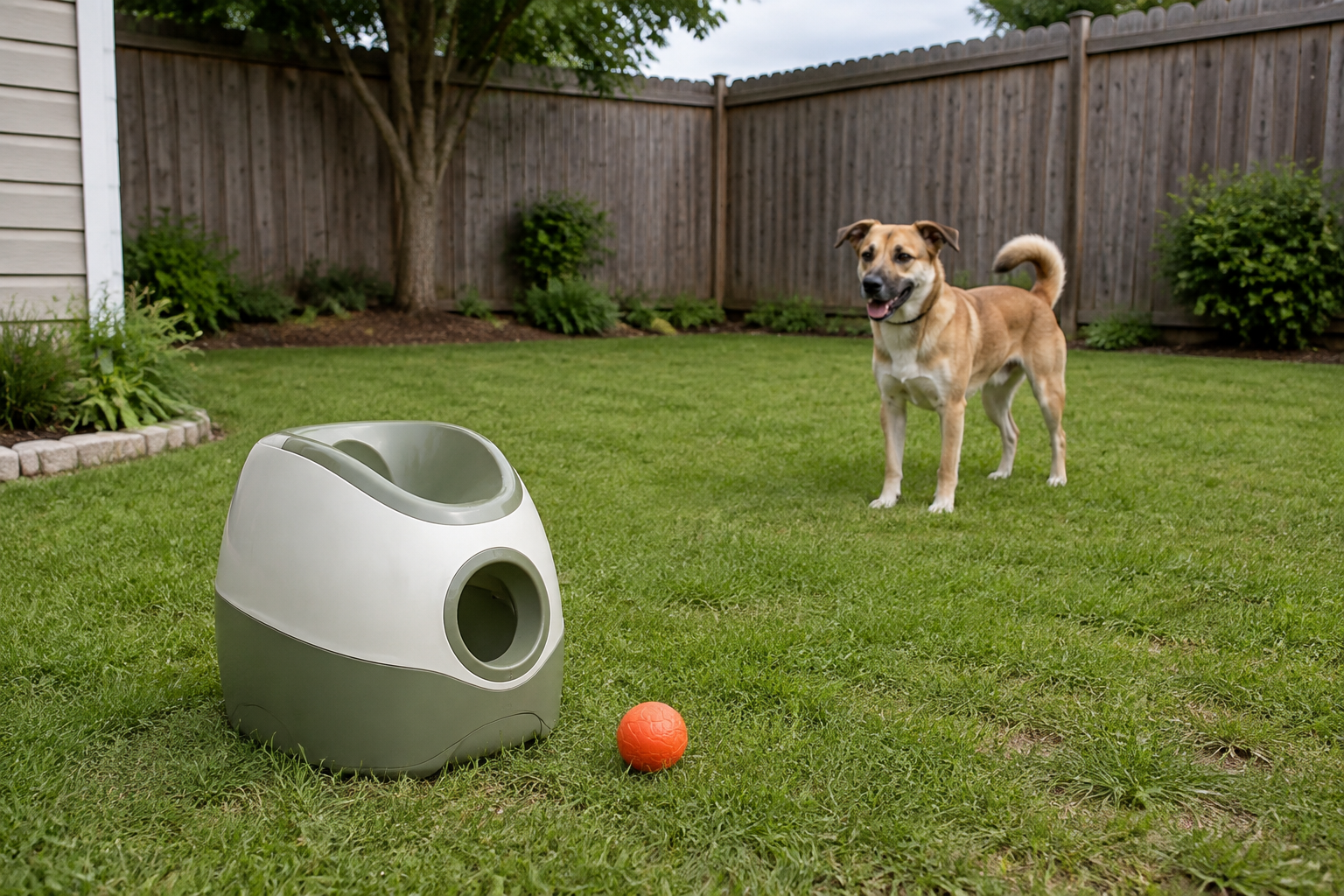
An automatic launcher is a convenience tool for interactive play, not an exercise prescription, behavior solution, pet sitter, or substitute for time with your dog. Follow the specific product instructions, keep control of the session, and stop if your dog shows pain, limping, breathing difficulty, distress, fixation, guarding, or a sudden change in willingness to play. Ask a veterinarian about physical concerns and a qualified trainer about persistent play-related behavior concerns.
The five-minute worth-it test
- Clear space: Can every available setting keep the ball inside a measured lane away from roads, fences, steps, people, pets, windows, and hard obstacles?
- Supervision: Will an adult stay present and able to pause the machine throughout every session?
- Dog fit: Is the compatible ball an appropriate diameter, and can your dog stay out of the launch path and return area?
- Machine tolerance: Can you introduce the sound and movement gradually without pushing a hesitant dog?
- Maintenance: Will you clean saliva and dirt, inspect balls and openings, manage power safely, and store everything out of reach?
Several confident yes answers can support the purchase. A tight space, uncertain ball size, inconsistent supervision, or a dog that is frightened or over-aroused points toward a manual launcher, ordinary hand toss, ground roll, or another supervised activity.
When automation can add useful convenience
The clearest fit is a dog-owner pair that already enjoys fetch and wants a repeatable, lower-effort throwing setup in a controlled space. Adjustable settings can help match the machine to the available lane, while a stable loading opening can add another predictable step to an interactive routine.
That value depends on active owner involvement. You still need to position the machine, control access, monitor every return, provide breaks, inspect the balls, and end the game. If the product would mostly repeat what you already do comfortably by hand, its floor space, noise, power needs, and cleaning may outweigh the convenience.
Measure the play lane before comparing products
Measure from the launch opening to the nearest safe stopping boundary, then account for variation in ball travel and bounce. Use only settings suitable for the space and surface under the manufacturer's directions. A maximum-distance claim is not a target, and an indoor label does not mean every room has adequate clearance.
Place the unit on the surface and in the orientation the maker specifies. Keep the launch path clear and prevent dogs, children, or other pets from standing directly in front of the opening. If you cannot create a controlled lane, skip the automatic format.
Ball size and compatibility are hard requirements
Use only the ball diameters, materials, and conditions allowed by the manufacturer. A ball that is too small for the dog can create a serious swallowing or choking risk, while the wrong size or a misshapen, split, or heavily worn ball may not feed through the machine as intended. If appropriate sizing is uncertain, ask a veterinarian.
Inspect every ball before play and remove damaged ones. Do not let the dog chew the machine, loading opening, cord, batteries, or balls between sessions. Keep spare balls stored where the dog cannot reach them unsupervised.
Noise, training effort, and temperament tradeoffs
Motors and launch mechanisms can make sounds before the ball moves. Start with the machine off and allow the dog to observe it from a comfortable distance. Follow the maker's introduction guidance, keep early sessions short, and never force approach or loading. A dog that remains fearful, frantic, possessive, or difficult to interrupt is not a good candidate for more repetitions.
Self-loading is not a requirement for the product to be useful. Many owners may find it simpler to load the ball themselves while controlling the pace. That choice also keeps hands-on supervision central to the game.
Power, cleanup, and storage costs
- Power source: Compare the maker's current adapter or battery requirements, cord placement, charging directions, and whether the intended location supports them.
- Cleaning: Follow the manual for the hopper, launch opening, exterior, and compatible balls. Disconnect power when instructed and let cleaned parts dry fully.
- Inspection: Check the housing, opening, moving parts, cord, adapter, battery compartment, and feet before use. Stop using damaged equipment.
- Storage: Account for the full machine footprint plus balls and power accessories, and keep them away from unsupervised pets.
- Ongoing supplies: Compatible replacement balls and, for some models, batteries add cost beyond the initial purchase.
Who should skip an automatic launcher?
Skip it if you lack a clear measured lane, cannot supervise continuously, cannot keep the dog away from the launch opening, or do not have an appropriate compatible ball. It is also a poor fit for a dog that destroys balls, guards toys, becomes difficult to interrupt, or is distressed by mechanical sounds.
Dogs with pain, injury, movement changes, breathing concerns, exercise restrictions, or unusual fatigue need veterinary guidance before a repetitive fetch routine. A product should not be used to work around those concerns.
Automatic vs manual vs no launcher
- Choose automatic when adjustable repeat launches add meaningful convenience and the space, dog, supervision, and maintenance routine all fit.
- Choose manual when you want easier pickup and flexible throw control without a motor, power source, or mechanical noise.
- Choose hand tosses or ground rolls when the area is tight, your dog prefers quieter interaction, or you want the simplest way to control each repetition.
- Choose another activity when fetch creates distress, fixation, guarding, unsafe movement, or poor fit with the individual dog's needs.
The bottom line
An automatic ball launcher is worth it only when it improves an already appropriate, supervised fetch routine enough to justify its space, noise, power, cleaning, and compatible-ball requirements. For many homes, a manual launcher or ordinary hand toss is the simpler choice.
If automation still fits, verify every current specification and warning through the linked category route. If you decide against it, the manual launcher guide compares simpler formats, while the supervised enrichment guide offers quieter alternatives.