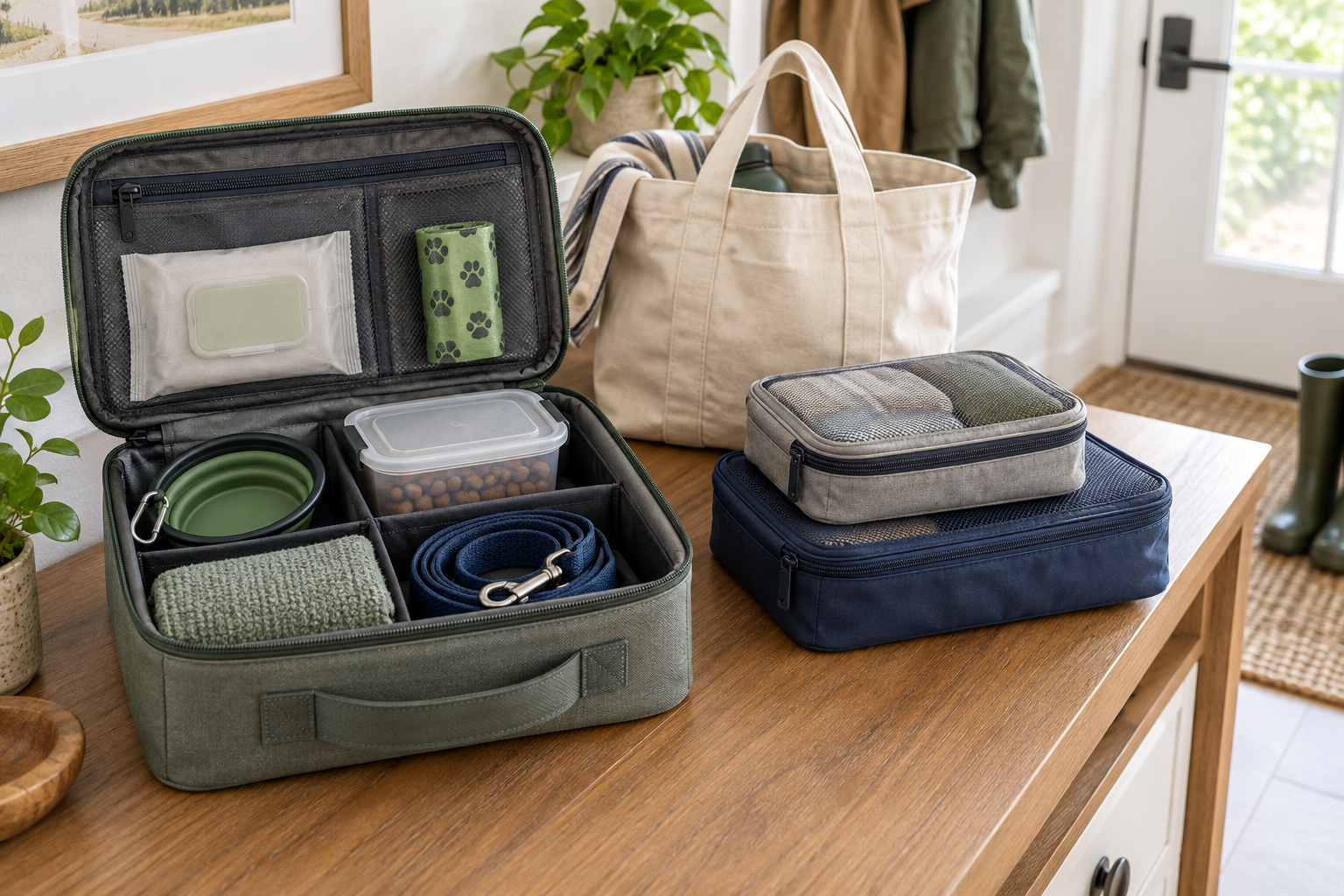
A travel supply case is an organization convenience, not a safety device, food-storage guarantee, or substitute for a pet carrier. Use only containers intended for the item inside, follow food and gear care directions, and do not use an ordinary organizer for medication or other temperature-sensitive supplies; ask your veterinarian or pharmacist how those items should travel.
Quick Decision: Buy, Repurpose, Simplify, or Skip
Buy when the same measured kit travels often and a closed, easy-to-carry case fixes repeated sorting or spill-containment problems. Repurpose a washable tote when the load changes from trip to trip. Use packing cubes when existing luggage works but small items disappear inside it. Skip when the trip needs only a leash, waste bags, water, and one small cleanup item.
Start With Trip Frequency and a Real Inventory
Pack for one ordinary errand, routine appointment, or day trip before shopping. List what was actually used, what stayed untouched, and what was awkward to find. Occasional travelers can often keep a short checklist and load an existing tote when needed. A dedicated case becomes easier to justify when the same clean, dry supplies move together often enough that repacking causes mistakes or delay.
Do not size the organizer around imagined emergencies. Keep veterinary documents and any professionally directed supplies in the format and conditions their provider recommends. The everyday case should focus on ordinary logistics such as an empty clean bowl, sealed food container, waste bags, towel, wipes, and compatible walking gear.
Measure Usable Space, Not the Outside Shell
Measure the packed bowl, sealed containers, rolled towel, and longest rigid item. Then compare those figures with usable interior dimensions after dividers and lid pockets take space. Check the case's empty weight and estimate the packed weight; a larger organizer can become unpleasant to carry before every compartment is full.
Test whether the closed case fits its actual destination: an entry shelf, luggage area, footwell that does not interfere with occupants, or another secured storage position. Follow vehicle and product guidance for securing loose gear. Never let an organizer obstruct controls, access, ventilation, or the pet's properly established travel area.
Compartments Help Only When They Match the Routine
Fixed dividers can keep bottles upright and small items visible, but they waste space when the load is bulky or changes often. Removable dividers are more adaptable if their fasteners stay secure and are easy to clean. Mesh lid pockets expose contents at a glance; opaque zip pockets contain visual clutter but require a labeling or restocking habit.
Separate clean items from used towels, waste, and damp gear. A removable wet bag can be easier to wash than the whole case. Food should remain in an appropriate closed container, away from cleaning products, and handled according to its packaging and your veterinarian's feeding guidance.
Check Closure, Carry Method, and Cleaning
- Closure: zippers or buckles should close without pressing on packed items.
- Handles: check attachment points and whether the loaded case carries level.
- Shoulder strap: compare adjustment range, attachment hardware, and the maker's directions.
- Interior: look for surfaces you can fully reach, empty, and dry.
- Base: confirm it sits steadily where you pack it and fits the chosen storage spot.
- Pet access: keep food, wipes, bags, straps, and small pieces secured away from chewing or play.
When a Tote or Packing Cubes Work Better
A tote suits towels, blankets, and other bulky soft goods because its interior can flex. Choose one with a closure if contents must remain contained, and check whether its base and handles tolerate the planned load. A tote you already own is the sensible trial: if items stay reachable and the bag cleans easily, there may be no problem left to solve.
Packing cubes suit owners who share luggage between human and pet gear or want to lift one category out at a stop. They add their own zippers, seams, and weight, so two clearly assigned cubes are often more useful than filling every available size. Neither alternative needs to look pet-specific to work well.
Who Should Skip a Dedicated Case
Skip it if trips are rare, the actual kit is very small, existing luggage already keeps items organized, or the case will remain partially empty. Also skip any option with unclear usable dimensions, care instructions, or load guidance. If the main need is vehicle storage rather than portable trip packing, compare car organizers for dog-walking and cleanup gear instead.
A supply organizer does not transport or restrain a pet. For routine carrier trips, start with pet carrier fit, ventilation, access, and cleaning criteria. Contact a veterinarian about illness, pain, travel-related distress, or medical transport needs rather than trying to solve those issues with packing accessories.
Bottom Line
A pet travel supply case is worth it when a stable, frequently repeated inventory fits its measured compartments and the loaded case is easier to carry, clean, and restock than an existing bag. Test the outing with a washable tote first, use packing cubes when existing luggage only needs internal order, and skip the purchase when simplifying the kit solves the problem.
Build the broader routine with the grab-and-go pet outing kit, or pack a narrower cleanup kit for car rides and day trips. If you decide a dedicated organizer fits, compare hard-shell and fabric travel supply cases by packed shape, weight, cleaning, and storage.