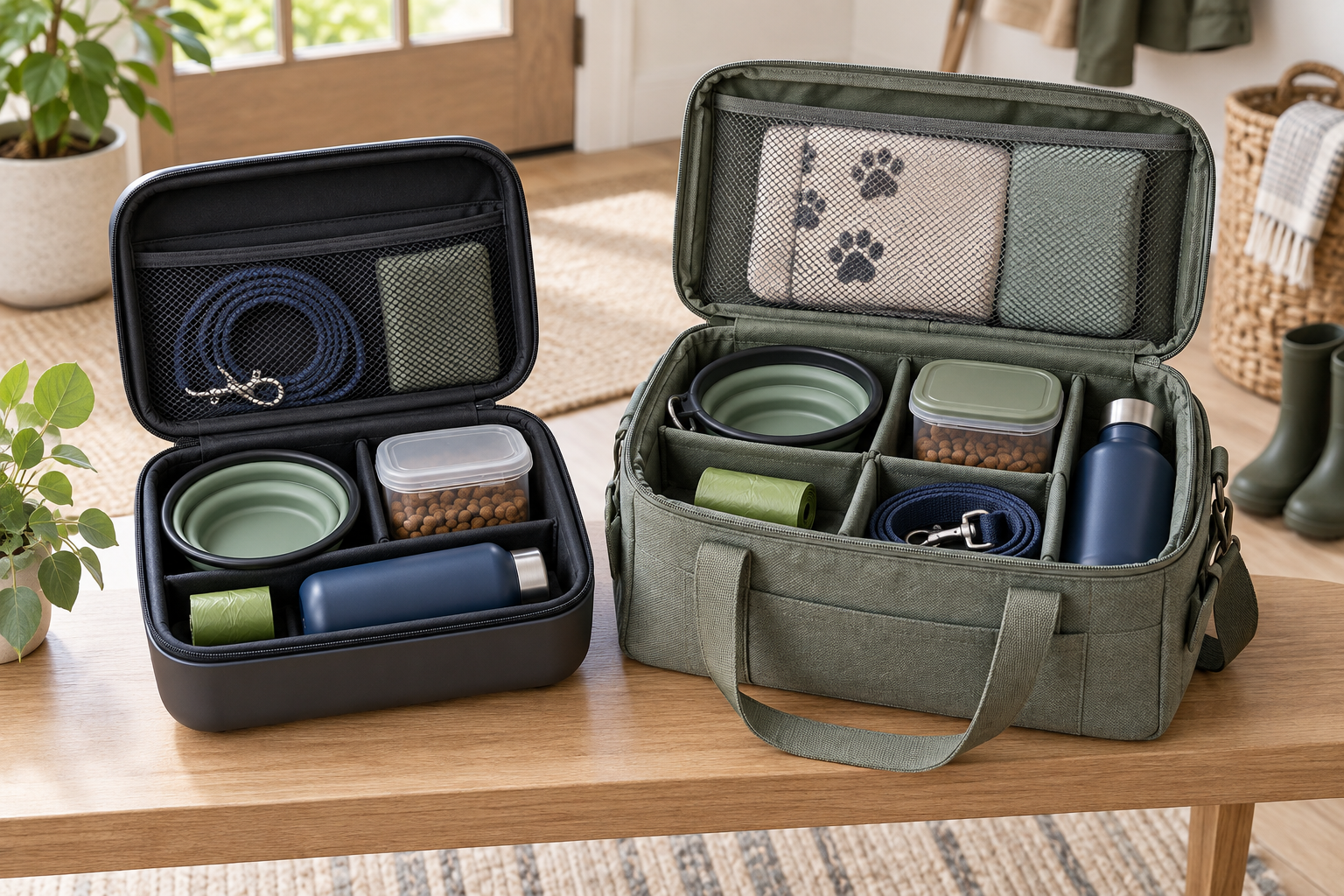
A supply case organizes gear; it is not a pet carrier, vehicle restraint, insulated food-storage guarantee, or medical case. Keep food in an appropriate sealed container, separate it from cleanup products, secure loose luggage according to applicable vehicle and product guidance, and ask a veterinarian or pharmacist how medication or temperature-sensitive supplies should travel.
Quick Decision
- Choose hard-shell when the measured kit is compact and stable, a fixed exterior fits its storage spot, and you value a shape that does not collapse around its contents.
- Choose fabric when the inventory changes, exterior pockets are useful, and a lighter or slightly compressible package fits the trip.
- Skip both when an existing washable tote or packing cube already keeps the few necessary items organized.
Protection Means Different Things
A rigid shell can help prevent ordinary soft luggage from pressing directly against the case contents, but the complete product—not the category name—determines what it tolerates. Do not assume a case is impact-proof, waterproof, crush-proof, or safe for fragile items unless the maker provides a clear current claim and instructions.
Fabric sides flex around awkward shapes and may make it easier to use pockets, but they can also slump when partly loaded. Inspect the base, seams, handles, strap anchors, zippers, and divider fasteners. A structured fabric bag may behave very differently from a collapsible tote, so compare the actual construction.
Compare Usable Interior Space
Hard shells hold their outside dimensions whether full or empty. Rounded corners, lid depth, hinges, and molded ribs can reduce usable space. Measure the closed containers and longest item, then check whether the lid closes without pressing on bottles, bowls, or zipper tracks.
Fabric cases can accept a slightly irregular bundle, but pockets, padding, and dividers still consume room. A soft wall that bulges may make the loaded case larger than its listed base footprint. Pack to the intended shape and confirm it still fits the shelf, cargo cubby, or luggage area.
Weight, Handles, and Carrying
Compare empty product weight before adding water, food, and cleaning gear. A small rigid case may be easy to grip but awkward if its handle is narrow or off-center. A fabric bag may include shoulder straps, yet the attachment points and loaded balance matter more than the presence of a strap.
Use only the carrying method described by the maker. Check that zippers close freely, handles remain secure, and the case carries level enough for the contents. Secure the packed organizer so it cannot move through the vehicle, obstruct controls, or interfere with occupants or the pet's established travel area.
Compartments and Access
Fixed molded compartments suit a stable kit only when their dimensions match it. Removable fabric dividers allow the layout to change but can shift if their fasteners are poorly positioned or overloaded. Lid pockets help small items stay visible; deep outside pockets are useful only if they do not hide supplies that need regular cleaning or replacement.
Separate clean bowls, sealed food, and fresh towels from used wipes, damp cloths, or waste. A removable washable pouch for dirty items can be easier to manage than relying on the organizer lining. Keep straps, plastic bags, food, and small objects secured away from pet access.
Cleaning and Drying
A hard exterior may be easy to wipe, while seams, zipper tracks, foam, fabric hinges, and molded recesses can still trap debris. Follow the care directions for every material and let the case dry completely before closing it.
Some fabric organizers have removable inserts or washable components; others allow spot cleaning only. Do not infer machine washability from appearance. Check whether the base board, padding, dividers, and straps must be removed, and whether all interior corners can be reached and dried.
Storage Between Trips
A hard-shell case keeps the same footprint on a shelf and may stack only if the maker permits it and the shape is stable. A fabric case may fold or compress when empty, but structured panels can prevent true flat storage. Measure the case in the condition in which you will actually store it.
Empty crumbs, remove damp gear, and check the inventory after each outing rather than leaving the case packed indefinitely. Store it where pets cannot chew straps, access food, or pull down the organizer.
Who Should Skip a Hard-Shell Case?
Skip hard-shell when the fixed shape wastes space, the rounded interior will not accept your longest item, the empty case is too heavy, or the rigid footprint does not fit your luggage area. It is also a poor fit when your kit varies so much that every trip requires forcing a new layout.
Who Should Skip a Fabric Case?
Skip fabric when the loaded bag slumps, dividers will not hold the measured items, cleaning directions do not suit routine messes, or the bag loses its intended shape in storage. Do not choose fabric on an assumption that it is washable; verify the complete care label first.
Red Flags Before Buying
- Only exterior measurements are provided, with no useful view of the interior.
- Shell, lining, base, divider, closure, or care information is unclear.
- Photos hide the handle attachments, zipper path, corners, or packed shape.
- The listing makes broad waterproof, crush-proof, food-safety, or medical-storage claims without specific maintained support.
- The organizer is shown transporting a pet or replacing appropriate restraint equipment.
Bottom Line
Hard-shell cases trade flexibility for a fixed shape around a compact inventory. Fabric cases trade some rigidity for pockets, adjustable layouts, and easier accommodation of changing soft goods. Choose only after the real packed kit fits the usable interior, the loaded case is manageable, its cleaning routine is realistic, and its stored shape fits the trip.
Start with the everyday pet outing kit, then use the travel supply case worth-it test before buying either construction. If an ordinary flexible bag is enough, compare washable pet supply totes for short trips instead.