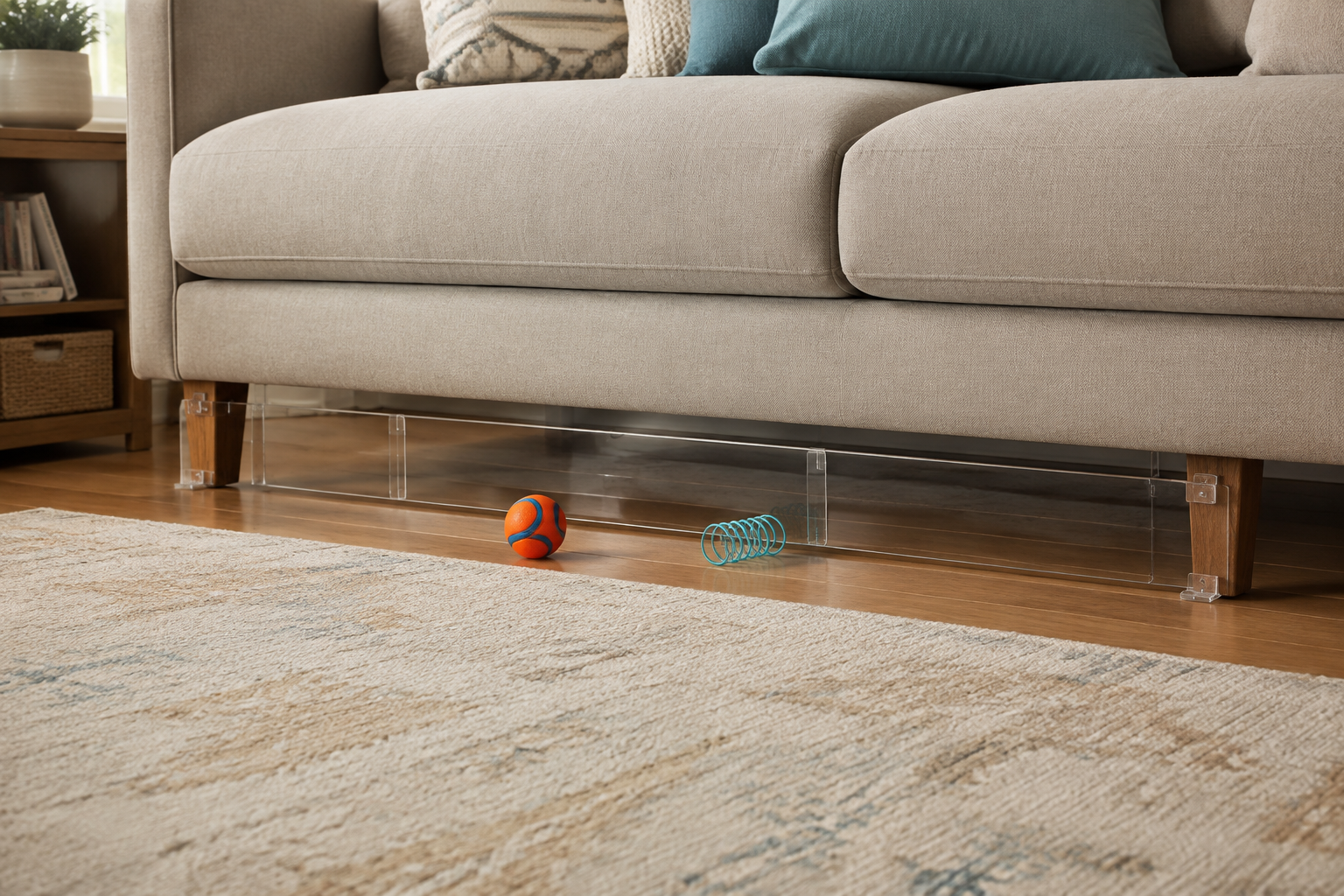
A toy blocker is a housekeeping convenience, not a restraint, behavior tool, or substitute for supervised play. It should not close a pet into a space, cover an air vent, hide electrical access, or touch moving furniture hardware.
Quick Decision: Buy, Adjust, Repurpose, or Skip
Buy when retrieval happens repeatedly at one measurable gap and a purpose-built barrier can remain secure and removable. Adjust by choosing larger suitable toys or changing furniture clearance when that solves the pattern more simply. Repurpose only a smooth, stable, removable barrier with no sharp edges, loose pieces, exposed cords, or pet-accessible adhesive. Skip when a retrieval tool already handles the occasional stray toy or installation creates a new maintenance problem.
Audit the Room Before Shopping
For several normal play sessions, note which toys go under, how often retrieval stops the activity, and whether the same furniture edge is responsible. Measure each toy at its narrowest pass-through dimension. A blocker may be unnecessary if one undersized ball is the whole issue and a larger, appropriate toy fits the same play routine.
Measure the gap at several points and record separate runs between legs. Include rugs, uneven floors, center supports, drawers, recliner hardware, robot-vacuum routes, floor vents, power strips, and any area that must remain reachable. A product that fits the advertised height but blocks a mechanism or cleaning route does not fit the room.
When a Dedicated Blocker Earns Its Space
- The pattern repeats: small toys disappear often enough that retrieval regularly interrupts play or room reset.
- The opening is stable: the furniture does not recline, fold, roll, or need ventilation through the planned barrier line.
- The fit is measurable: the guard covers the tallest gap and each open run without unstable stacks or loose offcuts.
- Attachment is compatible: the maker permits the method on the actual furniture and floor surfaces.
- Access remains planned: you can remove or open a section to clean dust, inspect the floor, and retrieve anything else.
- Your pet ignores it: panels, foam, mesh, clips, or edges do not become a chewing, pawing, or pulling target.
Try the Simpler Fix First
If only one toy repeatedly disappears, retire it when damaged and consider a larger suitable play item rather than closing every gap in the room. A long, smooth retrieval tool may be enough for infrequent problems. Rearranging furniture can help only when it preserves stability, walking clearance, outlet and vent access, and the maker's placement directions.
Do not wedge towels, cardboard, wood scraps, or boxes into a gap without checking stability and pet access. Frayed fabric, splintered edges, staples, tape, small connectors, and crushable pieces can turn a minor nuisance into a new object for a pet to mouth or pull apart.
Choose a Format Only After Deciding to Buy
Clear modular panels suit straight visible runs but depend on accurate height and connector placement. Cut-to-fit foam can suit low, even gaps but needs neat edges and secure fit. Taut mesh can span longer openings but loose ties or sagging sections are poor choices around curious pets. The toy-blocker buying guide compares those varieties without treating any one format as universally best.
Installation and Cleaning Checks
Follow the product and furniture directions, especially around adhesive, finished wood, veneer, upholstery, and moving parts. Remove offcuts and packaging immediately. After setup, press gently along the full barrier to find sections that bow, lift, or detach. Never assume adhesive will remove without residue.
Inspect during routine floor cleaning and whenever furniture moves. Clean both sides, keep a deliberate retrieval point, and remove the product if panels crack, foam crumbles, mesh stretches, clips loosen, edges lift, or the pet starts chewing or pulling at it.
Who Should Skip One?
Skip a blocker for reclining sofas, adjustable beds, rolling furniture, irregular gaps, fragile finishes, blocked vents, required robot-vacuum paths, or rooms where secure installation is not possible. It is also a poor fit when the pet persistently targets the barrier or when cleaning beneath the furniture would become harder.
If a pet is crawling under furniture to hide, appears distressed, or suddenly changes play or resting behavior, do not simply close the space and assume the issue is solved. Ask a licensed veterinarian about possible health concerns and a qualified behavior professional when fear or distress may be involved.
Bottom Line
An under-furniture toy blocker is worth it for a frequent, localized retrieval problem with a stationary, measurable, safely accessible gap. First audit the toys and room; then buy only if a fitted, inspectable barrier is simpler than choosing a larger toy, adjusting the setup, or using an occasional retrieval tool.
For the broader routine, use the supervised enrichment pillar and the toy-rotation setup to keep accessible toys appropriate and manageable.