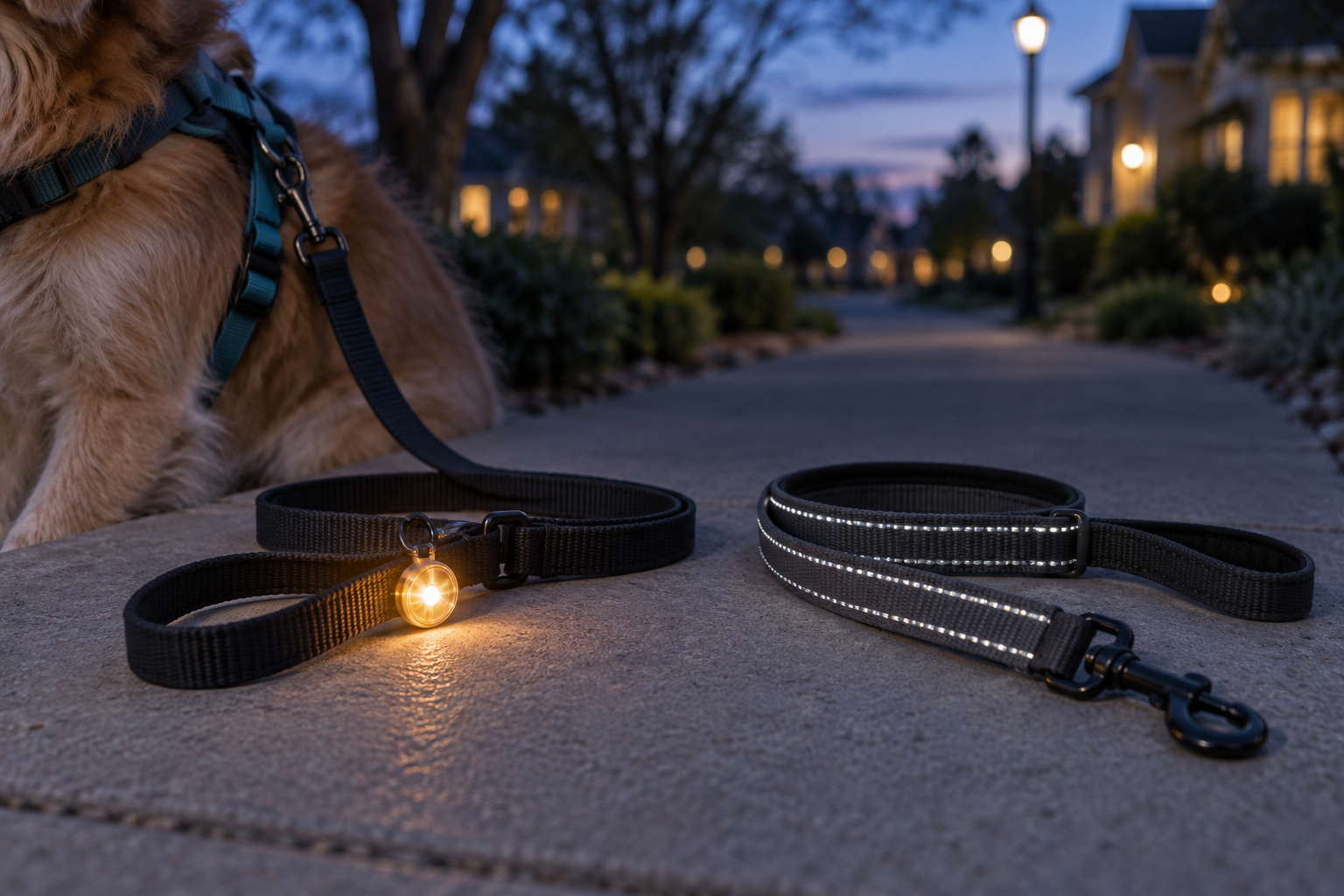
This is a technology-choice guide, not a promise that either accessory makes a route safe. Stay attentive, use an appropriate leash and handling setup, follow local rules, and carry a separate human-directed light when you need to see the walking surface. Do not aim a bright or flashing light toward a dog's eyes.
Quick Decision: Light or Reflective Leash?
- Choose a leash light when an appropriate attachment point is available and you will reliably manage charging or batteries, controls, inspection, and weather limits.
- Choose a reflective leash when you prefer no electronics and the leash itself fits your dog, handler, route, and usual sources of outside light.
- Use both thoughtfully when the pieces remain compatible and manageable, and each adds a distinct layer without interfering with leash control.
- Choose neither yet when the route is poorly lit, hardware is worn, the dog chews accessories, or the added device distracts the dog or handler.
The Core Difference: Emitted vs Reflected Light
A powered leash light emits its own light. That can make it noticeable without a nearby headlamp aimed directly at it, but visibility still depends on placement, brightness, angle, obstructions, surroundings, and whether the device is working. Manufacturer-stated modes and runtime are planning inputs, not guarantees under every temperature, battery age, or setting.
Reflective thread or panels do not create light. They return some light that reaches them, so performance depends on the approaching light source and viewing angle. A reflective leash may be a useful passive layer, but it is not a substitute for route choice, attention, or illumination you need to see hazards.
Attachment and Handling Tradeoffs
Before buying a light, identify the exact leash ring, handle, webbing, or harness location the maker permits. Compare the opening, closure, device weight, swing, button access, and whether the device can strike the dog, handler, or hardware. Reject a light that twists the leash, crowds the grip, weakens control, dangles into chewing reach, or can detach easily.
A reflective leash avoids the extra clipped object, but it replaces the whole leash. Check length, width, material, handle comfort, stitching, connection hardware, and compatibility with the walking setup—not just the reflective strip. Reflective decoration does not make unsuitable leash construction acceptable.
Power, Weather Labels, and Maintenance
For a rechargeable light, check the current charging method, port closure, maker-stated charge and runtime guidance, and storage instructions. For replaceable batteries, check the exact battery type, compartment closure, disposal guidance, and whether small cells can be kept securely away from pets and children. Test the device before leaving and carry a backup light when darkness would make the route hard to manage.
Read the precise weather-resistance language for either product. Terms such as water-resistant and waterproof are not interchangeable, and a stated rating only has the scope described by the maker. After a damp walk, wipe equipment as directed and let it dry fully. Inspect clips, seams, reflective material, leash webbing, handle, and snap before reuse.
Who Should Skip a Clip-On Light?
Skip it if there is no maker-approved secure attachment point, if the dog persistently mouths hanging accessories, or if the extra weight and motion interfere with handling. It may also be poor value for owners who will not maintain the battery or who already carry a suitable light positioned for their needs.
Who Should Skip a Reflective Leash?
Skip a reflective model when it compromises the leash dimensions, grip, hardware, or construction you need. It is also a limited standalone choice on routes with little light to reflect. If your current leash is in good condition and fits well, a compatible reflective sleeve or separate handler-worn visibility layer may avoid an unnecessary replacement, provided its maker permits the setup.
Red Flags Before Buying
- There are no clear dimensions, attachment instructions, power details, care directions, or weather label.
- The listing promises universal visibility, accident prevention, or guaranteed safety.
- A light blocks the handle, adds a snag point, opens under light handling, or hangs within chewing reach.
- Reflective details are shown only in edited promotional darkness with no explanation of placement or leash construction.
- The accessory encourages relying on a dim or high-traffic route that you otherwise could not manage.
- Any walking hardware is frayed, cracked, loose, corroded, or incompatible with the dog and handler.
Build a Practical Low-Light Routine
Start with a route, schedule, leash setup, and human-directed light you can manage. Then add visibility aids as layers. The site's everyday pet outing guide helps organize bags, water, cleanup supplies, and optional visibility gear. If the dog suddenly resists walks, seems painful, panics, or reacts in a way you cannot safely manage, pause the gear decision and contact a veterinarian or qualified behavior professional as appropriate.
Bottom Line
A clip-on leash light is the more direct active option when secure attachment, power, controls, and maintenance fit your routine. A reflective leash is the simpler passive option when the leash itself fits well and outside light reliably reaches its reflective area. Use either as one visibility layer—not as a safety guarantee—and prioritize route judgment, sound walking hardware, attentive handling, and a backup plan.