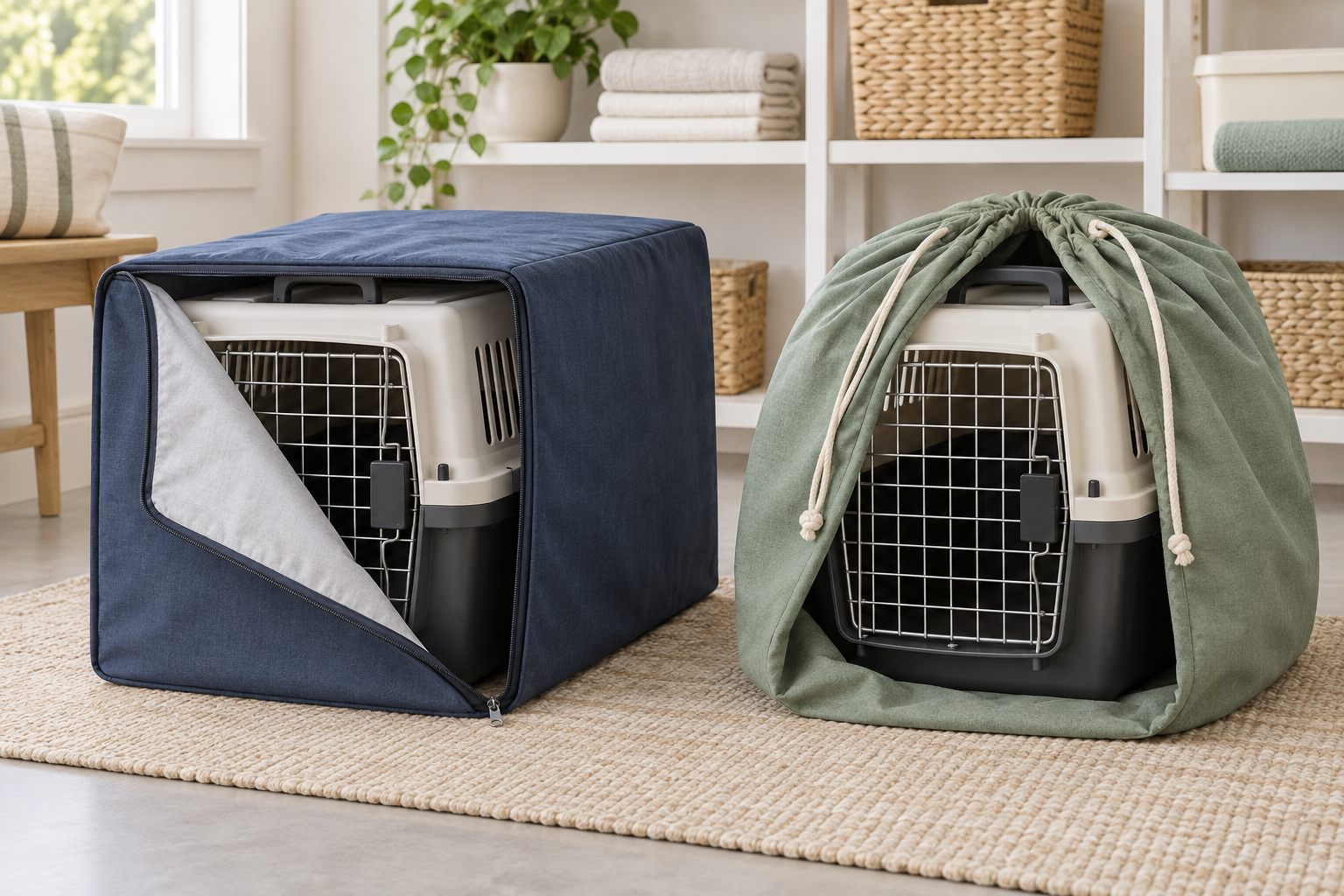
Never put a cover on a carrier while a pet is inside. A storage cover is not a travel rain cover, crate cover, warming layer, sound barrier, or behavior aid. Remove it completely before preparing the carrier for use, then inspect and clean the carrier according to its instructions.
Quick Decision
- Choose zippered when you can match the carrier precisely and want a wide, repeatable access panel.
- Choose drawstring when you need a more forgiving opening and can keep the cord tidy during storage.
- Skip both when the carrier stays in a clean closed cabinet, the storage area is damp, or a washable household layer already handles the dust.
Fit Is More Than Three Outside Measurements
Measure the carrier at protruding hinges, latches, feet, vents, and folded handles. Note whether the cover must pass over a top handle or open around a front door. Allow only the clearance the cover maker calls for; excessive fabric can snag, while an undersized cover can strain seams or hardware.
Also measure the shelf, closet, or utility-space opening. A cover that fits the carrier but blocks a shelf edge, label, or carrying handle can make inspection and removal harder.
Zippered Covers: Defined Shape and Broad Access
A fitted zippered cover can open along a predictable face, which helps when the carrier remains on a shelf during covering or uncovering. Look at the complete zipper route, pull size, seam placement, and whether the opening clears the carrier door and top handle.
The tradeoff is lower tolerance for measurement errors. Corners and zipper ends can take strain when the carrier is too large or inserted at an angle. Stop using a cover with a stuck zipper, torn seam, exposed sharp part, or damage that catches on the carrier.
Drawstring Covers: Flexible Opening and Gathered Bulk
A drawstring opening can accommodate modest differences in shape and may lift off quickly. Compare the fully open circumference with the carrier's widest path. Check where gathered fabric rests and whether it interferes with a label or handle.
A loose cord creates its own storage task. Secure it as the maker directs and keep it inaccessible to pets and children. Skip a design whose toggle, knot, or excess cord will dangle into a walkway or where a pet can reach the stored carrier.
Fabric, Moisture, Cleaning, and Ventilation
Store only a carrier that has been cleaned and dried completely. A cover cannot correct a damp garage, active leak, condensation, pest problem, or contaminated carrier. Review the cover's material and care label rather than assuming “breathable,” “waterproof,” or “washable” from appearance.
After washing, dry the cover fully as directed before replacing it. Periodically remove it to inspect the carrier, shelf, fabric, seams, zipper or cord, and the space beneath. If you find persistent moisture, odor, residue, mold-like growth, pests, or material damage, stop using the setup and address the storage condition.
Access, Labels, and the Next Trip
A visible label can identify the carrier size, compatible pet, removable parts, and stored accessories without turning the cover into a catch-all. Do not store medication, food, cleaners, damp textiles, or small hazards loose inside the carrier. Before a trip, remove the cover fully, inspect every carrier surface and fastener, and reinstall the correct bedding or liner.
Who Should Skip a Storage Cover?
Skip a dedicated cover if the carrier is used too frequently to be cleaned and dried before storage, if the only location is damp or hard to inspect, if the cover would conceal damage, or if pets can reach the closure. Closed shelving or a simple washable dust layer may be enough when the carrier is already protected.
Bottom Line
A zippered cover rewards precise fit with defined access and edge coverage. A drawstring cover offers more opening tolerance but leaves gathered fabric and a cord to manage. Choose only after measuring the carrier and storage space, and use either format exclusively on a clean, dry, empty carrier.
Plan the complete between-trip routine with the pet outing kit guide, compare carrier fit and cleaning criteria, or review washable covers for empty crates in dusty storage when a crate—not a carrier—is the item being stored.