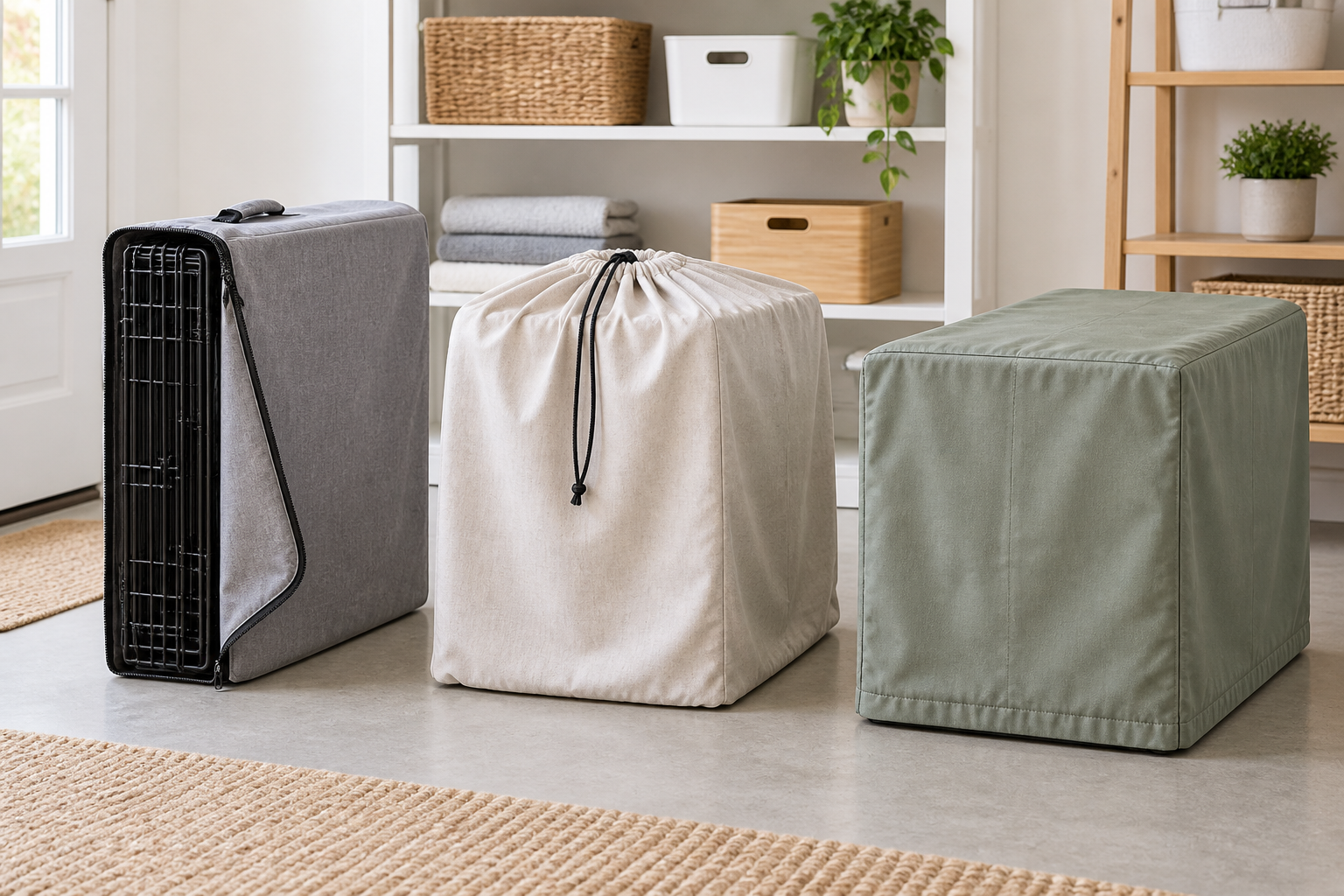
This guide is about protecting an unused crate from ordinary indoor dust. It does not recommend covering an occupied crate, storing a damp or dirty crate, or using a fabric cover as a training, calming, weatherproofing, pest-control, or safety solution.
Measure the crate in its stored shape
Decide whether the crate will be folded or remain assembled, then measure its widest length, width, and height—including handles, latches, feet, clips, and any secured divider. Compare those measurements with the listing's interior dimensions when provided. Leave modest ease for seams and the opening; forcing a tight cover over exposed hardware can damage fabric or make removal awkward.
Photograph or note how the crate folds before covering it. Secure loose components according to the crate maker's instructions, but do not trap small parts where they can rub through fabric or fall out when the cover opens.
Quick format comparison
- Zippered cover: contains the folded shape and opens broadly, but the zipper must clear protruding hardware and remain easy to operate.
- Drawstring cover: adapts to a less exact shape, but loose cord and gathered fabric need tidy, inaccessible storage.
- Fitted utility cover: looks neat on an assembled empty crate, but must match the full footprint and should never be mistaken for an in-use crate cover.
- Clean cotton sheet: may be enough in a dry closet when containment is unnecessary and the drape will not create a trip or snag hazard.
- No cover: simplest when the storage spot is clean and the crate is easy to wipe before reuse.
Selection criteria that matter
- Measured compatibility: use the crate's stored dimensions, not its advertised size label.
- Opening: check whether a zipper, drawcord, elastic edge, or open bottom lets the cover go on without scraping hardware.
- Fabric and care: confirm fiber content and current washing and drying instructions; “washable” does not always mean machine washable or tumble dryable.
- Seams and closures: inspect stress points after every wash and retire a cover with a broken zipper, loose cord, torn seam, or shedding coating.
- Labeling: add a removable tag outside the cover for crate dimensions and compatible parts without writing over required product labels.
- Stored access: keep the package out of walkways and away from pets, children, heat, open flame, moisture, chemicals, and heavy items that could deform the crate.
Clean and dry everything before storage
Remove bedding, bowls, toys, waste, and detachable accessories. Clean the crate and tray according to their manufacturers' directions, rinse where directed, and let every joint, channel, tray edge, and fabric item dry completely. A cover can hide moisture rather than solve it. If you see corrosion, bent wire, cracked plastic, damaged latches, sharp edges, mold, pests, or an unexplained odor, address the underlying problem before storage or reuse.
Wash the cover on its own schedule and let it dry fully before refitting. During long storage, inspect the area periodically instead of assuming a closed cover has kept conditions unchanged.
Who should skip a dedicated cover
Skip the purchase when an existing clean sheet fits safely, the crate is stored only briefly, or the storage area is easy to dust. Also skip a cover when the crate is damp, the location has leaks or pests, the fabric would sit against a heater, the closure cannot avoid sharp hardware, or pets can reach cords, elastic, or loose fabric.
If the crate will remain set up for a pet, use the crate cover versus quiet-room comparison instead. An occupied crate needs airflow, observation, door access, temperature, and fabric-reach checks that a storage dust cover is not designed to satisfy.
The bottom line
Choose a zippered cover for a consistently folded crate, a drawstring format for a safely managed adjustable opening, or a fitted utility cover for an empty assembled crate. Measure the stored shape, verify the exact care label, clean and fully dry the crate first, and skip the accessory when a simple washable layer already does the job.