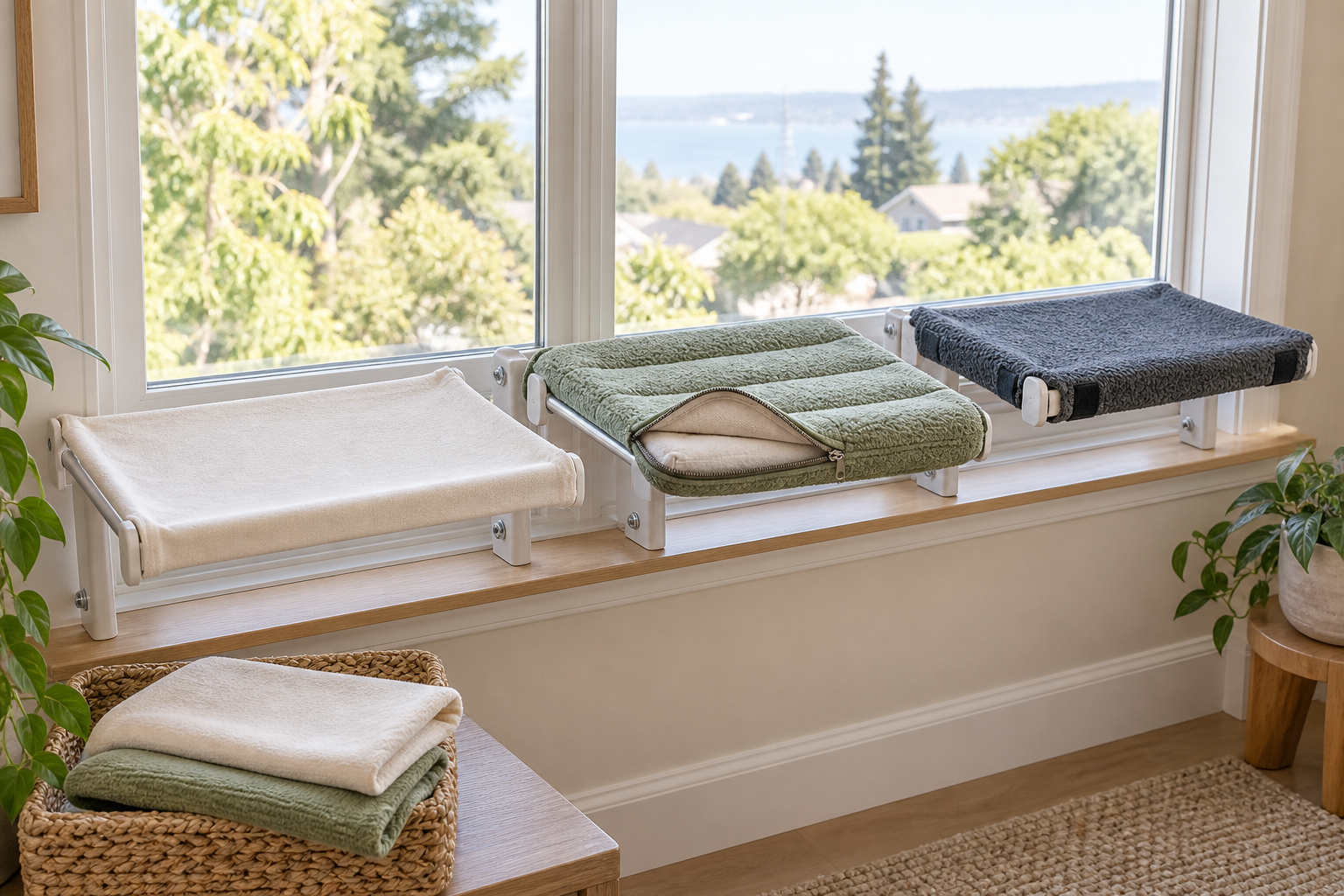
A replacement cover is a maintenance part, not a repair for bent tubing, cracked mounts, worn suction cups, damaged cables, loose brackets, or an unsuitable window. Remove the perch from use while any structural or attachment concern is unresolved.
Quick Pick by Perch Condition
Choose a maker-specific cover when the manufacturer currently lists it for the exact frame. Consider a measured zippered cover when the frame was designed for that enclosure and every dimension and closure aligns. Consider a fitted tab cover only when the existing frame has corresponding attachment points. Skip cover-only replacement when the frame, mount, hardware, or window setup needs attention.
Identify the Frame Before Measuring
Look for the brand, model, size, manual, order record, or markings on the frame. Similar-looking platforms may differ in tube diameter, corner radius, crossbar placement, cable openings, and cover tension. A photo match or a shared length label is not enough.
Remove the old cover only as directed and measure it laid flat without stretching: finished length, width, pocket depth, corner shape, opening positions, zipper length, tab locations, and padding thickness. Also measure the bare frame. Compare both sets of numbers with the current listing.
Fit and Attachment Matter More Than Softness
A cover should install without forcing seams, bowing the frame, leaving unsupported gaps, covering attachment hardware, or creating folds that change the usable platform. Sleeves need the correct frame path; zippers need to close fully without strain; tabs need enough overlap at the intended points.
Do not add knots, pins, clips, adhesive strips, or altered openings unless the manufacturer explicitly supports that change. Keep closures, loose fabric, and fastening ends outside chewing or entanglement reach.
Compare Fabric and Padding as a System
Read the material description and care label for the cover actually supplied. A removable outer textile, sewn-in padding, foam insert, and underside coating can have different cleaning limits. Check whether padding must be removed, whether the cover can enter a washing machine, and what drying method is specified.
Choose texture around the cat and cleanup routine without assuming plush means comfortable for every cat. Deep pile can hold fur and litter; slick fabric may shift if the frame does not tension it correctly. Reject rough seams, exposed zipper parts, damaged coatings, strong lingering odor, or padding that bunches after care.
Washing, Drying, and Reassembly
Follow the replacement-cover and perch makers' instructions. Close fasteners or zippers only when directed, use compatible detergent and temperature settings, and dry every layer fully. Do not reinstall damp padding or stretch a cover onto the frame to force it dry.
After laundering, inspect seam alignment, shrinkage, stretched tabs, zipper function, pockets, and finished dimensions. Reassemble the empty perch, tension the fabric as directed, and recheck the complete mount before allowing use.
Inspect the Whole Perch at the Same Time
- Frame: look for bending, cracks, sharp edges, loose joints, or corrosion.
- Mount: inspect every suction cup, bracket, brace, cable, connector, and stated contact surface.
- Window: check glass, sill, trim, latch, blind clearance, direct sun, and the route into and off the perch.
- Platform: confirm the cover is taut, complete, correctly oriented, and large enough for the intended usable area.
- Cat fit: follow the stated total load limit and watch calm entry, resting, turning, and exit during supervised reintroduction.
Who Should Skip a Replacement Cover?
Skip the purchase when compatibility depends on guesswork, the original cover was not designed to be replaced, or the delivered cost and return friction approach the value of an otherwise worn perch. Replace the complete perch when the frame or mounting system is questionable.
Also pause an elevated setup for a cat showing new reluctance to jump, limping, weakness, poor balance, or pain. A washable cover cannot solve a mobility or health concern; ask a licensed veterinarian about a sudden or concerning change.
Connect the Cover to the Right Setup
If the frame is sound but its mounting format is the issue, compare suction-cup and sill-mounted designs. Renters can use the broader window perch guide for lease, window, and freestanding alternatives. For a deep ledge that does not need a mounted frame, compare washable cat sill beds.
Bottom Line
A maker-specific washable cover is the cleanest replacement path. A compatible zippered or tab-fastened cover can work when its finished dimensions and attachment layout match exactly. Measure the old cover and bare frame, follow both makers' care directions, inspect the complete perch, and skip cover-only replacement when any structural or mounting part is uncertain.