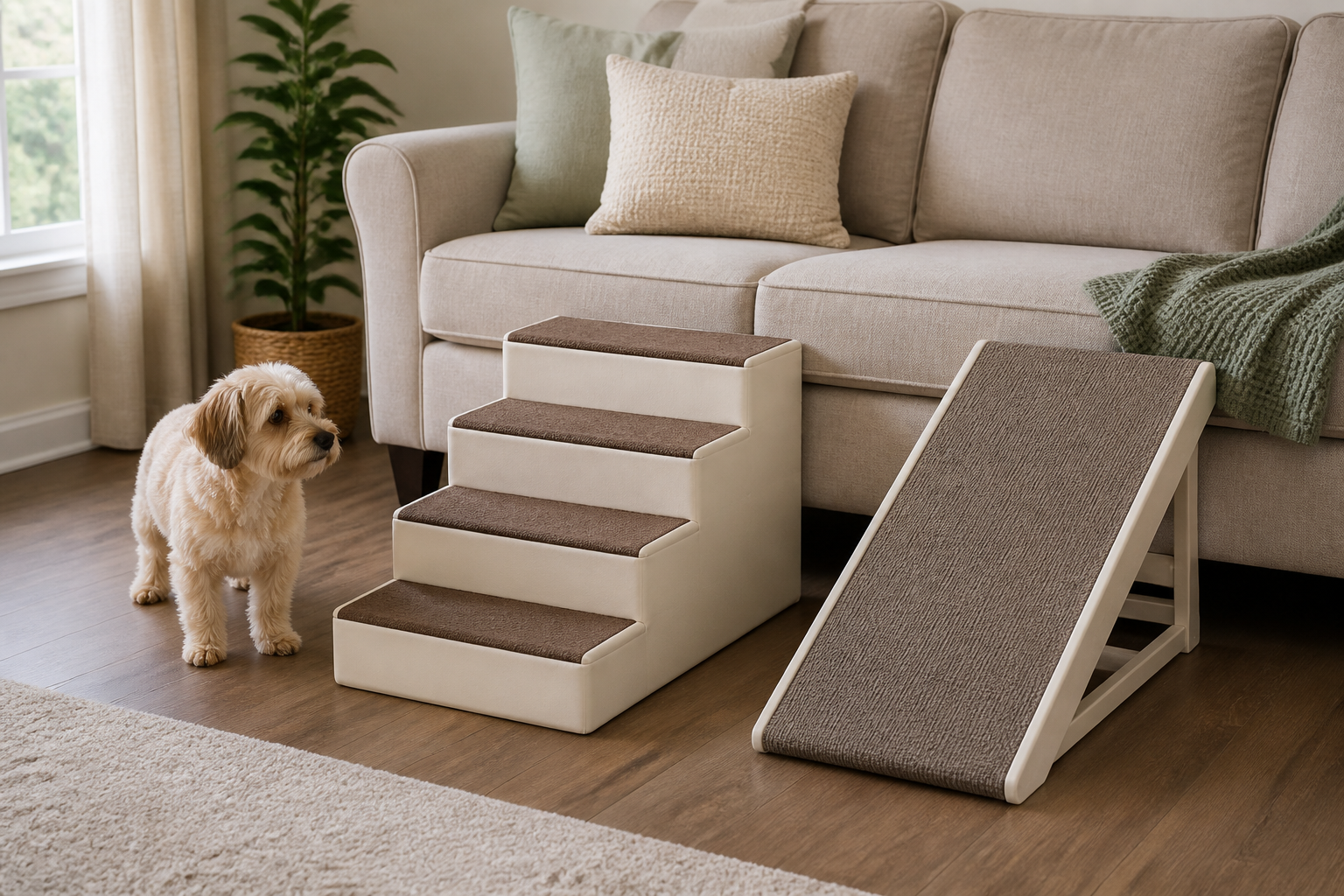
This is a category decision guide, not a hands-on review or medical recommendation. Steps and ramps are convenience products: they do not diagnose, treat, or prevent pain, arthritis, injury, weakness, or other mobility problems.
Quick Decision: Buy, Skip, Delay, Choose an Alternative, or Escalate
Buy when the furniture is a regular destination, the product fits the measured height and floor space, its base stays steady, and your pet approaches it calmly during supervised trials.
Skip when a low pet bed or floor-level rest area already works, the only placement blocks a walkway, or your pet jumps off the side, freezes, chews, or repeatedly avoids the product.
Delay until you have measured the furniture and room, checked current product limits and care instructions, and decided where the item will stay. A route that is usually folded away will not help when the pet needs it.
Choose an alternative when lowering the resting area, restricting furniture access, adding a non-slip rug to the normal floor route, or using a stable floor-level bed solves the practical problem with less equipment.
Escalate to a licensed veterinarian before relying on access gear if your pet is limping, crying, weak, repeatedly falling, suddenly reluctant to move or jump, recovering from an injury or procedure, or showing another concerning change. Ask the veterinarian what access, lifting, and activity are appropriate for that individual pet.
The Worth-It Test
- One clear destination: Will the product serve a sofa or bed your pet uses often?
- Measured connection: Does the top step or ramp end meet the usable furniture surface without a large gap or awkward final jump?
- Stable footprint: Can the full base sit flat without sliding, rocking, or crossing a busy route?
- Usable geometry: Are the steps deep enough for the pet to place its body, or is the ramp long enough for a manageable slope?
- Traction: Does the surface offer grip without loose covers, sharp texture, or exposed fasteners?
- Calm pet response: Does the pet investigate and use the route without being pulled, pushed, or rushed?
- Maintainable routine: Can you vacuum or wash the surface, inspect the frame, and leave the route available consistently?
Steps vs Ramp: The Practical Tradeoff
Steps usually use less floor length and may fit beside a sofa or lower bed, but short products can hide tall, narrow rises. Check each tread's depth and height rather than relying on the overall product height.
Ramps provide a continuous surface, but a gentle slope takes more room. A compact ramp that reaches a tall bed may be too steep for the pet you hoped would use it. Do not assume “ramp” automatically means easier.
Pet size alone does not settle the decision. Body length, confidence, normal movement, paw grip, and the room layout all affect fit. A qualified veterinarian should guide the plan when medical or recovery needs are involved.
Cost, Maintenance, and Setup Tradeoffs
The real cost includes the footprint and routine, not just the purchase. Foam steps can be lighter to move but may compress or attract chewing. Framed steps and ramps may feel steadier but can be heavier and harder to store. Folding hardware and adjustable joints add parts that need inspection.
Measure before buying, then confirm the maker's current dimensions, weight limits, setup instructions, and return policy. Check whether a cover removes without dismantling the product and whether it can be washed and dried with your normal laundry. Wipe hard surfaces, remove fur and grit from tread material, and stop using anything with loose fabric, cracked parts, wobble, exposed fasteners, or a damaged non-slip base.
Who Should Skip Steps or Ramps
Skip access gear as a product-only answer for sudden movement changes, pain, weakness, repeated slipping, or falls. Also skip it when the pet cannot be supervised during introduction, the route sits beside a drop or other hazard, or people are likely to trip over it at night.
Destructive chewers and pets who leap from the side may need a different room setup. Do not force a frightened pet onto the product or lure it into a jump it is not comfortable making.
Red Flags Before Buying
- The listing gives only total height and omits step depth, individual rise, ramp length, or product footprint.
- The product would end below the destination and still require a difficult final jump.
- The surface is slick, the cover appears loose, or the base lacks a credible anti-slip setup for your floor.
- The proposed ramp is very short for a tall surface.
- The item blocks a doorway, bedside route, drawer, closet, or emergency exit.
- Marketing promises to treat pain, prevent injury, or solve a mobility condition.
- The maker's limits, assembly directions, replacement-cover details, or care instructions are unclear.
Cheaper Alternatives and Better First Moves
A stable floor-level bed beside the household may preserve a comfortable resting choice without adding a climb. Moving an existing pet bed, lowering the destination where practical, or limiting furniture access can be simpler than training around a bulky product. A non-slip floor runner can improve the approach to a resting area, but it does not make an unsuitable step or steep ramp safe.
If the category passes this test, compare measured formats in Best Pet Steps and Ramps for Sofas and Beds. For vehicle loading specifically, compare roll-up and folding pet ramps by packed shape and setup. For the broader room decision, use How to Choose a Pet Bed for Small Spaces, the closest current comfort-and-home-setup pillar.
Bottom Line
Pet steps or a ramp are worth it only when the product fits the furniture, floor space, cleaning routine, and pet's calm observed behavior. Steps tend to suit tighter floor plans; ramps need enough length to offer a usable slope.
Skip or delay when the room fit is improvised, the pet refuses the route, or a lower resting area solves the same problem. When movement has changed or pain may be involved, put the purchase on hold and ask a licensed veterinarian what is appropriate.