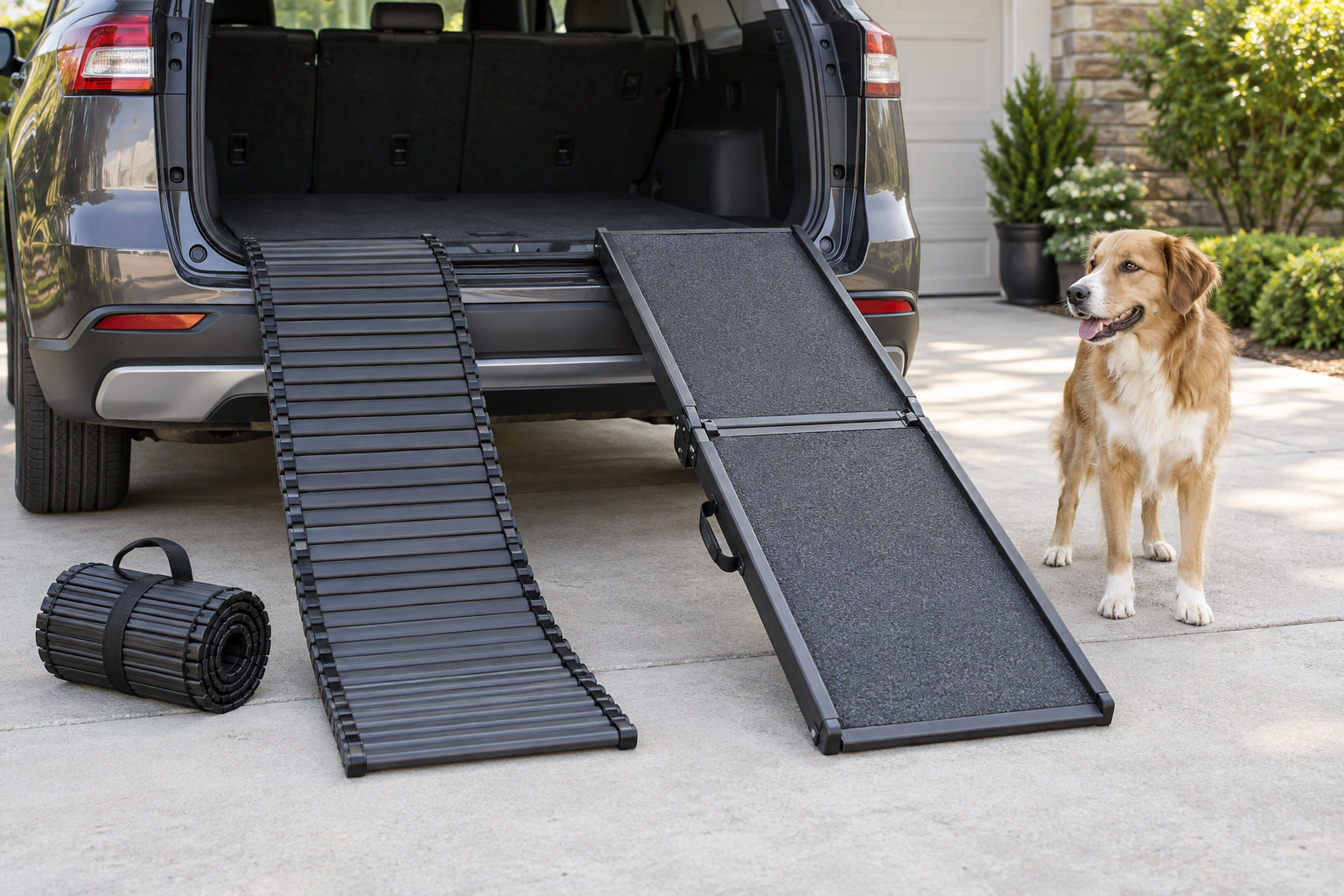
This comparison assumes the pet is already comfortable moving and has been cleared for ramp use when health or mobility is uncertain. A ramp is a convenience tool; it does not treat pain, prevent injury, or replace veterinary advice.
Quick Decision
- Choose roll-up when the bundled diameter and length fit a narrow storage area, and every support and attachment can be checked during setup.
- Choose folding when a flat rigid package fits the vehicle and a hinged deployment routine is easier for you to control.
- Skip both when the ramp would be too short for the loading height, lacks secure vehicle contact, exceeds your comfortable carry weight, or the pet refuses it.
Deployed Geometry Comes First
Measure from the ground to the actual loading surface and measure the clear ground run behind or beside the parked vehicle. Compare those numbers with the maker's deployed length and supported-height guidance. A compact ramp can create an impractically steep approach; the word “portable” does not settle whether the geometry fits.
Check usable width, raised edges, gaps, top contact, and the transition into the cargo floor or seat area. Use only a maker-permitted vehicle contact point, park on stable level ground, secure the vehicle, and keep the ramp away from traffic.
Roll-Up Storage and Setup
A roll-up design can turn a long surface into a narrow bundle. That can suit a deep cargo cubby or the space behind a seat, but packed diameter, straps, and loose components still need room. Look at how the slats or sections are supported when deployed and whether the instructions require separate rails, braces, straps, or attachment pieces.
Count the real setup steps. A format that packs neatly but is awkward to align, tension, or secure may not fit a frequent-trip routine. Inspect connections, slats, straps, tread, and end contacts before each use; stop if anything is loose, cracked, bent, or damaged.
Folding Storage and Setup
A folding ramp usually remains a broad panel with one or more hinges. A bi-fold model may be quick to open but long when stored. A tri-fold may shorten the package while adding thickness, weight distribution changes, and another joint to manage. Measure the folded object rather than assuming it fits because the cargo area looks large.
Check how the panels lock or stay open, where hands go during deployment, and whether the carry latch can release unexpectedly. Keep fingers, paws, fur, and leashes clear of hinges. Never modify the hinge or use the ramp contrary to its current instructions.
Surface, Rigidity, and Pet Response
Compare the current tread material, texture, gaps, edge design, and cleaning directions. Roll-up slats may feel and sound different underfoot from a continuous framed panel. Folding designs may have transitions at their joints. Neither construction is automatically steadier; that depends on the complete product, correct setup, load, surface, and condition.
Introduce any new ramp at ground level in a calm place before approaching the vehicle. Do not pull, force, or lure a hesitant pet onto a deployed ramp near traffic. If the pet freezes, scrambles, jumps off, or seems uncomfortable, stop and reassess.
Weight, Carrying, and Cargo Restraint
Product weight matters twice: while you position the ramp and while it rides in the vehicle. Compare the handle location and whether you can lift the packed ramp without losing control. Secure it according to appropriate vehicle and product guidance so it does not become loose cargo.
Check the maker-stated load limit and all usage conditions rather than selecting from pet weight alone. Do not infer capacity from appearance, materials, or category. Account for the complete instructions and inspect the ramp routinely.
Cleaning and Weather
Review maker directions for brushing, washing, rinsing, and drying the tread, frame, slats, straps, and hinges. Mud or moisture can change grip and can hide wear. Let every part dry as directed before rolling or folding it for storage, and do not assume weather resistance without an explicit current label.
Who Should Skip a Roll-Up Ramp?
Skip it when assembly is easy to misread, loose pieces are hard to track, the rolled bundle does not stay secured, or the flexible/slatted feel unsettles the pet. It is also a poor fit when the supports cannot sit correctly at the measured vehicle height.
Who Should Skip a Folding Ramp?
Skip it when the folded panel is too large or heavy to handle, hinges create difficult pinch points, the carry latch is unreliable, or you cannot open it without entering the roadway or crowding the pet.
Red Flags Before Buying
- Deployed length, usable width, packed dimensions, product weight, or maker-stated load limit is missing.
- The listing promises injury prevention, pain relief, universal stability, or suitability for every vehicle or pet.
- Vehicle contact, attachment, hinge or support directions are unclear.
- The tread cannot be cleaned or inspected using published directions.
- Photos hide the approach angle, joints, underside supports, or top transition.
Build the Safer Outing Routine
For the prior category decision, read Are Pet Steps or Ramps Worth It? For vehicle cleanup and containment, compare a dog car hammock with a cargo liner. The outings hub connects carriers, water, walking, cleanup, and travel-storage guides.
If a pet has new stiffness, weakness, pain, reluctance to move, balance changes, or difficulty entering a vehicle, pause the equipment decision and contact a licensed veterinarian. Ask what access method and activity are appropriate before training with a ramp.
Bottom Line
A roll-up ramp prioritizes a narrow bundled shape but may add flexible components and setup checks. A folding ramp prioritizes a rigid hinged surface but stores as a broad panel and introduces hinge handling. The better format is the one whose deployed geometry, packed size, weight, setup, surface, and current instructions fit both your measured vehicle and the pet's calm response.