Quick Answer
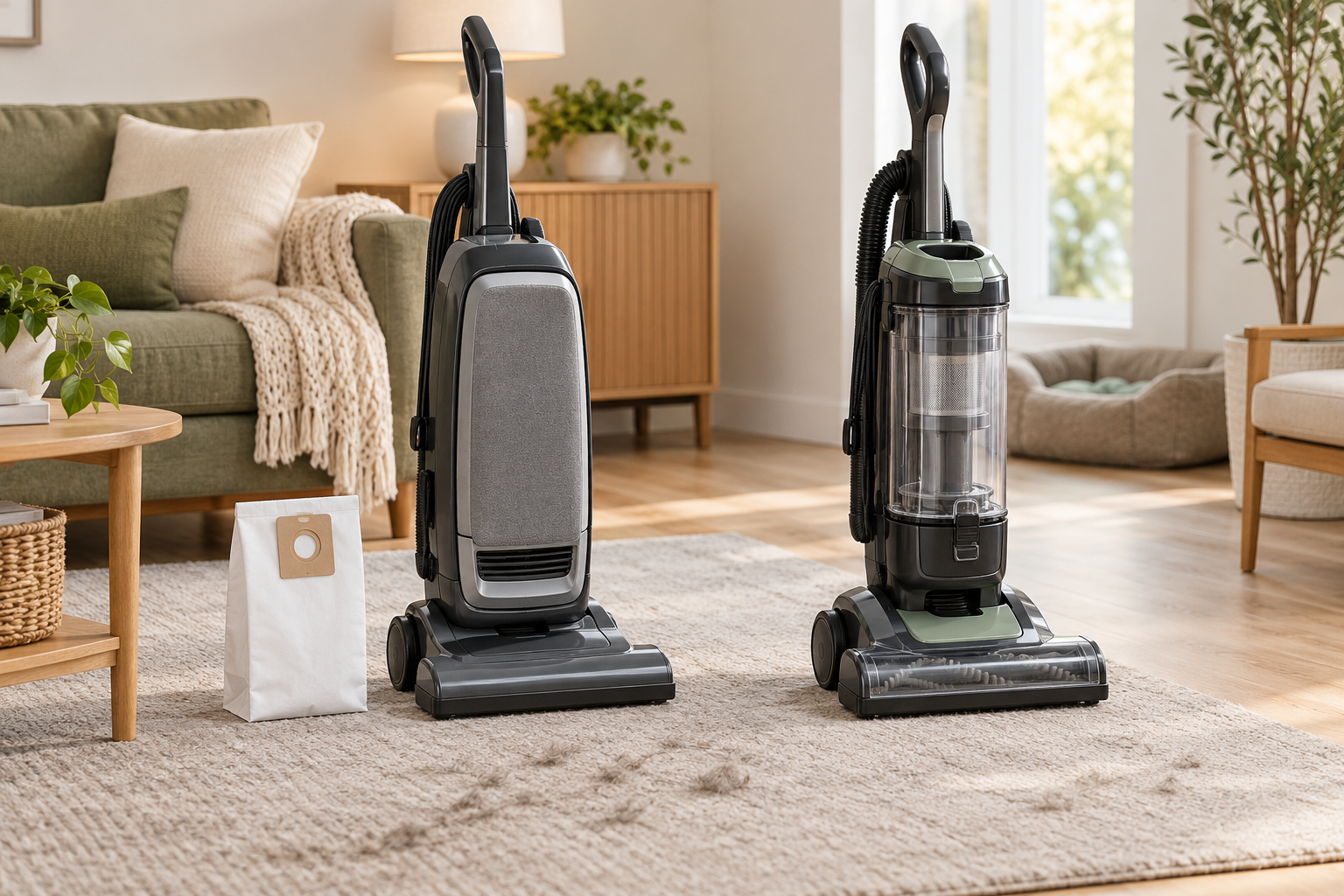
Bagged: collected debris stays in a replaceable bag that you remove according to the manual. This suits households willing to store the exact compatible bags and reorder them before they run out. Check how the bag attaches, whether the machine indicates a full bag, and whether the bag is readily available for that model.
Bagless: collected debris goes into a reusable bin that you empty and clean as directed. This suits households willing to handle the open bin, inspect fill lines, and keep up with filter and seal care. A visible bin does not prove suction, filtration, or air-quality performance.
Neither format wins by itself. Floor-head design, approved surfaces, operating weight, cord or battery routine, attachments, filters, replacement parts, and storage can matter more than the collection system. Pet hair also varies by surface and home; no format guarantees pickup.
Who Each Format Fits—and the Tradeoffs
A bagged vacuum fits a planned replacement routine
Bagged machines make sense when you prefer to remove one closed collection piece instead of tipping loose debris from a bin. The tradeoff is an ongoing supply: the bag must match the exact model, be stored somewhere dry, and be available when needed. Do not substitute a bag merely because it looks similar.
A bagless vacuum fits visible fill checks
Bagless machines make sense when you want to see the debris level and reuse the collection bin. The tradeoff is direct bin care: emptying can release loose hair or dust, and the manual may require cleaning and complete drying of specific parts. Never wash a filter, cyclone, motor housing, or electrical part unless the manufacturer explicitly allows it.
| Decision point | Bagged | Bagless |
|---|---|---|
| Fullness check | Indicator or manual inspection, depending on model | Visible fill line or manual check |
| Recurring supplies | Compatible replacement bags; filters may also be required | Usually no debris bag; replacement filters or other parts may still be required |
| Emptying work | Remove and dispose of the bag as directed | Open, empty, inspect, and clean the bin as directed |
| Storage | Machine plus a dry supply of correct bags | Machine plus drying space for washable parts, when applicable |
| Best fit | People who prefer planned, contained replacements | People comfortable with frequent visible checks and bin care |
A Labeled Hypothetical Consumables Worksheet
This worksheet is a planning example, not a price forecast or product test. Use the exact maker's instructions and your own observed replacement interval.
- Record the exact bag and filter part numbers before buying the machine.
- Observe how many bags your household actually uses over a representative eight-week period; do not assume a universal interval.
- Calculate estimated annual bag use = observed bags used ÷ observed weeks × 52.
- Example only: if a household uses 2 bags in 8 weeks, the estimate is 2 ÷ 8 × 52 = 13 bags per year.
- Multiply by the current per-bag cost from an approved seller, then add only the filters or parts the manual schedules. Keep bagless filter replacement and cleaning time in the comparison too.
Recalculate if shedding volume, floor area, cleanup frequency, occupants, or the machine changes. Never keep operating past a fill line or replacement instruction just to meet an estimate.
Setup and Maintenance Checks
- Before purchase: locate the current manual and official parts list. Confirm approved surfaces, operating weight, machine dimensions, bag or bin capacity as stated, filter locations, replacement identifiers, cord or battery instructions, and warranty terms.
- Before each use: inspect the bag or bin, filters, floor head, hose, cord, and attachments as the manual directs. Remove loose objects and keep pets away from moving parts, cords, and operating noise.
- For a bagged machine: seat the specified bag correctly and replace it at the maker's trigger. Do not reuse a disposable bag unless its instructions explicitly permit reuse.
- For a bagless machine: empty at the stated line and in the manner directed. If parts are washable, let them dry for the full stated period before reassembly.
- For either: cut or remove wrapped hair only with the machine unplugged or otherwise made safe exactly as directed. Replace damaged seals, filters, bags, bins, hoses, or brush parts with compatible components.
Manufacturer manuals are the primary source for model-specific upkeep. For example, Miele's official parts and accessories route illustrates why bag and filter identity must be checked by model. Dyson's vacuum support route is provided so readers can locate model-specific bagless maintenance guidance, but it returned HTTP 403 to our retrieval tool on October 30, 2026, so this page does not claim to have reviewed its current contents. A manufacturer source documents its own products; it does not prove that every bagged or bagless vacuum behaves the same way.
Who Should Skip Each Format?
Skip a bagged vacuum when compatible bags are difficult to identify or reliably obtain, you cannot store replacements, or recurring supply tracking will not happen.
Skip a bagless vacuum when opening and emptying a debris bin is impractical, you lack a suitable place to perform the maker-approved cleaning routine, or washable parts cannot dry fully before the next use.
Skip buying either when your existing vacuum already handles the measured surfaces and hair load, a manual tool works for the small recurring area, the proposed machine is too heavy or large for the route, or replacement parts and instructions cannot be verified. If dust exposure is a health concern, ask an appropriate healthcare professional about your situation rather than treating a collection format as medical protection.
As an Amazon Associate, The Good Petly earns from qualifying purchases.
Compare the Two Formats Only After the Routine Fits
These are category routes, not named winners or hands-on results. Verify the exact model's manual, surfaces, bags or bin, filters, parts, operating weight, dimensions, and storage before buying.
 Compare bagged vacuum formatsCheck exact bag and filter identifiers, full-bag indication, surface guidance, weight, parts supply, and storage.Category routeCompare bagless vacuum formatsCheck fill line, emptying steps, filter and seal care, approved washing, drying time, weight, and storage.Keep the tool you haveSkip a new machine when an existing vacuum or manual hair-removal tool already handles the recurring area.
Next Steps for Pet-Hair Cleanup
Once collection format is settled, compare a corded and cordless vacuum by power routine and reach, or decide between a robot and cordless vacuum by automation and direct control. For stairs and upholstery, use the vacuum attachment chooser. Browse the cleanup guide hub for manual alternatives.
Bottom Line
Choose bagged when a contained replacement and reliable supply of exact bags fit your routine. Choose bagless when visible fill checks and reusable-bin care fit better. Compare the whole machine—not just the collection label—and keep your current tool when neither format solves a measured gap.