Quick Answer
Choose a washable-prefilter format when visible fur and dust reach the intake and you want an accessible first layer, provided the exact prefilter is actually washable and can dry fully as directed.
Choose a carbon-filter format when you want a documented carbon stage and accept its replacement cost. Carbon media is not a substitute for removing litter waste, laundering bedding, ventilating appropriately, or cleaning the odor source.
Choose a sensor-equipped format when automatic fan changes fit the room and the product explains what its sensor measures. A changing display is not a diagnosis of indoor air quality or a health result.
An air purifier handles moving air; it does not pick up fur already on floors and fabric. For that job, compare pet-hair removers for soft surfaces or robot-vacuum formats for small homes.
Start With Verified Room Sizing
Measure the room’s floor area and note ceiling height, door position, furniture, and the only realistic appliance locations. Then compare those measurements with current manufacturer documentation and, where available, an independent listing such as the AHAM Verifide air-filtration standards guidance.
Clean Air Delivery Rate, or CADR, is reported separately for smoke, dust, and pollen in the AHAM framework. A single vague “covers up to” claim does not tell you the test method, assumed operating time, fan setting, or air-change target. Look for the actual rating and method, and avoid extrapolating a small-room rating to a larger open plan.
Do not buy by the word “pet” alone. It does not establish independent performance, quiet operation, filter life, or fit for your room. This guide does not rank named models because those specifications, filter routes, and certifications need current item-level verification.
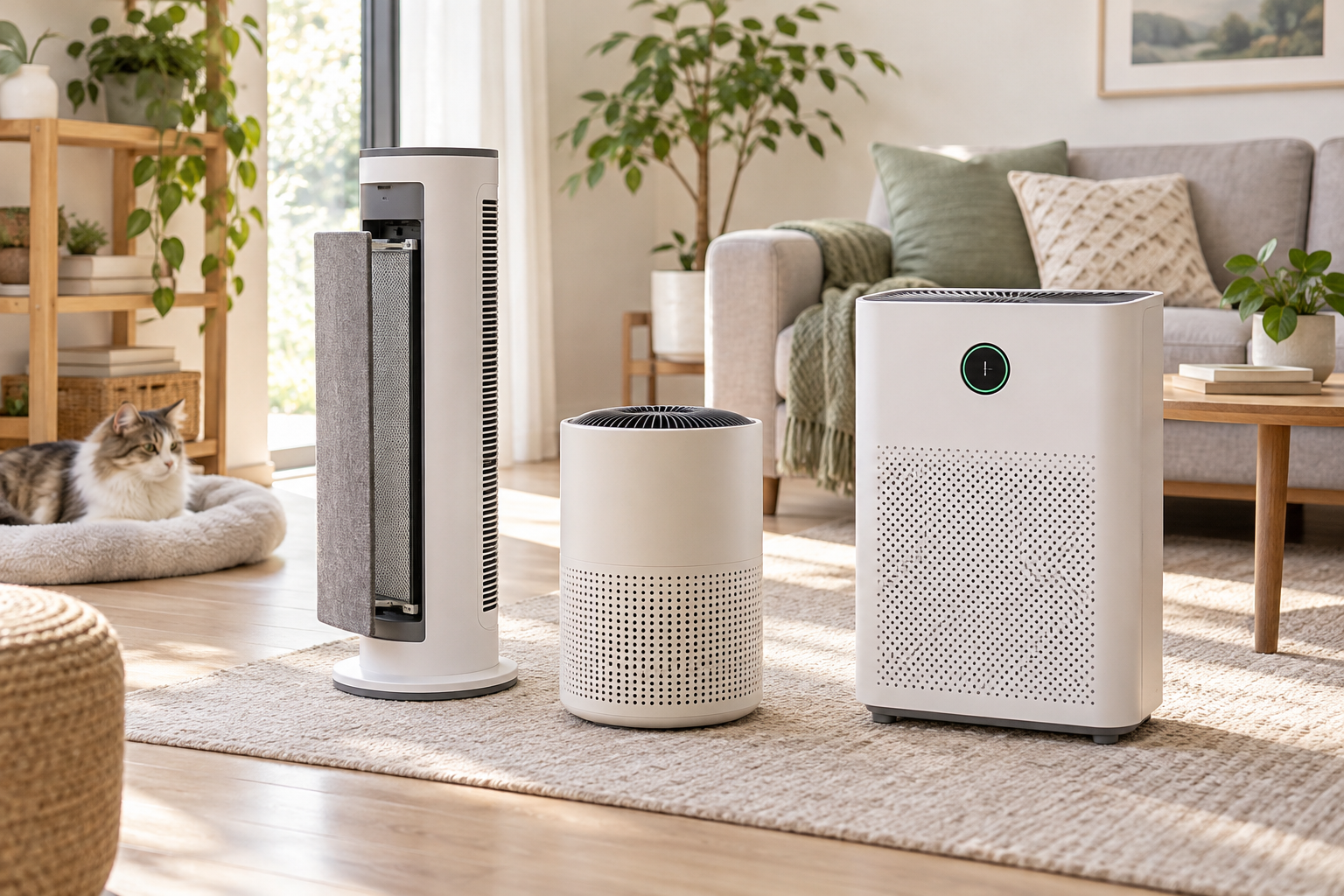
How the Three Formats Differ
Washable-prefilter formats
An accessible prefilter can catch larger debris before it reaches inner filters, but only wash a component that the exact manual identifies as washable. Compare how it releases, whether handling sheds debris, where it can dry, and whether the purifier must remain off while the part is out. A washable outer layer does not mean every filter in the unit is washable.
Carbon-filter formats
Carbon media is an added consumable, not a promise to erase every pet or household odor. Compare the documented filter stack, replacement part number, replacement guidance, sealed storage needs, and whether the unit combines carbon with other filters. Source cleanup still comes first: empty waste, wash compatible textiles, and address damp or soiled materials directly.
Sensor-equipped formats
A sensor can change fan speed or report a reading, depending on the exact design. Check what it detects, where it is located, how it is cleaned, whether the display can dim, and whether automatic mode can be overridden. Skip the premium if you would run a steady manual setting and never use the additional controls.
Plan for Intake Clearance, Noise, and Pets
Use the manufacturer’s required intake, outlet, wall, curtain, and furniture clearances. Do not tuck the unit into a corner merely because the footprint fits. Measure the body, the space needed to remove filters, and the route needed to carry filters without brushing debris across the room.
Place the appliance on the supported surface, keep its cord out of chewing and traffic paths, and do not let bedding, curtains, toys, or fur mats block openings. Give pets a quiet place away from moving air and fan noise. Stop using the setup if a pet is distressed or repeatedly interferes with it; a qualified behavior professional can help with persistent reactions.
Compare sound information at the fan settings you expect to use, not only the lowest setting. In a bedroom or home office, display brightness and control sounds can matter as much as the published decibel figure. If the room cannot provide the required clearances without creating a trip or chew hazard, skip the appliance.
Count Filter Care and Ownership Cost
- Current filters: Identify every filter, its part number, current replacement route, and the maker’s maintenance instructions before buying.
- Access: Check whether panels and filters can open in the planned location without moving heavy furniture.
- Indicators: Learn whether a filter light is a timer, a sensor-based estimate, or another mechanism, and follow the manual rather than appearance alone.
- Energy and controls: Compare rated power, fan settings, schedules, Wi-Fi or account requirements, and whether core controls work without an app.
- Cleaning boundaries: Never wet a non-washable filter or reinstall a washable part before it is fully dry under the maker’s directions.
- Source cleanup: Keep vacuuming compatible floors, removing hair from fabrics, laundering washable pet items, and cleaning litter or accident areas appropriately.
Price the appliance and a realistic supply cycle together. A compact unit with hard-to-find filters can be a worse fit than a slightly larger unit with documented, obtainable replacements. Prices and availability change, so verify them on the current product and manufacturer pages.
Who Should Skip an Air Purifier?
Skip one for now if you cannot verify room sizing, replacement filters, required clearances, or a cord-safe location. Also skip it if the budget would be better spent fixing an active moisture problem, cleaning a recurring source, or maintaining an existing vacuum and washable textiles.
Do not use an air purifier as a treatment plan for a person or pet. If someone has breathing symptoms or allergy concerns, speak with an appropriate licensed clinician. If a pet has coughing, breathing difficulty, nasal discharge, skin irritation, or another concerning change, contact a veterinarian; an appliance cannot diagnose or treat the cause.
People considering ozone-generating devices or ionizing features should review current public-health guidance and the exact product documentation rather than assuming “air cleaning” means risk-free. This guide focuses on filter-based room purifiers and does not recommend ozone generation.
Related Cleanup Guides
Start with direct source cleanup using the soft-surface pet-hair remover guide. For automated floor pickup, compare robot vacuums for small pet homes. If the problem is a specific recurring smell, use the small-apartment odor-control guide to identify the source before adding another appliance.
Bottom Line
The best small-room air purifier is the format whose independently supported room rating, filter upkeep, sound, dimensions, and clearances fit the actual room. A washable prefilter can simplify large-particle care, carbon media adds a replaceable layer, and a sensor adds automation—but none replaces removing pet hair, cleaning odor sources, or seeking professional help for health concerns.