Quick Answer
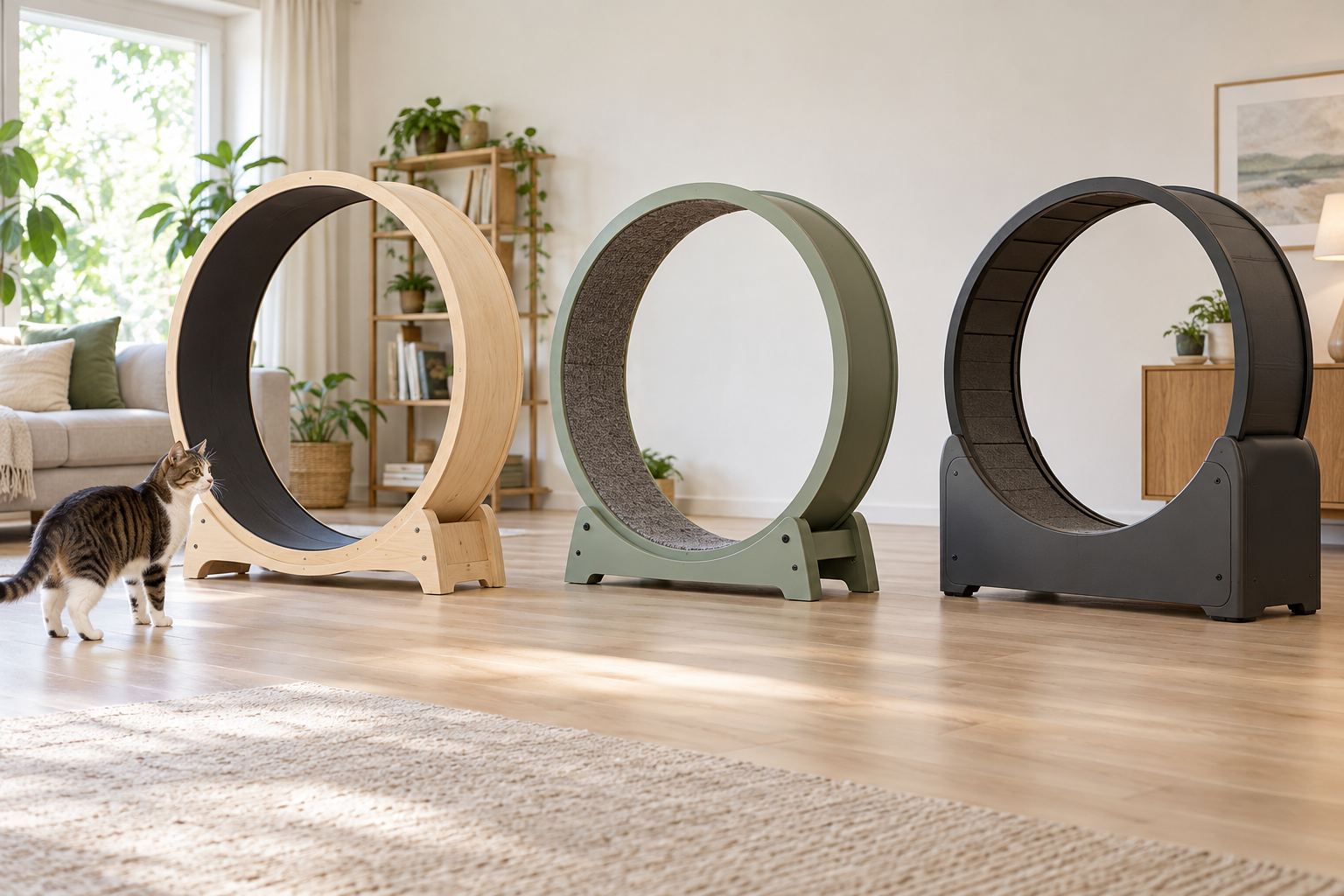
Compare a solid track when simple surface cleaning is the priority. Compare a carpet track when you can verify secure attachment, replacement availability, and a realistic cleaning routine. Compare a guarded base when its housing reduces exposed access around the support area without hiding parts you need to inspect.
No format is automatically appropriate for every cat or room. Do not choose by a photo, an “XL” label, or a broad quiet claim. Verify the exact current measurements, maker guidance, assembly requirements, clearances, and return terms. Never place, hold, lure, or confine a cat on a moving wheel.
Measure the Room Before Shopping
Record the available floor width and depth, wall height, baseboard projection, and the nearest furniture, door swing, curtain, cord, vent, shelf, and walkway. Compare those numbers with the product’s complete assembled footprint—not only the wheel diameter. Include the clearance the maker requires around the sides, rear, and moving rim.
Plan a level indoor location where the wheel cannot block an exit or tip into a traffic path. The floor must match current maker instructions. A rug, mat, shim, wall anchor, or improvised brace should not be added unless the maker specifically permits it for that model and surface.
How the Three Formats Differ
Solid track
A continuous track may avoid removable fabric edges and can make routine wiping straightforward when the stated material and care directions support it. Compare surface traction, panel seams, joint alignment, finish, cleaning products, and how the track is repaired or replaced if damaged.
Carpet track
A textile-like running strip changes grip and upkeep. Confirm whether the material is permanently attached, hook-and-loop mounted, or installed another way; whether replacement pieces are sold for the exact model; and whether edges, fasteners, or lifted sections can be reached during inspection. Follow the stated washing and drying method rather than assuming the track is machine washable.
Guarded base
A larger housing may cover part of the support or roller area, but “guarded” is not a universal construction standard. Inspect listing images and instructions to learn what remains open, where paws and tails could approach, and how covers are removed for cleaning and maintenance. More enclosure can also mean a larger footprint and more disassembly.
Buying Criteria That Matter
- Inner diameter and track width: use exact current maker guidance for intended cat size; do not infer fit from the outer diameter.
- Complete footprint: include the base, supports, rim, guards, fasteners, and required operating clearance.
- Base and floor contact: confirm the approved floor types, leveling instructions, and whether anti-slip parts are included.
- Track construction: check seams, edges, texture, attachment, cleaning directions, drying, and replacement availability.
- Moving areas: identify gaps, rollers, joints, and access points specified in the instructions, and keep children and other pets away during setup or use.
- Assembly: compare package weight, component size, tools, fastener sequence, leveling checks, and whether two adults are recommended.
- Noise: treat “quiet” as seller wording, not a measured promise. Review the design, placement directions, adjustment steps, and return terms.
- Inspection: make sure you can see and reach every maker-identified wear point without improvised disassembly.
- Returns and parts: check return conditions before assembly and look for an exact-model track, roller, fastener, or panel route.
A Conservative Setup and Inspection Routine
Inventory the unopened parts against the instructions, then assemble the wheel exactly as directed in the final measured location. Before a cat enters the room, check alignment, fasteners, base contact, clearances, track attachment, rim movement, and any stop or lock described by the maker. Keep packaging until the allowed fit check is complete.
Allow the cat to approach or leave freely. Do not put the cat onto the wheel, restrain the cat near it, force movement, or use food in a way that keeps the cat on equipment it is trying to leave. Stay close enough to stop access according to the maker’s directions if the wheel shifts, makes a new sound, or the cat appears hesitant or distressed.
Before each session, check for loose fasteners, track lift, cracks, rubbing, wobble, unexpected resistance, sharp edges, debris, or a changed gap. Stop use and follow maker support guidance when anything changes. Clean only as directed and let every part dry fully before access resumes.
Who Should Skip a Cat Wheel?
Skip it when the room or return plan is uncertain. A wheel consumes substantial assembled space; a cat tunnel, wand-toy routine, climbing setup, or puzzle product may be easier to store and rotate.
Skip it when you cannot supervise voluntary access. A wheel is not an unattended activity station, a training shortcut, or a guaranteed way to change weight, boredom, anxiety, sleep, or behavior.
Skip it when the cat avoids moving equipment or the household cannot keep other pets and children clear. Cat preference matters, and an expensive product need not be made to “work.”
Ask a veterinarian before considering a wheel for a cat with pain, limping, weakness, balance changes, breathing difficulty, a recent procedure, mobility limits, or a weight-management need. A product page cannot diagnose a problem or prescribe activity. Stop and contact a veterinarian if movement, gait, breathing, or willingness to move changes.
Related Indoor Enrichment Guides
For a smaller moving product, compare automatic cat-toy mechanisms by floor clearance, parts, controls, noise, and cleaning. If a food-based activity is appropriate for the cat, use the cat puzzle feeder guide. For low-tech chase play, compare cat wand-toy formats and keep every session supervised.
Bottom Line
The best cat exercise wheel is the format that fits the measured room and current maker guidance, remains stable and inspectable, has a track you can maintain, and allows the cat to choose whether to engage. Compare solid, carpeted, and guarded-base formats for those practical differences—not for promised exercise, weight, or behavior outcomes.