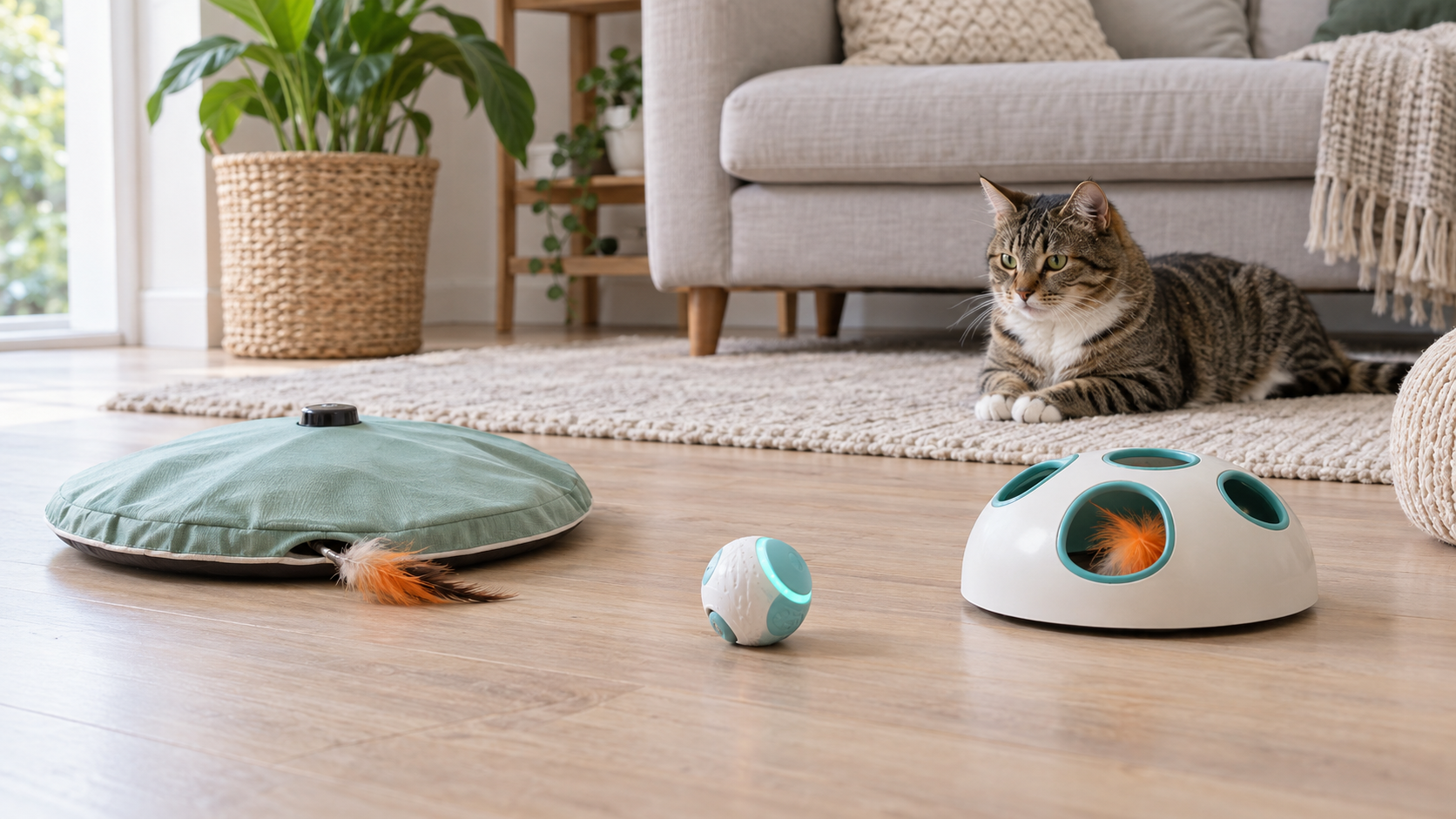
This guide is a category-level buying framework, not a claim that every automatic toy is safe for every cat. Automatic movement can startle some cats, and feathers, strings, wands, covers, wheels, or battery doors can become damage points. Stay close enough to switch the toy off, inspect it before and after each session, and follow the current maker’s directions.
Quick Comparison: Match the Mechanism to the Room
Rolling motion toys: for clear hard floors
A rechargeable rolling ball can change direction without a large base, but its route is less predictable. Measure the gap beneath furniture, remove cords and fragile objects, and check whether the toy can reach stairs, vents, water bowls, or another pet’s resting area. A rolling toy is a poor fit when the room cannot be cleared or your cat immediately tries to bite or trap it.
Concealed-wand toys: for a defined play spot
This format moves a wand or lure beneath a fabric cover. The base stays in one place, which can simplify room setup, but the cover and the point where the lure emerges need close inspection. Look for a cover that sits flat, a battery compartment your cat cannot open, accessible controls, and a clear replacement route for worn lures.
Multi-opening motion toys: for changing sight lines
A covered base may present a moving lure through different openings. Compare the opening edges, base stability, noise, and whether hair and debris can be removed without dismantling the motor housing. Skip loose feather or string attachments when your cat pulls, chews, or swallows toy material.
Selection Criteria That Matter
- Motion and controls: Prefer clearly labeled modes and a stop control you can reach immediately. Treat timers as convenience features, not permission to leave the session unattended.
- Room fit: Measure the toy and clear its likely path. Rolling formats need more open floor than stationary covered formats.
- Loose parts: Check wands, feathers, strings, covers, wheels, fasteners, and battery doors before and after play. Retire damaged parts rather than improvising a repair.
- Power setup: Confirm whether the current model uses replaceable batteries or charging, where the port or door sits, and what the maker says about charging and storage.
- Noise: Manufacturer sound claims are hard to compare across rooms. Use return terms as part of the decision if your cat is cautious around motors or sudden movement.
- Cleaning: Hair and dust collect around wheels, openings, fabric edges, and moving shafts. Choose surfaces and removable pieces you can clean according to the maker’s instructions.
- Storage: Put the toy away after the session so you can control access, protect attachments, and notice damage before its next use.
Plan a Short, Calm First Session
Set the toy on the surface the maker allows, clear the surrounding area, and let your cat observe it from a distance. Start with the gentlest available setting rather than putting the toy beside the cat. Stop if your cat hides, freezes, pants, vocalizes unusually, repeatedly swats without disengaging, or tries to chew or dismantle the mechanism. Do not force interaction.
Automatic toys are one optional part of enrichment, not a substitute for attentive play or a solution for anxiety, aggression, destructive behavior, or a sudden activity change. If play behavior changes abruptly or you are concerned about distress, pain, vision, coordination, or compulsive behavior, contact a veterinarian or qualified feline behavior professional.
For a broader framework covering difficulty, materials, cleaning, and temperament, read how to choose pet toys for supervised enrichment. A simple toy rotation bin can also keep powered toys stored between sessions and separate from loose attachments.
Who Should Skip an Automatic Cat Toy
Skip this category if you cannot supervise the full session, the play area has stairs or hazards you cannot block, or your cat routinely chews and swallows strings, feathers, fabric, foam, or plastic. A manual wand used with careful control, a sturdy static toy, a cardboard box, or a measured cat tunnel may be simpler—but loose wand toys still need supervised use and secure storage.
Also pause the purchase for a cat who is fearful of motors or sudden motion, becomes tense around moving toys, or has a health or mobility concern that changes how they play. Ask your veterinarian about appropriate activity when pain, injury, illness, balance, or mobility is in question.
The Bottom Line
Choose by mechanism, not novelty. A rolling toy needs a clear route; a concealed-wand toy needs a sound cover and attachment point; a multi-opening toy needs smooth openings and easy debris access. Whichever variety you consider, verify current specifications, supervise every session, stop at distress or rough dismantling, and store the toy after use.