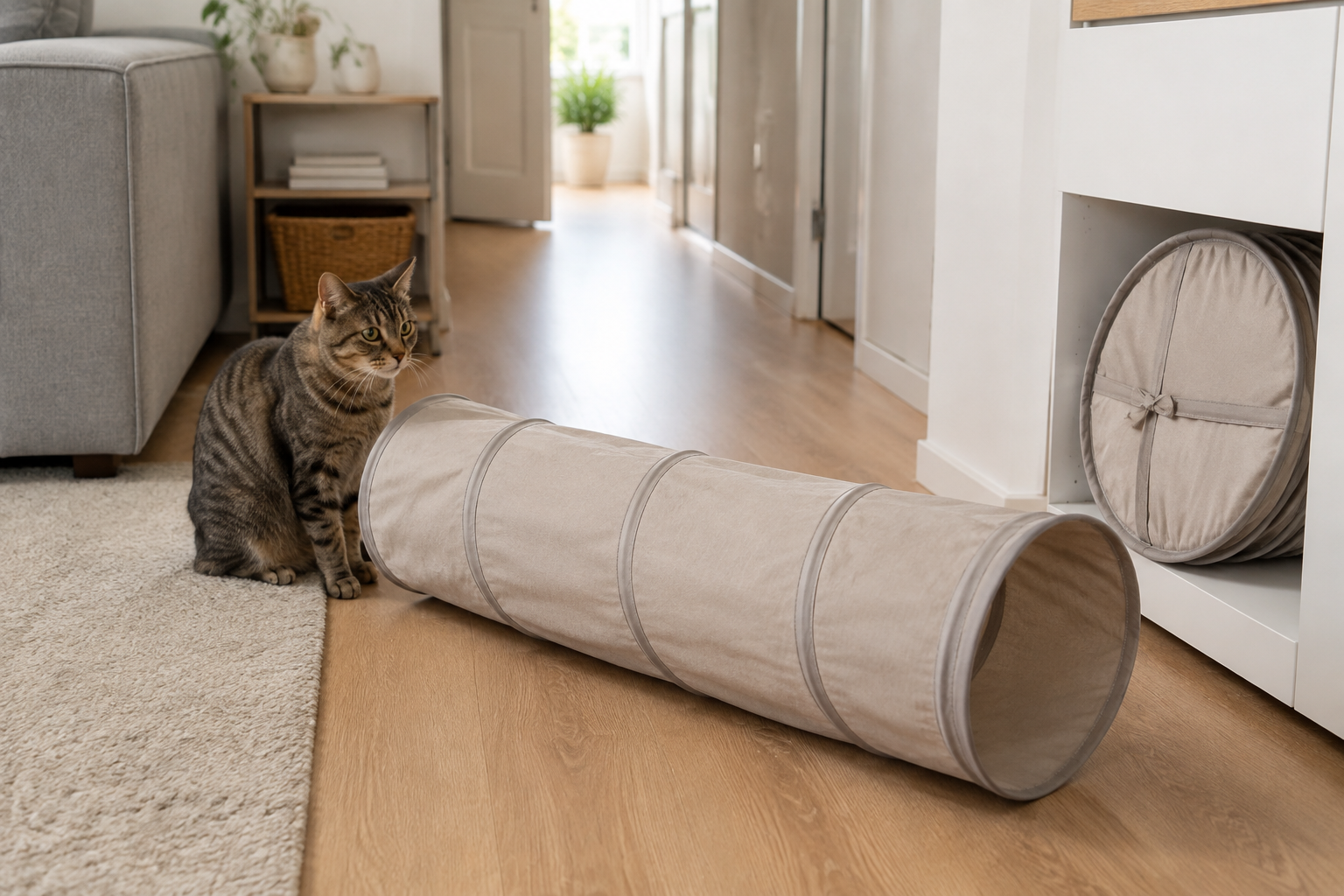
This is a buying-decision guide, not a claim that a tunnel will change a cat's behavior. A tunnel is a convenience item for supervised play and temporary cover. It does not treat inactivity, anxiety, conflict, pain, or another health or behavior concern.
Quick Verdict: Buy, Delay, Repurpose, or Skip
- Buy: your cat repeatedly uses open boxes, paper bags with handles removed, furniture gaps, or other safe open-ended cover during play; you have measured both the play zone and storage spot.
- Delay: you do not yet know which play style your cat prefers or where the tunnel can open without blocking a route.
- Repurpose: try a clean, stable cardboard box with two large cut openings to observe interest before buying. Remove staples, tape loops, sharp edges, and damaged cardboard.
- Skip: your cat chews fabric, string, elastic, foam, or frame coverings; dislikes enclosed objects; or the only available location is a doorway, stair landing, or busy walkway.
The Five-Part Small-Apartment Test
- Observed use: Does your cat choose hide-and-pounce or run-through play without being placed inside?
- Open footprint: Can the complete shape sit clear of doors, stairs, heaters, feeding routes, litter routes, and human traffic?
- Stored footprint: Do the published folded dimensions fit a shelf, closet, or closed bin without crushing the frame?
- Household sound: Will crinkle fabric be tolerable for your cat, neighbors, sleep schedule, and shared room?
- Upkeep: Can you inspect seams and frame ends, remove fur, follow the maker's cleaning directions, and dry it fully before storage?
Measure the Open Shape, Not Just Its Length
Product photos can make a tunnel look smaller than it is. Mark its published fully open length and widest point on the floor with removable tape. For a curved or multi-arm design, include every branch and the space needed for a cat to enter and leave without meeting furniture immediately.
Then measure the usable opening rather than assuming a label such as “large” fits. Lining, sagging fabric, and frame bands can reduce the clear diameter. Your cat should be able to pass through without squeezing, and both ends should remain unobstructed.
Noise Can Decide Whether It Gets Used
Crinkle lining may interest some cats and send others away. In a studio, bedroom, or home with shared walls, that sound also affects when the tunnel can stay open. If your cat startles at rustling material, a quiet fabric shell is the better category to compare. Do not force, chase, or carry a cat into a tunnel to create interest.
Foldability Only Helps When Storage Is Easy
A tunnel earns small-home space when one person can collapse it according to its instructions and the secured bundle has a predictable home. Loose closure ties, a springy bundle balanced above a shelf, or a tunnel that stays open all week are signs that “foldable” is not solving the room problem.
If daily folding feels unrealistic, a short straight tunnel that can sit safely beside furniture may fit better than a larger branching design. The pet toy rotation guide can help you decide what stays available and what gets stored.
Cleaning and Damage Checks
Follow the manufacturer's cleaning and drying directions; not every fabric tunnel is machine washable. Pay attention to interior seams, frame channels, closure ties, and any detachable pieces. Stop using the tunnel if wire is exposed or bent, a frame end presses through the fabric, seams open, or a small part loosens.
Attached strings, feathers, pom-poms, and elastic require close supervision and may make an otherwise suitable tunnel a poor fit for a cat that chews or swallows loose material. A plain tunnel without dangling pieces is a sensible alternative.
Who Should Skip a Cat Tunnel
Skip it when floor circulation is already tight, when storage depends on an awkward daily chore, or when your cat consistently prefers elevated, open, or scratch-based play. The money may be better directed toward a product that matches observed use, such as a measured scratching surface or a sturdy window-side setup.
A narrow tunnel may also be unsuitable for a cat with mobility limitations, pain, vision changes, or trouble turning. Contact a licensed veterinarian about sudden hiding, reduced activity, appetite changes, signs of pain, or other health changes. For persistent household conflict or distress, seek a qualified cat behavior professional rather than expecting a tunnel to solve it.
Lower-Commitment Alternatives
A clean cardboard box with two generous openings can test interest. A supervised wand-toy session uses almost no permanent floor space, while a small toy rotation can create novelty without another large object. If your cat prefers scratching to enclosed play, compare sisal and cardboard scratchers by orientation, mess, replacement, and placement.
Bottom Line
A cat tunnel is worth it in a small apartment when your cat already shows interest in open-ended cover, the full shape fits a safe temporary play zone, the folded bundle has a convenient home, and the material can be inspected and cleaned. Delay the purchase until those facts are clear, and skip it when a box, wand toy, or smaller activity already matches the routine.