If you are still deciding whether this category earns any floor space, start with the small-apartment cat tunnel worth-it test. It covers likely use, storage, noise, and lower-commitment alternatives before you compare formats here.
This guide compares stated product features and practical formats; it is not based on hands-on testing. A tunnel is a supervised play and hiding accessory, not a treatment for inactivity, anxiety, conflict between cats, or another behavior or health concern. Remove it if your cat chews the fabric or frame, becomes trapped, guards an entrance, or seems uncomfortable.
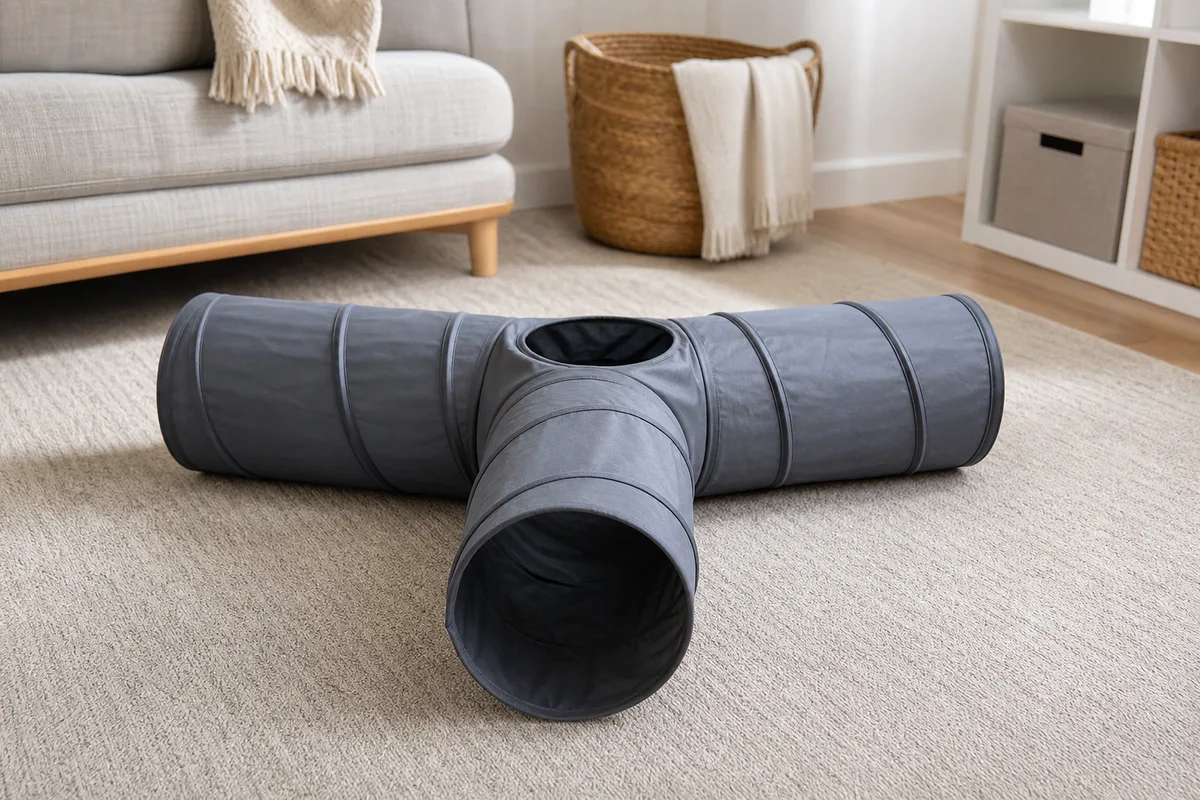
Best Compact Multi-Exit Pick: Prosper Pet Collapsible Cat Tunnel
A three-way tunnel makes sense when the goal is several entry choices without laying one long tube across the room. It can support peek-through, chase, and hide-and-pounce play around one central footprint. Multiple exits are also more practical than a single dead end when two compatible cats use the area, although active supervision still matters.
The tradeoff is a busier frame and more seams to inspect. Measure the whole open footprint, not just one arm. Check the spring-frame ends, stitching, center junction, hanging toys, and closure ties before each session. If an attached toy frays or encourages chewing, remove the tunnel or safely remove the toy only when the manufacturer says it can be detached.
Best for the Smallest Footprint: A Short Straight Tunnel
A short straight tunnel is easier to run beside a sofa, bed, or wall. Both ends stay visible, the interior is simpler to inspect, and there are fewer junctions to collect fur. It is the calmer default when floor space is tight or the tunnel must be opened and stored every day.
Look for an opening comfortably larger than your cat's widest point and enough length to create cover without blocking a walkway. Avoid placing it where someone could step on it, where a door could trap it, or at the top of stairs. A straight tunnel is less interesting for cats that prefer several peek points, but a side window can add visibility without a three-arm footprint.
Best for More Visual Cover: An S-Shaped or Curved Tunnel
A curved tunnel hides one end from the other and can make a simple wand-toy session more engaging without adding loose floor toys. It suits a room with enough open space for the full curve and a cat that likes to pause out of sight before reappearing.
Curves take more room than their listed length suggests and can be harder to vacuum or wipe inside. Choose one with more than one usable exit, accessible interior surfaces, and a collapse mechanism you can secure. Skip a sharply bent or narrow model if your cat is large, cautious about enclosed spaces, or has limited mobility.
Selection Criteria That Matter
- Opening diameter: Compare the clear interior opening with your cat's body width; plush lining and sagging fabric can reduce usable space.
- Open footprint: Mark the tunnel's full length and width on the floor before buying, including curves and every arm of a multi-way model.
- Collapsed size: Check whether the folded bundle fits a shelf, closet, or lidded toy bin and whether straps hold it securely.
- Frame ends: Inspect spring-wire ends and seam covers regularly. Stop using a tunnel if wire is exposed, bent, or pushing through fabric.
- Fabric and sound: Crinkle lining can invite play but may be disruptive in an apartment or unpleasant for a noise-sensitive cat. Quiet fabric is a valid feature, not a downgrade.
- Cleaning: Follow the maker's care directions. Prefer accessible interiors and materials that can be fully dried before the tunnel returns to storage.
- Exit layout: Two or more exits reduce dead ends. For multi-cat use, watch for blocking, chasing that stops being mutual, or guarding.
- Attached toys: Pom-poms, elastic, feathers, and strings require supervision and frequent checks for loose pieces or fraying.
- Placement: Keep the tunnel away from stairs, heaters, closing doors, food and litter routes, and busy walking paths.
A Quick Comparison Framework
- Choose a short straight tunnel for narrow floor space, quick inspection, and frequent storage.
- Choose a three-way tunnel for multiple entrances in one compact play zone.
- Choose an S-shaped tunnel for more visual cover when the room can hold the curve safely.
- Choose a quiet-fabric tunnel for shared walls, nighttime routines, or a cat that avoids crinkle sounds.
- Choose a model without dangling toys when your cat chews string, elastic, feathers, or fabric.
Who Should Skip a Cat Tunnel
Skip a fabric tunnel if your cat bites or eats fabric, elastic, string, foam, or wire coverings, or if you cannot supervise its early sessions. A cardboard box with multiple large openings may be a simpler short-term play object, provided it is clean, staple-free, stable, and removed when damaged.
Also skip a narrow or curved tunnel for a cat with mobility limitations, pain, vision changes, or difficulty turning. A tunnel cannot diagnose or solve sudden hiding, reduced activity, aggression, appetite changes, or signs of pain. Contact a licensed veterinarian about health changes, and seek a qualified cat behavior professional for persistent household conflict or distress.
Make a Small Tunnel Work in a Small Room
Open the tunnel for a short session in a clear area, let your cat investigate without being pushed inside, and use a wand toy from outside rather than putting your hands into a tunnel with an excited cat. Store wand toys separately after play. Fold the tunnel only when no pet is inside or nearby.
Keep the room from becoming permanent toy clutter by using the simple toy rotation bin routine. For other compact vertical options, compare cat trees for small apartments and scratching posts for small apartments. Those products solve climbing and scratching needs; this page stays focused on a fold-away hide-and-chase space.
The Bottom Line
The Prosper Pet collapsible tunnel is a practical compact multi-exit format to compare when you want several approaches in one play zone. A short straight tunnel is the better choice for the smallest rooms and easiest cleanup, while an S-shaped tunnel earns its extra footprint only when your cat uses the added visual cover.
Measure the open shape, verify a comfortable opening, inspect every frame end and attached toy, and choose the least noisy fabric your household and cat will comfortably use. The best small-space tunnel is the one that can be supervised, checked, cleaned, and put away without turning the room into an obstacle course.