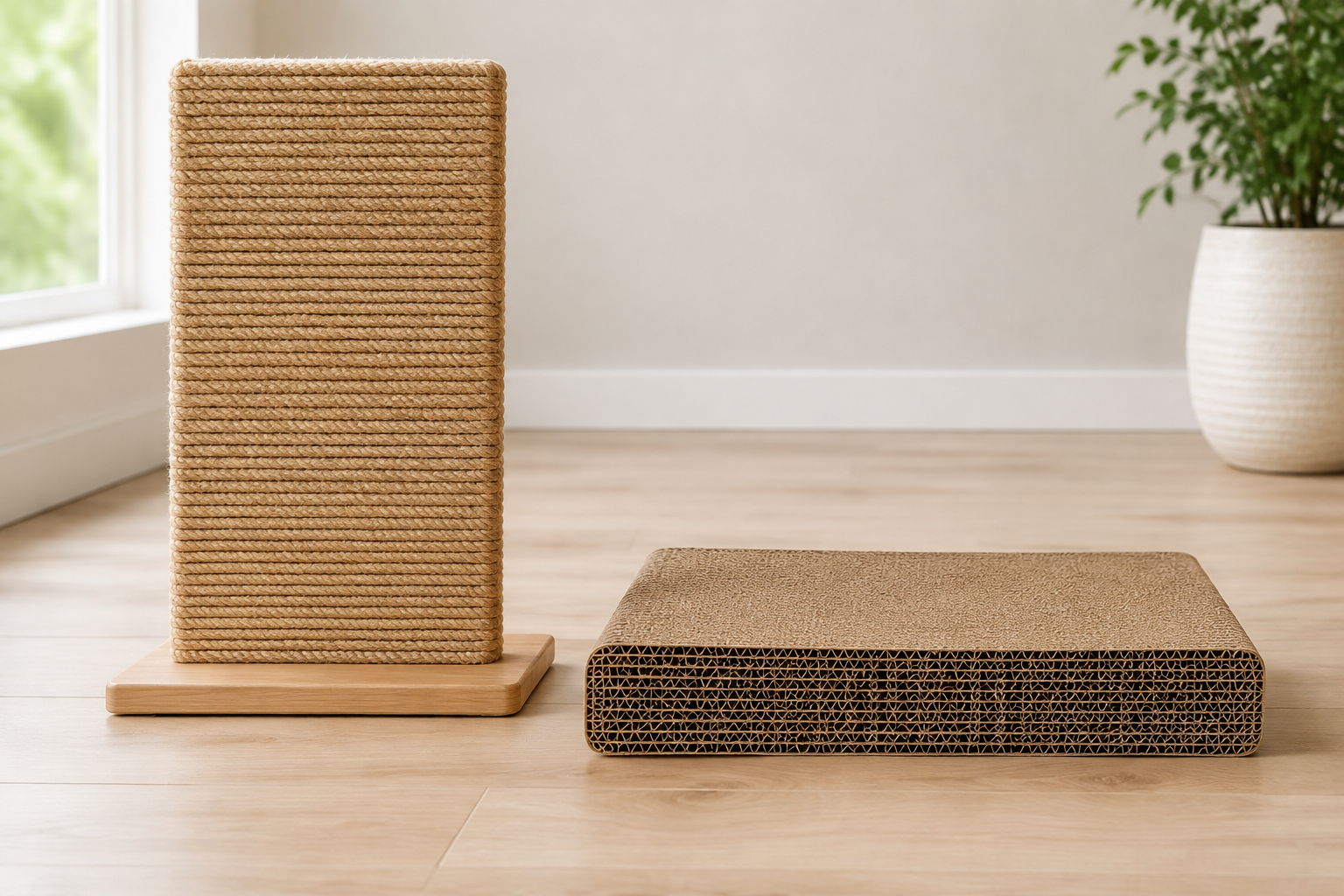
Both materials provide a surface for normal scratching, but neither can guarantee that a cat will ignore furniture or change a persistent behavior. Place and introduce any scratcher with supervision, inspect it often, and address sudden behavior changes with a veterinarian or qualified feline behavior professional.
Quick comparison
- Common orientation: sisal is often attached to posts, boards, and angled frames; corrugated cardboard is common in flat pads, curves, and low lounges.
- Structure: sisal depends on a stable frame and secure attachment; cardboard depends on pad thickness, tray grip, and intact layered edges.
- Debris: sisal can shed fibers as it wears, while cardboard commonly releases flakes and dust around the pad.
- Replacement: some sisal units have replaceable panels or rope, while many cardboard pads are reversible inserts or whole replaceable units.
- Cleaning: both are usually dry-cleaning surfaces; follow the maker's care directions and do not soak materials that are not labeled washable.
Choose the scratching angle before the material
Watch where and how your cat already scratches. A cat that stands tall against a sofa end or doorframe may need a stable vertical surface with enough usable height to stretch. A cat that works at rugs, mats, or the top of a box may prefer a broad horizontal pad. Some cats use both, so two modest surfaces in useful locations can make more sense than one large multipurpose unit.
Do not infer preference from one brief introduction. Put the scratcher near an existing scratching route, keep it steady, and give the cat time to investigate without forcing paws onto it. If the selected material is in the wrong orientation, changing from cardboard to sisal may not solve the mismatch.
When sisal fits better
Sisal is useful when you need a textured surface attached to a post, wall-safe board, ramp, or sturdy frame. Compare the actual usable scratch area rather than the overall product height. The base should resist tipping during the cat's full motion, and wall-mounted designs need hardware and a wall type that match the manufacturer's directions.
Inspect whether the product uses rope, woven sisal fabric, or a replaceable panel. Rope creates ridges and can loosen in sections; fabric provides a flatter plane but may fray differently. Check attachment points, exposed staples or adhesives, base edges, and any loose fiber. Retire or repair only as the maker directs when the surface becomes detached or hardware is accessible.
When cardboard fits better
Corrugated cardboard is often the simpler choice for cats that prefer broad floor-level scratching. A reversible insert can extend the useful life of the material, and a fitted tray can contain some debris. Measure the usable top surface and make sure the cat can brace without the pad sliding or rocking.
The tradeoff is cleanup and replacement. Flakes collect around the pad, especially at favorite spots, and a lightweight unit may travel across hard flooring. Compare refill availability and exact insert dimensions before choosing a reusable frame. Replace a pad when it collapses, exposes sharp or glued layers, sheds pieces the cat tries to eat, or no longer stays secure.
Placement, stability, and floor space
A tall sisal post may use less floor length but still needs a broad enough base and clear stretching space. A cardboard lounge stays low but can occupy a larger rectangle in a walkway. Measure doors, cleaning paths, and nearby furniture before choosing. Keep either scratcher away from unstable shelves, cords, breakable objects, and places where loose pieces could fall into food or water.
On smooth floors, use only a backing or underlay that is compatible with the floor finish and does not expose chewable edges. Do not improvise with loose tape, tacks, or strings. Recheck wall fixings, frame joints, base grip, and material attachment as part of routine cleaning.
Cleaning and replacement costs
Vacuum or sweep loose fibers and cardboard flakes often enough for the room. Follow the manufacturer's care label for the surface and frame; many natural-fiber and cardboard scratchers should not be saturated. Clean reusable trays separately if the instructions permit, then dry them fully before reinstalling an insert.
Compare cost over the routine you actually expect: initial frame cost, compatible refills, shipping and storage space, and how quickly the cat wears one area. A higher initial price does not prove longer life, and a cheap insert is not good value if its size, stability, or orientation goes unused.
Who should skip each material?
Skip sisal when the available product cannot be secured against tipping, its usable surface is too short, or loosened rope and fibers are hard to monitor. Skip cardboard when loose flakes are unacceptable, the pad slides in the intended location, or the cat tears off and swallows pieces.
Skip the purchase for now if an existing scratcher already matches the cat's angle and remains stable and intact. Pause product experimentation if scratching changes suddenly or comes with hiding, appetite or litter-box changes, overgrooming, limping, sensitivity, or distress. A veterinarian can assess health concerns; a qualified feline behavior professional can help with a persistent pattern after health issues are considered.
The bottom line
Choose sisal when a stable structured surface matches an upright or angled scratching motion and you are prepared to inspect attachment and fiber wear. Choose cardboard when a broad low surface matches the cat's habits and routine sweeping plus replacement is manageable. Orientation, stability, usable area, safe wear, and actual use are better decision criteria than the material name alone.