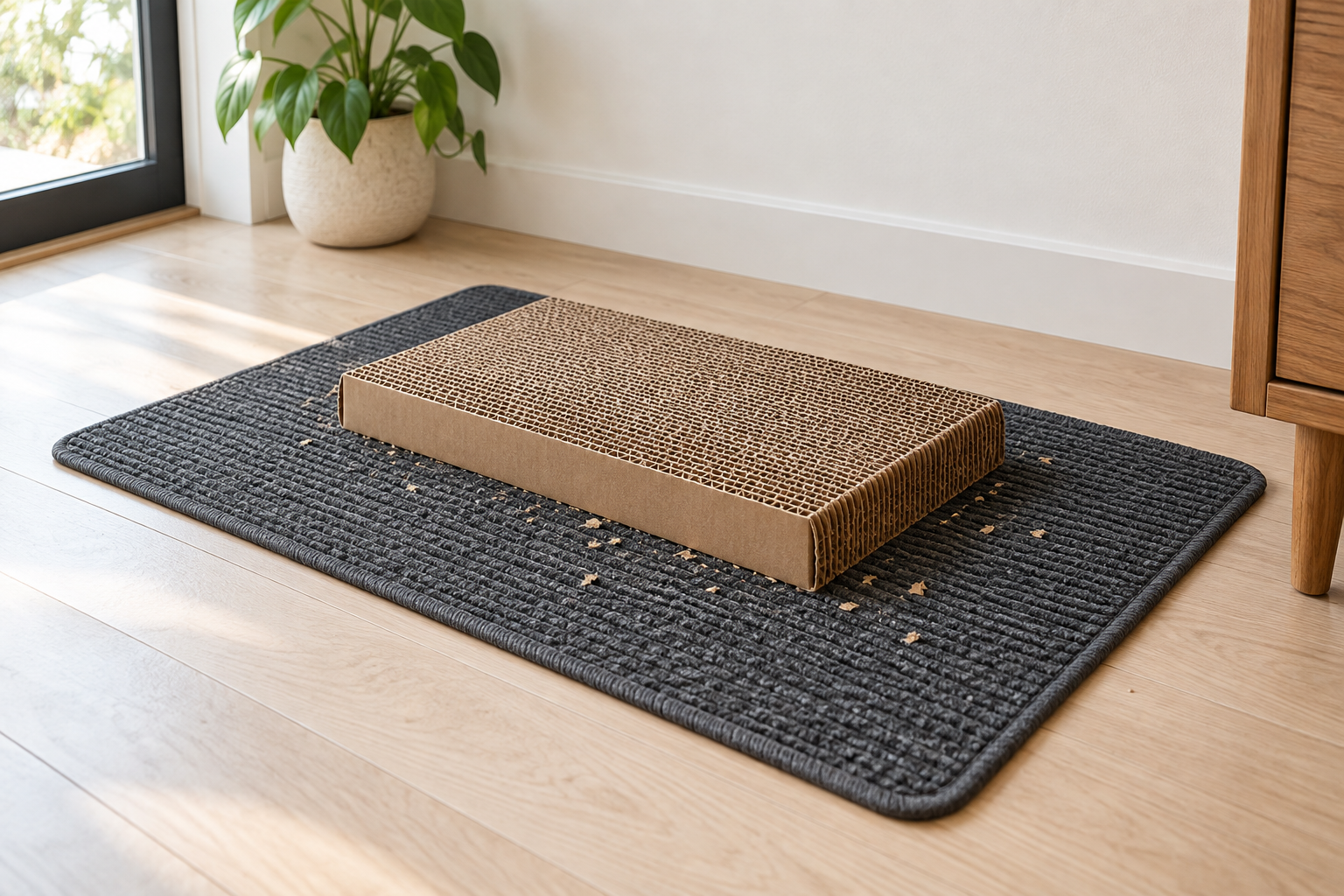
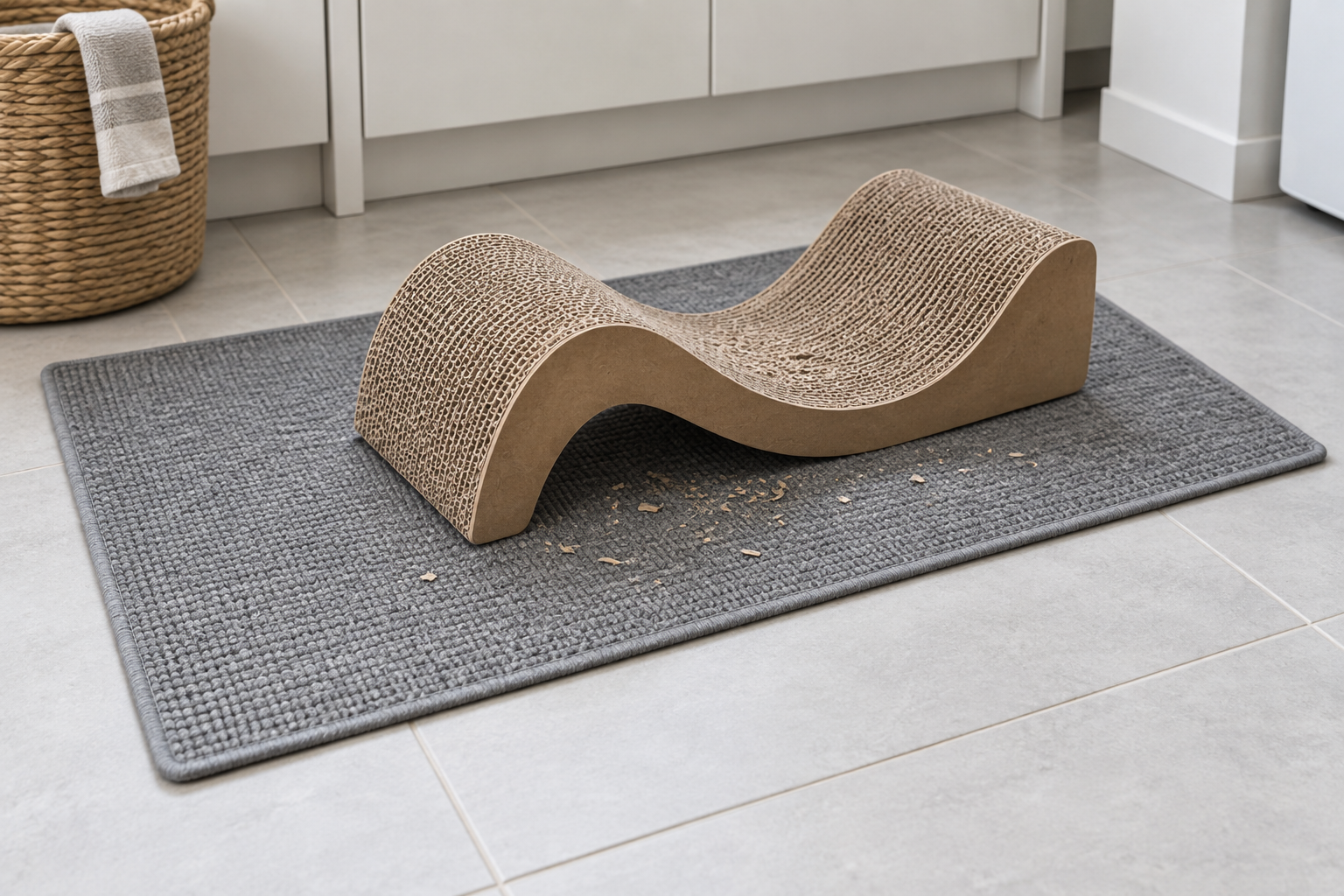
 Washable flat-weave mats
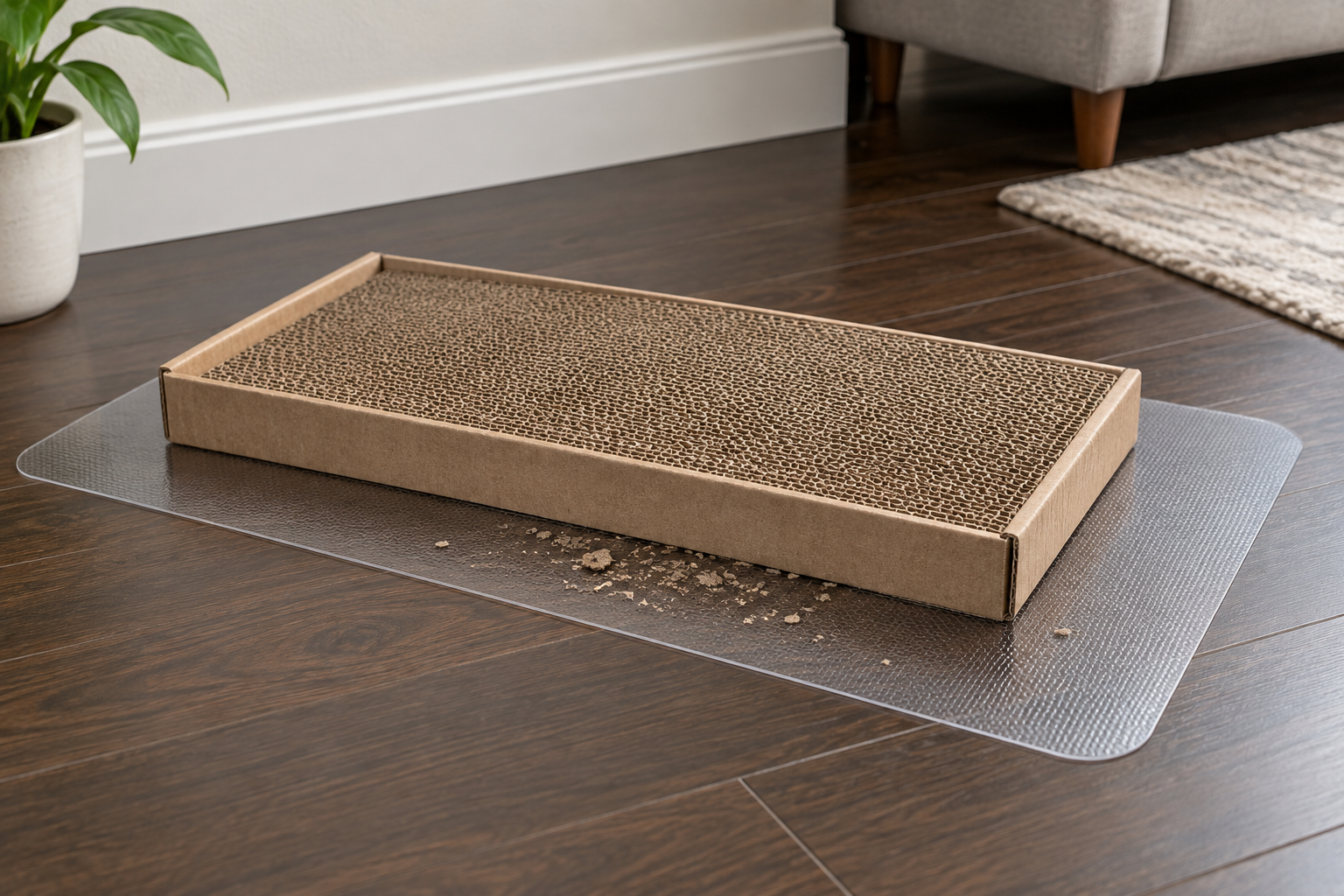 Thin clear floor-protector mats
This guide is a selection framework, not hands-on testing. A mat may make routine debris collection easier, but it cannot guarantee that a cat will use the scratcher, protect every floor finish, or stop scratching elsewhere.
Measure the debris zone, not only the scratcher
Measure the scratcher's full base, then observe where flakes land after ordinary use. Allow useful margin on the sides where the cat enters and exits, while keeping the mat clear of door swings, chair legs, vents, food and water, and busy walkways. A mat that barely matches the base will not catch much debris; an oversized mat can become harder to lift or launder.
Check whether the scratcher depends on direct floor contact, rubber feet, a tray lip, or a weighted base. Adding a soft or slippery layer can change how it sits. If the unit rocks, slides, or twists on the mat, choose a different combination rather than improvising fasteners.
How the three formats differ
- Ribbed utility mat: texture can hold visible dry flakes until vacuuming, but deep channels can take more passes to clean.
- Washable flat weave: a flexible fabric may be easy to shake out and launder when its label permits, but wet backing needs complete drying.
- Thin floor protector: a smooth or lightly textured sheet keeps debris visible and wipeable, but it may not trap flakes and can show curled edges or trapped grit.
Check the floor before the backing
“Non-slip” is not the same as suitable for every hard floor. Rubber-like backing, plasticizers, moisture, grit, sunlight, and long contact can affect some finishes. Follow both makers' surface directions, test only if those directions permit it, and lift the mat regularly to inspect and clean beneath it. Do not put a damp mat back onto wood, laminate, cork, or another moisture-sensitive surface.
A clear protector also needs scrutiny: confirm the intended side faces down, it lies flat at room temperature, and its edge does not become a trip point. Never assume a chair mat, shelf liner, or bath mat is automatically appropriate simply because the dimensions work.
Match texture to cleanup
For light cardboard dust and flakes, choose a surface your vacuum head can cross without grabbing the edge. For larger pieces, a flatter mat can be quicker to lift and sweep. If sisal fibers are the main debris, avoid a weave that tangles with them unless you are comfortable picking fibers out by hand.
Read care directions before ordering. Check whether the mat may be shaken, vacuumed, spot-cleaned, rinsed, or machine washed, and whether heat drying is allowed. A mat advertised as washable may still be too large for your machine or too slow to dry in your home.
Pet fit and supervision
Some cats avoid unfamiliar textures, pull at bound edges, bunch fabric, or chew flexible material. Introduce the setup without forcing the cat onto it, supervise the first uses, and remove a mat that shifts, frays, cracks, exposes backing, or loses pieces. Keep loose tape, strings, clips, and improvised adhesives out of the setup.
If your cat suddenly stops using a familiar scratcher, scratches much more, chews or swallows mat or cardboard pieces, limps, hides, or seems uncomfortable, pause the product experiment and contact a veterinarian. A mat is a cleanup convenience, not a health or behavior treatment.
Who should skip a dedicated mat?
Skip it if the scratcher already sits securely in an easy-to-sweep area and the debris takes only a quick pass to collect. A mat also adds little value when its edge would cross a walkway, the floor maker advises against the backing, your cat chews mats, or you cannot dry a washable format fully.
A shallow open tray designed for the exact scratcher may be a simpler boundary when compatible. Moving the scratcher a short distance from rugs, bowls, and doorways can also make sweeping easier without adding another product.
The bottom line
Choose a ribbed mat for visible dry flakes, a washable flat weave when laundering suits the space, or a thin protector when a wipeable boundary and floor compatibility are clear. The best fit extends beyond the debris zone, keeps the scratcher stable, lies flat, cleans with tools you already use, and causes no avoidable trouble for the cat or floor.
For the scratcher itself, start with the broader horizontal scratch-pad guide. If you already own a reusable frame, use the replacement-insert compatibility checklist before buying refills.