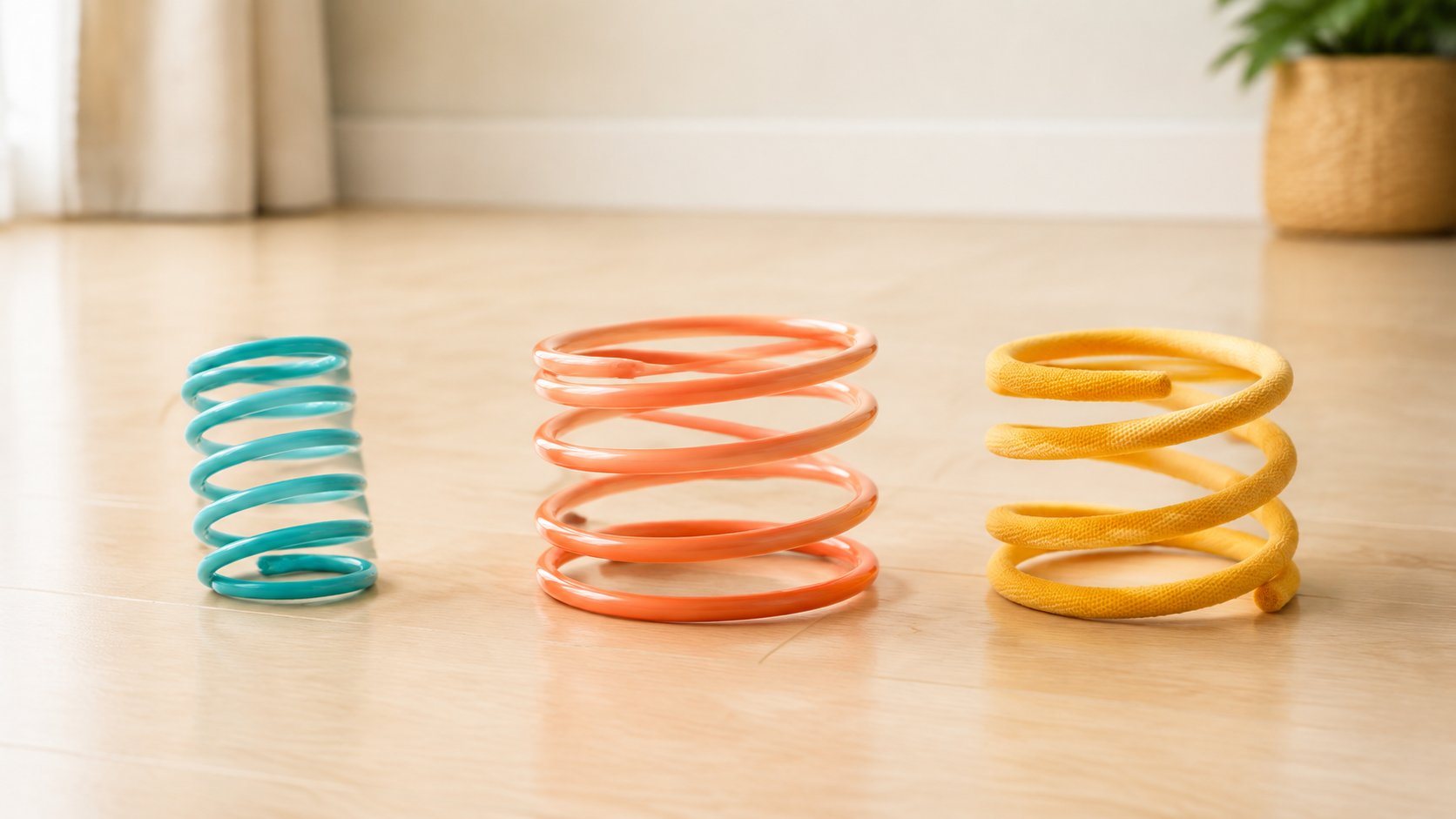
This is a product-category buying framework. Here, “best” means the variety whose size, motion, noise, visibility, and care routine suit your cat and hard-floor space. It does not mean every cat will engage with springs or that any small toy is safe without supervision.
Quick Comparison: Which Spring Format Fits?
Narrow plastic springs: quick movement, easier to lose
A narrow, lightweight coil may dart across a smooth floor and change direction after a bat. That movement can also send it beneath appliances or furniture. Compare the published diameter and length with floor gaps in the play area, and choose a bright color that stands out against the floor.
Wide plastic springs: more visible, still size-dependent
A wider coil can be easier for a person to spot and pick up, but “wide” is not a standardized size. Check actual measurements and edge finish. A bigger spring is not automatically suitable for every cat, and a flexible toy can compress.
Fabric-covered coils: softer surface, more seam checks
A fabric exterior may soften the sound and change how the toy grips the floor. It also adds seams and fibers that need inspection. Follow the maker's cleaning directions, let the toy dry fully, and remove it if the cover loosens, frays, or exposes the inner coil.
Selection Criteria That Matter on Hard Floors
- Measured size: Compare length, outside diameter, and compressed shape. Do not rely on photos or pack count to judge suitability.
- Edge and seam finish: Plastic ends should feel smooth; fabric coverings should be secure. Skip rough edges, loose threads, exposed wire, or separated material.
- Movement: A lighter narrow spring may skitter farther, while a wider or covered coil may move differently. Pick for the controlled play area, not the most dramatic motion.
- Visibility: Choose colors that contrast with your floor and furniture. Count toys out and back into storage after each session.
- Floor noise: Hard plastic can click or scrape on hard flooring. A covered style may be worth comparing in apartments or during quieter routines.
- Cleaning: Use only the maker's wash method. Rinse away residue when applicable and dry completely before storage.
- Storage: A lidded container kept out of reach helps prevent unsupervised access and makes missing toys obvious.
A Simple Room-and-Toy Comparison Framework
First, measure low gaps beneath sofas, cabinets, radiators, and appliances. Block unsafe gaps or choose a play zone where a spring can be recovered without moving heavy furniture. Second, compare the toy's stated dimensions with your cat's size and play habits. Third, decide how much clicking and long-distance skitter suits the room. Finally, choose the material you can inspect and clean consistently.
Before play, remove cords, fragile objects, and other small loose items. Offer one or two springs at a time, remain present, and put every toy away afterward. Hard floors can be slick; stop if the play setup causes uncontrolled collisions or repeated slipping.
Inspection, Retrieval, and Replacement
Check each coil under good light before and after play. Flex it only as the maker intends and look for sharp ends, stress whitening, cracks, permanent deformation, sticky texture, loose fabric, fraying, or missing pieces. Retire a damaged spring rather than trimming, gluing, taping, or reshaping it.
Retrieve springs from furniture gaps with a purpose-made reach tool only when the area is safe and accessible; never reach blindly near wiring, hot appliances, or moving mechanisms. If part of a toy may have been swallowed, contact a veterinarian promptly.
Who Should Skip Cat Spring Toys?
Skip small spring toys for cats that chew and swallow toy material, rapidly destroy flexible plastic or fabric, or cannot use them without trying to ingest pieces. Kittens and cats with vision, mobility, dental, or other health concerns may need a different toy and advice from a veterinarian about appropriate play.
Also skip buying a new pack if your cat ignores rolling toys or an intact toy you already own provides the same supervised play. A wand toy keeps the moving object connected to a handle, while a cat puzzle feeder offers a slower, food-based activity when that suits the cat's feeding plan.
The Bottom Line
Compare narrow plastic springs for lively movement, wide plastic springs for greater visibility, and fabric-covered coils for a different surface feel and sound. The strongest choice is appropriately sized, easy to find, smooth and intact, simple to clean, and used only during supervised play.