This guide compares stated design features and practical toy formats; it is not based on hands-on testing. Wand toys are for active, supervised play and should be put away where pets cannot reach them afterward. They do not treat inactivity, anxiety, aggression, or another health or behavior concern.
Best Simple Wire Pick: Cat Dancer 101
The Cat Dancer 101 uses springy wire to make its small cardboard pieces change direction with subtle hand movements. That makes it a sensible first comparison for a cat that watches tiny objects skitter or hover instead of chasing large feather bundles. Its stripped-down construction also avoids a long cord trailing across the room.
The tradeoff is short reach and a lure that can wear from grabbing, chewing, and saliva. Keep hands clear of a cat's pounce path, do not let the wire snap toward a face, and stop using the toy if the wire bends sharply, an end becomes exposed, or the cardboard breaks into loose pieces. Store the whole toy in a closed cabinet or secure container after play.
Best for Wide Sweeps: A Refillable String Wand
A longer rod with a cord can move a lure across the floor, around a tunnel, or briefly through the air while giving the owner more distance from paws. A swivel or secure clip and maker-approved replacement lures can extend the useful life of the rod.
String, elastic, feathers, bells, and clips add inspection points and should never be left accessible between sessions. Compare rod length, cord length, connector shape, replacement availability, and the size of every detachable part. Skip this format if secure storage is unrealistic or your cat immediately chews and tries to swallow string or feathers.
Best for Visible, Quieter Motion: A One-Piece Ribbon Wand
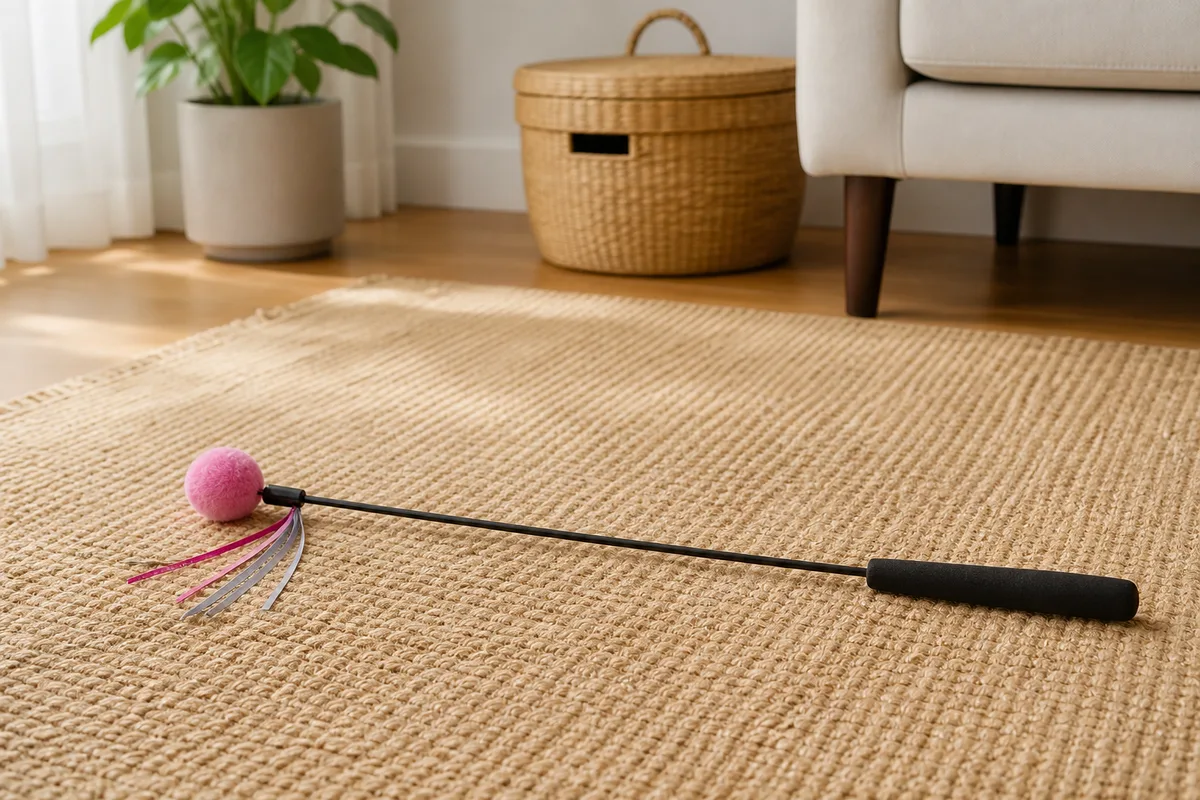
A broad fabric ribbon is easy to see and can slide in slow curves without the fluttering sound of feather attachments. A one-piece design has no lure clip to swap, which can simplify inspection and storage for owners who do not need multiple attachments.
Ribbon can still fray, wrap around legs, or be chewed. Choose a width and length you can keep under control, avoid loops, and end the session if fabric catches around a pet or furniture. Replace the toy at the first sign of torn edges or loose threads.
Selection Criteria That Matter
- Observed motion preference: Start with how your cat already plays: small jittery movement, long ground chases, slow ribbon sweeps, or brief airborne passes.
- Reach: A longer rod keeps hands farther from a pounce, but it needs more clear room and is harder to store.
- Attachment design: Clips and swivels allow refills but add small parts. Fixed lures are simpler but may require replacing the whole toy.
- String and elastic: Treat every cord as supervised-only. Put it behind a closed door or in a secure container after play.
- Lure size and material: Avoid loose pieces, sharp edges, shedding feathers, exposed wire, and parts your cat can swallow.
- Noise: Bells, crinkle material, and stiff feathers can be distracting in a small home. Quiet cardboard or ribbon is a valid choice.
- Storage: Telescoping rods save length but add joints to check. One-piece rods are simpler if you have a tall cabinet or wall-safe enclosure.
- Cleaning: Follow the maker's directions. Replace porous or feather lures when soiled or damaged rather than soaking parts not designed for washing.
- Multi-cat use: Use separate turns or enough space to prevent crowding, blocking, and collisions. Stop if play becomes tense or one cat cannot disengage.
A Quick Comparison Framework
- Choose a wire wand for compact, irregular motion and no trailing string.
- Choose a refillable string wand for wide sweeps and replaceable lure styles.
- Choose a one-piece ribbon wand for visible motion and fewer connector parts.
- Choose a telescoping rod only when compact storage outweighs the extra joints that need inspection.
- Choose a fixed, non-feather lure when loose feathers and tiny clips are a poor fit for your cat.
Who Should Skip a Wand Toy
Skip a wand if you cannot supervise every session and lock it away afterward, or if your cat persistently chews or swallows string, ribbon, feathers, cardboard, elastic, or small parts. A sturdy, appropriately sized solo toy may fit the household better, though it still needs routine inspection.
Pause play if your cat is panting, limping, colliding with furniture, becoming distressed, or unable to disengage. A toy is not a solution for sudden behavior changes, pain, reduced activity, household conflict, or compulsive chewing. Contact a licensed veterinarian about health changes, and seek a qualified cat behavior professional for persistent distress or conflict.
Use and Store a Wand Without Creating More Clutter
Clear a short route away from stairs, breakables, cords, food bowls, and other pets. Move the lure away from your hands, allow pauses, and let the cat catch it occasionally without chewing it. End before play becomes frantic, inspect the entire toy, and store it immediately in a closed location.
Our supervised enrichment guide offers a broader way to match products to play style. For a mix of batting, carrying, and chasing toys, use the cat toy variety-pack comparison. Keep supervised-only toys separated with the simple toy rotation routine.
The Bottom Line
The Cat Dancer 101 is a practical first comparison for cats drawn to small, unpredictable movement and owners who want to avoid a long string. A refillable string wand is better for broad sweeps and replaceable lures, while a one-piece ribbon wand offers quieter, highly visible movement with fewer connector parts.
Choose from the chase style your cat already shows, then judge the toy by reach, attachment security, inspection needs, and whether you can store it out of reach every time. The best wand is not the one with the most elaborate lure; it is the one you can supervise, check, and put away consistently.