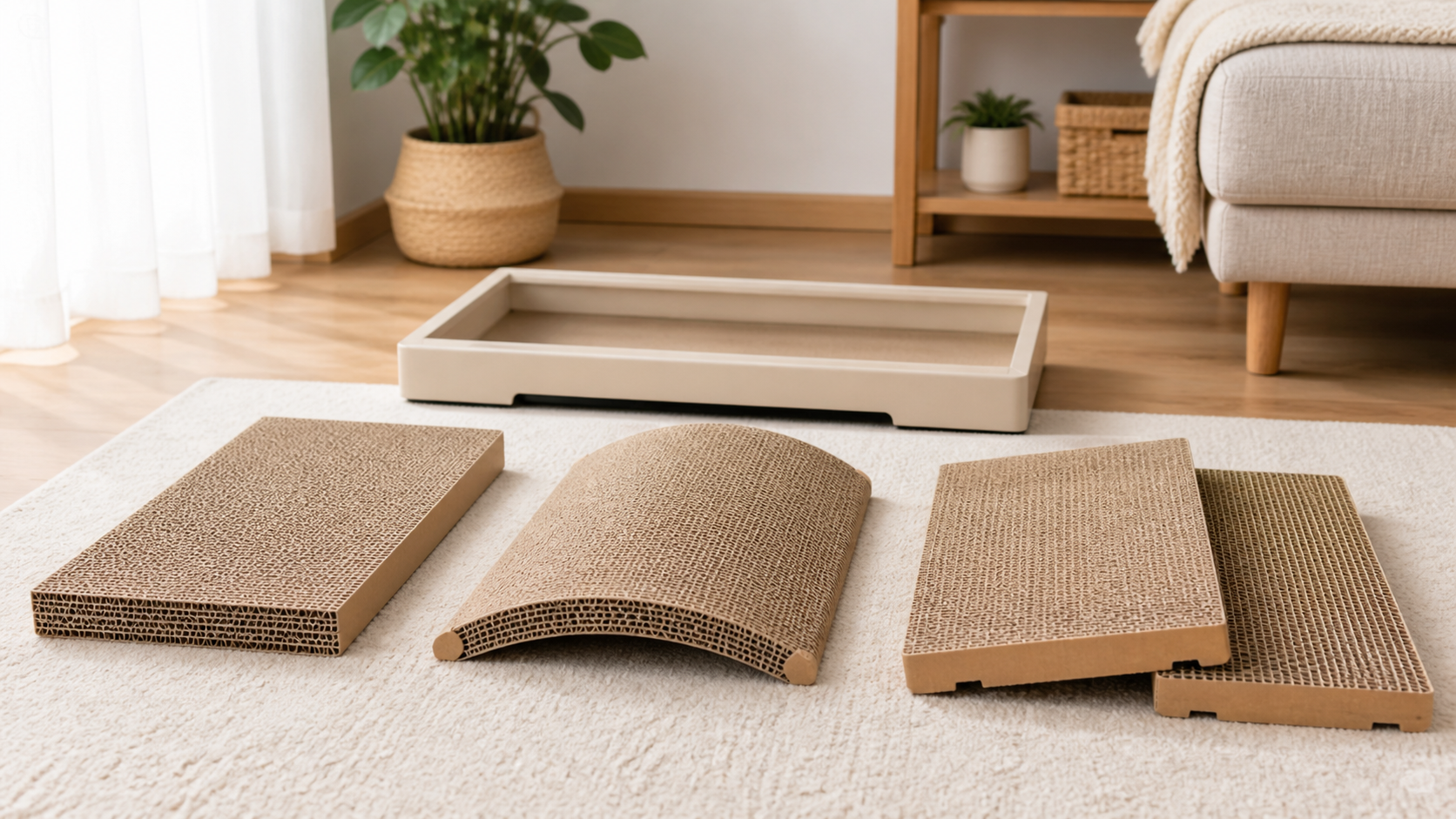
This is a category comparison, not a hands-on test or a current-product ranking. Replacement inserts are not universally interchangeable, even when their photos look similar. Use the frame maker's documented replacement guidance where available, and supervise the first few uses after installing any new refill.
Quick Comparison: Match the Shape to the Existing Frame
Flat rectangular inserts: easiest to measure
A flat insert suits a simple rectangular tray when all three dimensions match and the insert sits fully inside the retaining lip. Multipacks can reduce reordering, but only buy several after confirming one refill fits without bowing, sliding, or leaving a paw-catching gap.
Curved inserts: shape matters as much as dimensions
A curved insert may rest on end supports or follow a frame contour. Two refills with the same overall length can have different arc heights, end cuts, or contact points. Look for an explicit compatible model or a dimensional diagram that covers the full profile.
Reversible inserts: useful only when the frame permits flipping
A reversible insert may extend usable life when both broad faces use the same scratching material. Before counting on two-sided use, check whether the underside has tabs, adhesive, feet, a backing layer, or a shaped edge that must face down.
How to Measure Refill Compatibility
Remove the worn insert and measure the frame's interior rather than its outside footprint. Record the available length and width at the narrowest points, the maximum insert thickness below the retaining lip, and any rounded corners, center supports, tabs, clips, notches, or sloped ends.
Then measure the old refill itself while it is still recognizable. Note which side faced up and whether the cardboard grain runs across or along the frame. A seller's phrase such as “standard size” is not a substitute for numbers or a documented frame-model match.
Selection Criteria That Matter
- Exact fit: Require compatible model information or complete length, width, thickness, and shape measurements.
- Retention: The refill should sit below the frame lip and work with every intended tab or clip without being forced.
- Material: Corrugated cardboard is common; avoid assuming every density or flute pattern will shed or wear the same way.
- Reversibility: Count a second usable side only when both faces are exposed scratching surfaces and the frame safely supports flipping.
- Pack count: Balance storage space against how often you actually replace an insert; keep spare cardboard dry.
- Debris: A fitted tray lip may contain loose cardboard better than an insert that sits proud of the frame.
- Disposal: Check local recycling rules because adhesives, coatings, contamination, or mixed materials can change what is accepted.
- Routine inspection: Replace an insert that collapses, exposes sharp frame edges, sheds large loose pieces, or no longer stays seated.
Who Should Skip a Replacement Insert
Skip a refill if the frame is cracked, unstable, has exposed fasteners, or lacks enough model or dimensional information to verify fit. Replacing the complete scratcher may be more sensible when compatible inserts cost nearly as much, require repeated returns, or leave gaps around a damaged tray.
Also pause if your cat chews and swallows cardboard, pulls large pieces free, becomes distressed around the scratcher, or suddenly changes scratching habits. Remove damaged material and ask a veterinarian about ingestion or an abrupt behavior change; a refill is an enrichment product, not a health or behavior treatment.
The Bottom Line
Choose a flat refill for a measured rectangular tray, a curved insert only for a matching frame profile, or a reversible insert when both faces genuinely work with the retention system. Exact compatibility beats pack size or vague durability language every time.
For the broader product decision, compare horizontal scratch-pad formats, debris mats for scratchers on hard floors, small-space scratching posts, and cat toy storage for an owner-managed enrichment routine.