Quick Answer
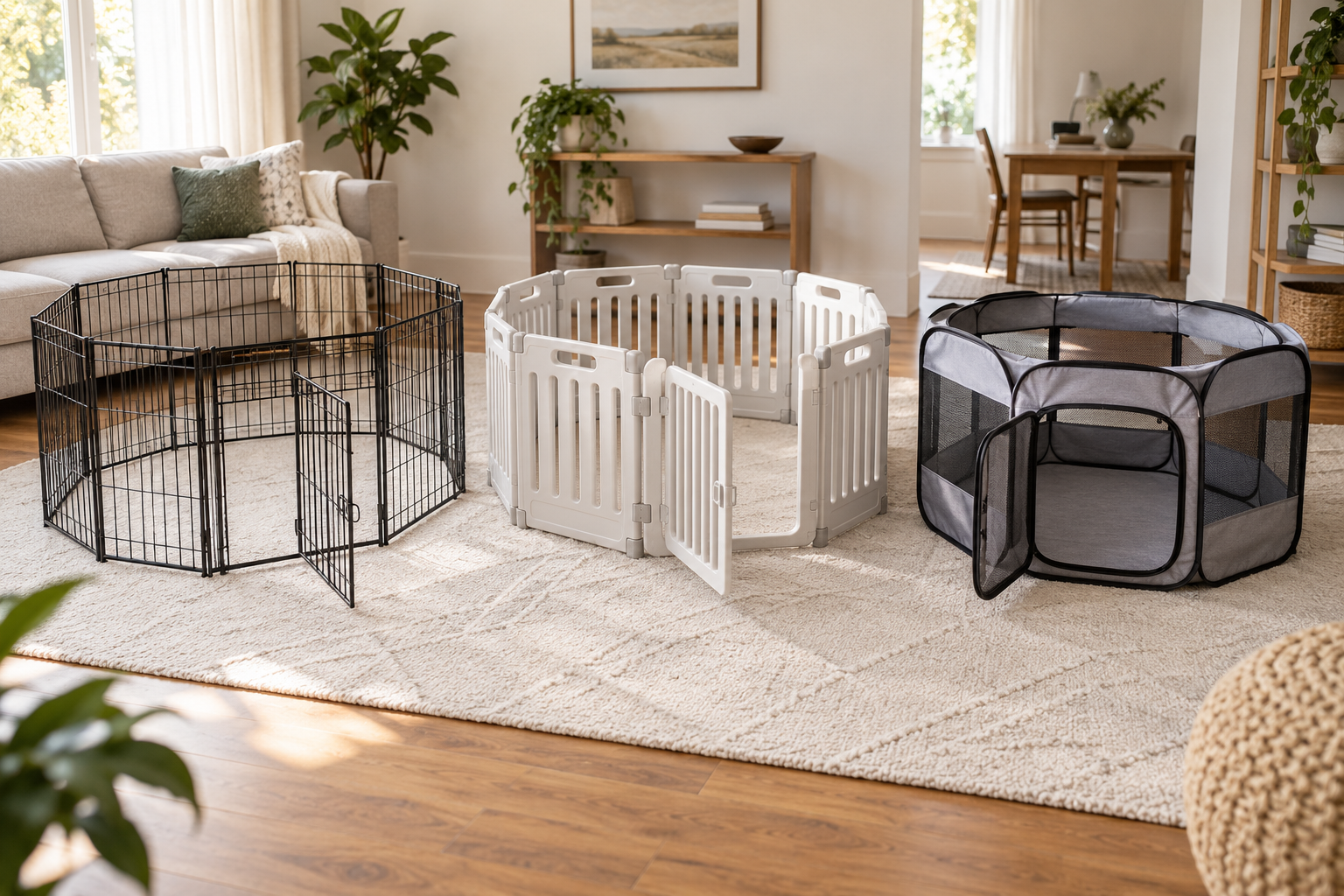
Start with folding wire panels when flexible geometry and flat storage matter and the spacing, height, connectors, and floor contact suit the puppy. Choose modular plastic panels when wipeable surfaces and a more enclosed visual boundary fit the room. Consider a fabric pen for lightweight temporary use only when the puppy does not chew, scratch, climb, or push at mesh and seams.
Use any pen only as its maker directs and supervise its use. If a puppy persistently tries to climb, chew, push, or panic around a boundary, stop using it and ask a veterinarian or qualified trainer for help rather than changing hardware at random.
Measure the Puppy, Room, and Routine
Mark the proposed outline on the floor before shopping. Include the full configured footprint, an approach path, the door swing, and enough room for an adult to reach every panel. Then measure the product's actual panel width and height, spacing, door opening and threshold, and any feet or connectors that project beyond the panels.
Growth matters, but a broad age or breed label cannot establish fit. Compare the puppy's current standing reach and observed climbing, pawing, squeezing, and chewing with the exact construction. Recheck fit and condition as the puppy grows. Keep the pen away from cords, curtains, furniture edges, plants, heaters, stairs, and anything reachable through or over a panel.
How the Formats Differ
Folding wire panels
Wire panels commonly fold flat and can form more than one shape. The tradeoffs are open spacing, exposed joints, weight, floor contact, and potential movement. Inspect every connector, latch, edge, and foot; do not improvise incompatible clips or anchors.
Modular plastic panels
Plastic modules can offer wipeable broad surfaces and configurable layouts. Joint design, panel flex, door geometry, base contact, and the number of pieces affect daily use. Check that every module locks as directed and that the configured shape remains stable on the actual floor.
Foldable fabric sides
Fabric pens are light and may pack compactly, but mesh, zippers, seams, and the base can become targets for chewing or scratching. Cleaning and drying may take longer than a wipe-down. Skip this format when the puppy works at fabric, mouths zippers, or pushes into flexible sides.
A Practical Buying Checklist
- Configured footprint: Verify the real shape and floor area, not only panel count.
- Height and spacing: Compare exact measurements with the individual puppy's reach and observed behavior.
- Door and latch: Check opening width, threshold, hand access, and operation without making escape-proof claims.
- Floor contact: Inspect feet or base material for the room's surface; add only maker-approved protection.
- Construction: Check joints, connectors, edges, mesh, stitching, zippers, and removable pieces.
- Cleaning: Follow current care directions and plan where every part can dry fully.
- Storage: Confirm folded or disassembled dimensions, weight, and a secure place away from the puppy.
- Placement: Maintain clearance from hazards and objects reachable through the boundary.
- Return terms: Confirm them before the pen is used.
For an existing exercise pen missing a removable connector, use the replacement-clip compatibility checklist; retire damaged panels or latches rather than improvising a repair.
Who Should Skip Each Format?
Skip wire if the spacing, joints, door, floor contact, or weight do not suit the puppy and room. Skip modular plastic if joints flex, the shape crowds the route, or the puppy can reach or mouth connectors. Skip fabric for persistent chewers, scratchers, climbers, or puppies that push hard against flexible sides.
Skip a playpen altogether when a closed puppy-proofed room, appropriately fitted gate, or direct supervision already manages the short routine with less equipment. Do not use a pen to leave a puppy unattended beyond the product directions or as a substitute for exercise, social contact, toilet breaks, training, veterinary care, or professional behavior support.
Bottom Line
The best temporary indoor puppy playpen is the format whose measured geometry, construction, cleaning, storage, and supervised-use limits match the actual puppy and room. Buy for a defined short routine, recheck the setup as the puppy grows, and stop using any damaged or repeatedly challenged boundary.