Start with the cover you can keep
Choose an insert only when the outer cover is sound, the replacement is confirmed compatible, and its cleaning routine works at home. Inspect seams, the zipper, the base and each compartment before shopping. If both cover and core need replacing, compare a complete bed before buying parts.
Keep a usable existing core when cleaning or reshaping it according to its own instructions solves the problem. A new filling is not automatically an improvement. Remove damaged bedding from use if your pet can reach or swallow its contents. For a clinician-specified resting surface, confirm any proposed change with that clinician.
Identify the model and every compartment
Find the bed label, order record and model/version before removing parts. Photograph how the base and bolsters sit. A rectangular mattress, a ring-shaped cushion and a couch bed with separate side channels need different replacements; a matching overall bed width is not enough.
FurHaven’s replacement-base listing says its foam dimensions have changed and asks owners to measure the foam being replaced. That is a concrete reason to check actual dimensions rather than trust a familiar size name. The listing is foam only, without a cover.
Orvis’s assembly instructions show separate bolsters, orientation matching and a foam base, with some models having a separate base compartment. Use the instructions for your actual bed; this does not establish that another brand’s modular pieces will fit or that replacements are available.
A cover-and-core measurement worksheet
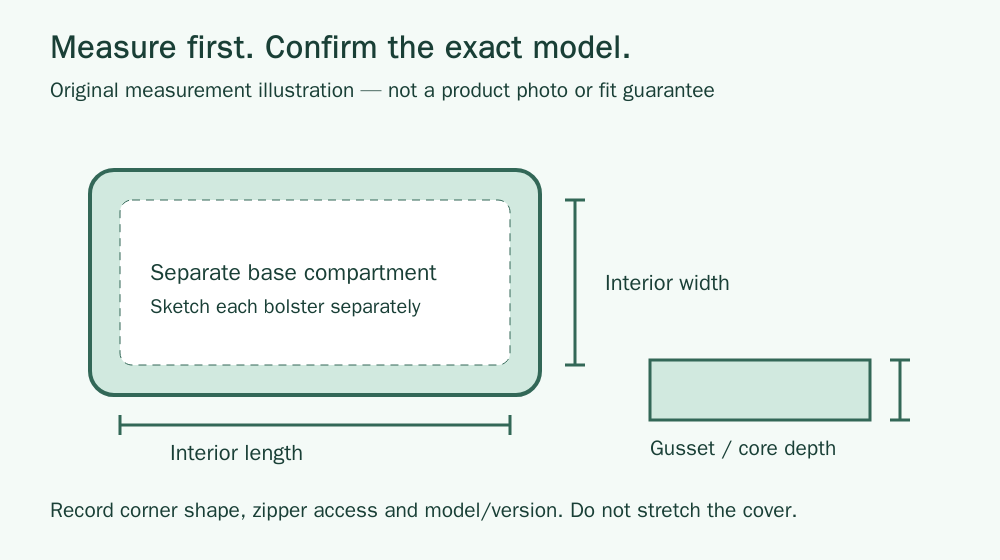
This is an original editorial decision aid, not a tested sizing tolerance. Clean and fully dry the cover according to its label, lay it without stretching, and record measurements in one unit throughout. Measure the interior seam to seam and compare with the maker’s specifications. Note permanent compression in the old core so it does not become your only sizing reference.
| Record | Your entry and check |
|---|---|
| Maker / model / version | ________ Label or order photo; ask the maker if uncertain. |
| Clean, dry cover interior | Length ____ Width ____ Gusset height ____ Units ____; round diameter ____; corner shape ____. |
| Old core, out of cover | Length ____ Width ____ Thickness ____; note compressed areas and original stated dimensions if available. |
| Compartment map | Base ____ Each bolster ____; orientation ____; usable zipper opening ____; attach a photo or sketch. |
| Candidate variant | Exact model ____ Stated dimensions ____ Construction ____ Compatible cover/version ____. |
| Separate care labels | Cover ____ Core ____; permitted washing method ____; drying space/time ____; washer capacity if applicable ____. |
| Fit decision | Confirmed by maker / ask maker / do not buy. Keep the compatibility response and return conditions. |
Hypothetical thickness example: a cover measured at 36 × 27 × 3 inches and a listed 36 × 27 × 5 inch core share a footprint, but the candidate is 2 inches deeper. Reject it unless the cover maker explicitly confirms compatibility. These invented example dimensions are not a recommended fit. Do not force a zipper or assume compressing the core will make it suitable.
For curved corners, tapered bases, unusual openings or unclear dimensions, send the maker your worksheet and photos. Ask which exact replacement variant fits that cover/version and whether the base and bolsters are supplied separately. There is no universal clearance or “size up” rule.
Compare construction by fit and upkeep
| Format | Check before buying | Reason to pause |
|---|---|---|
| One-piece foam base | Actual length, width, depth, corner shape, orientation and exact care instructions. | The listing matches the size label but not the dimensions, or does not identify the compatible cover. |
| Base plus separate bolsters | Every compartment and piece, including which components are included. | A base-only replacement leaves failed bolsters unresolved. Do not assume every piece is foam. |
| Encased filled insert | Exact filling, stated loft/dimensions, seams or baffles, and reshaping/cleaning instructions. | The owner needs machine washing but the actual insert permits only spot cleaning. |
| Refillable sack system | Compatible outer cover, maker-permitted contained filling and care of every item used. | Loose fill can become accessible, or an unfamiliar sack is assumed to fit any duvet. |
Manufacturer examples explain the differences; they are not tested recommendations. The Molly Mutt Stuff Sack is a nylon mesh container designed for that maker’s duvet system and household textiles, not a prefilled foam mattress. Follow the care restrictions of whatever contents you use; do not treat the sack’s washing description as permission to wash every possible filling.
The maker’s wool-filled insert instructions instead specify hand spot cleaning and prohibit a washer or dryer. A washable outer cover therefore does not establish that the whole bed can go into the laundry. These examples establish construction and care only; we have not tested comfort, durability or health outcomes.
Check repair costs without assuming savings
Use current quotes you can verify. Enter insert cost ____ + shipping ____ + any necessary compatible cover or liner ____ = repair total ____. Compare with a complete compatible bed total ____ including delivery. Record return restrictions ____ and who pays return shipping ____ before ordering. This worksheet uses your figures; no saving percentage is assumed.
Also record the handling cost in your routine: how will you remove the core, clean each permitted component, and dry it fully? If the insert requires care or drying space you cannot provide, a lower purchase cost does not make it a workable choice. Keep an existing clean compatible filling only where the system maker permits it.
When to stop and choose another path
- Cover also failing: torn seams, a broken closure or a failing base can make insert-only repair poor value. If only the exterior has failed and the core remains usable, use the replacement cover guide.
- No confirmed fit: ask the maker before ordering. Do not cut foam, add loose scraps or overstuff a cover to make an undocumented replacement work.
- Cleaning cannot resolve contamination: do not seal a problematic core inside another layer. Follow the actual component instructions and remove bedding that cannot be made suitable for reuse.
- Contents become accessible: stop use rather than buy more filling for a cover your pet tears open.
- A whole bed is needed: compare washable bed formats and use the bed sizing and placement guide.
Only after you have a sound, confirmed-fitting core should you consider a compatible protective liner. A liner is a separate fit and care decision, not a repair for failed filling.
Sources and editorial approach
Prepared by The Good Petly Editorial Desk with AI-assisted organization and drafting, checked against the manufacturer pages linked above on November 10, 2026. This is a researched chooser with original worksheets and an illustrative diagram, not hands-on testing or a product ranking. Manufacturer instructions establish their own products’ documented construction and care, not comparative performance. Confirm the current variant, instructions and compatibility with the maker before purchase.
Read our editorial approach or use Contact & corrections to flag an error, including this page URL. We do not claim veterinary review or professional qualifications.