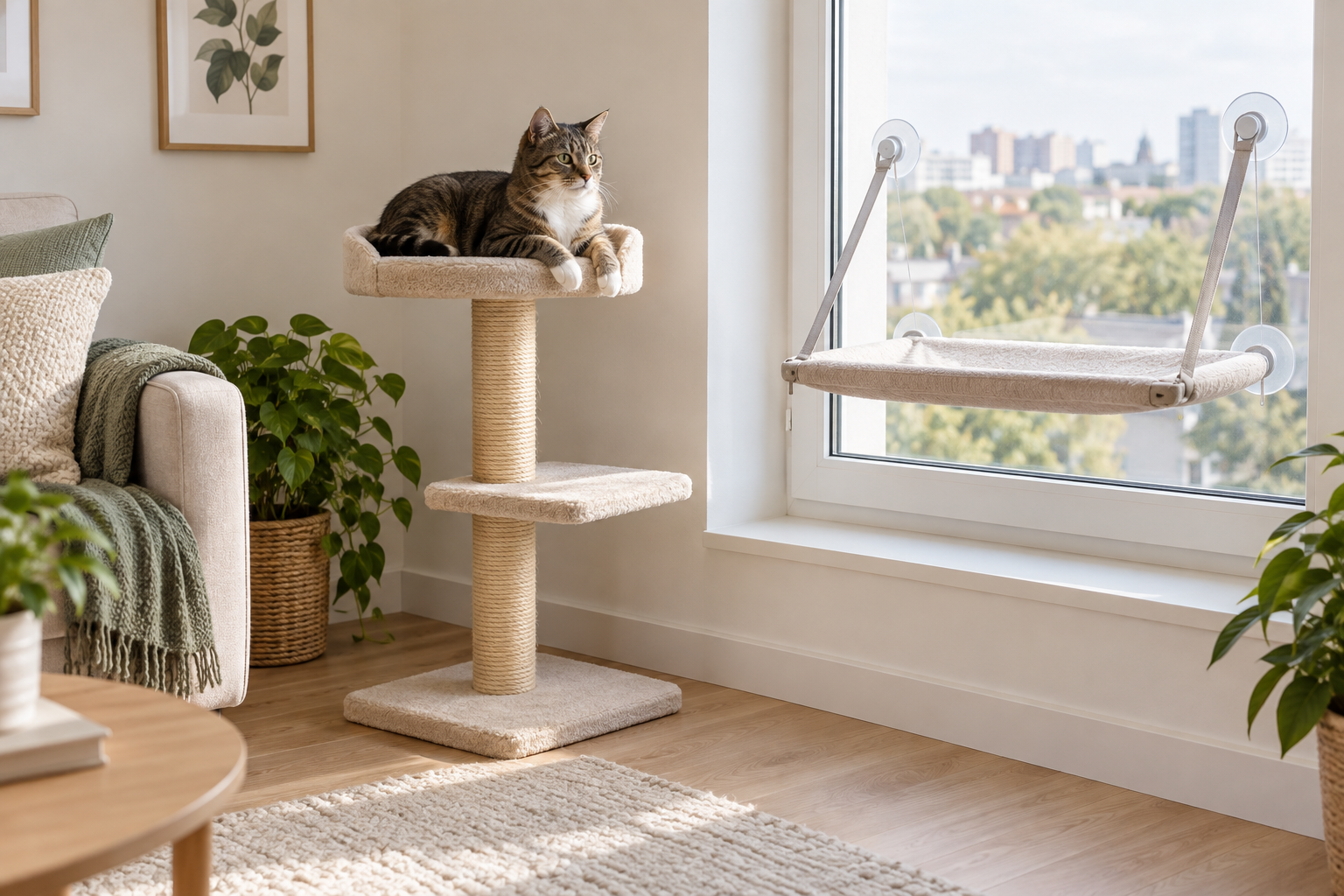
Quick Answer
Choose a compact cat tree if the room has enough level floor space for the complete base, your cat can use the platform sizes and entry heights, and the combined scratching-and-resting format replaces separate furniture you would otherwise need. It is also the simpler choice when the window is unsuitable for mounting.
Choose a window perch if preserving floor space matters most, your cat mainly needs a resting lookout, and the exact glass or sill matches the manufacturer's mounting directions. It asks for more window-specific measuring and recurring mount inspection.
Choose neither when both would obstruct a route, the tree cannot stand or anchor as directed, the window is damaged or incompatible, or your cat has new difficulty jumping. A stable floor bed or low scratcher may fit the room better.
Measure These Before You Shop
- Tree footprint: record the full base width and depth, not only the post or top platform. Leave room for doors, drawers, curtains, and normal walking paths.
- Usable platform: compare the resting surface—not the product's overall width—with your cat's ordinary curled and stretched resting positions.
- Window geometry: measure usable glass, sill depth, trim, blind clearance, and the space below. Identify whether the exact perch attaches to glass, sits on a sill, braces against trim, or stands on the floor.
- Stated limits and instructions: follow the manufacturer's weight limit, assembly, anchoring, mounting, and compatible-surface guidance. Do not combine parts or improvise a mount.
- Access route: consider how the cat gets on and off without using a hot radiator, loose shelf, blind cord, or narrow furniture edge as a step.
- Cleaning: check whether tree fabric can be vacuumed or removed and whether the perch cover detaches for washing. Confirm drying and reassembly directions.
The Practical Tradeoffs
A compact tree takes permanent floor area and can be awkward to move for cleaning, but it does not depend on a suitable window. Models with a scratching post may consolidate two categories of furniture. More platforms, hammocks, and enclosed areas also mean more seams and surfaces to inspect and clean.
A window perch clears the floor and keeps the setup visually lighter. In return, its usefulness depends on one specific window. Suction cups, braces, cables, fabric sleeves, and fasteners need inspection, while sunlight, drafts, curtains, and blind cords affect placement. A perch is not a fall-prevention device, and a screen is not a secure substitute for a closed, latched window.
Neither format is automatically better for every cat. Base the choice on observed resting and scratching preferences, normal movement, measured fit, and the maker's current directions—not on promises that furniture will prevent behavior problems or guarantee use.
Who Should Skip Each Format?
Skip the tree if its base cannot sit completely on a level surface, required anchoring is not possible, platforms are too small, or it would block an exit or narrow daily movement. Skip a fabric-heavy model if its fixed coverings do not fit your realistic cleanup routine.
Skip the mounted perch if the glass, sill, trim, or lease is incompatible; the mount is hard to inspect; the window becomes uncomfortably hot or drafty; blind cords cannot be secured; or the area below creates a poor landing zone. Choose a floor-standing alternative when the window itself is the weak link.
Pause either change and contact a veterinarian if your cat suddenly avoids jumping, falls, limps, seems painful, or shows a meaningful change in normal activity. Furniture is not a treatment for pain, weakness, or mobility changes.
Set Up, Observe, and Inspect
Assemble or mount the product exactly as directed and keep the instructions. Test stability by hand before your cat approaches. Keep the window closed and latched, secure nearby cords, and let the cat investigate without forcing or placing them on the new surface.
During early use, watch the approach and exit route. Recheck fasteners, anchors, cups, cables, fabric tension, seams, and frame joints on the schedule the maker gives and after moving or washing any part. Stop use if the structure shifts, hardware loosens, fabric tears, a scratching surface unravels, or your cat chews the mount.
Related Guides
If the floor-standing format wins, use our compact cat tree buying guide. If the window format fits better, compare cat window perches for renters and then suction-cup versus sill-mounted designs. For a smaller dedicated scratching setup, see scratching posts for small apartments.
Bottom Line
A compact cat tree is the stronger choice when a measured floor footprint can combine resting and scratching functions. A window perch is the stronger choice when the floor must remain open and a specific window supports the exact mount. The right format is the one that fits the room, the cat's usable surface, the cleaning routine, and every assembly or mounting requirement without improvisation.