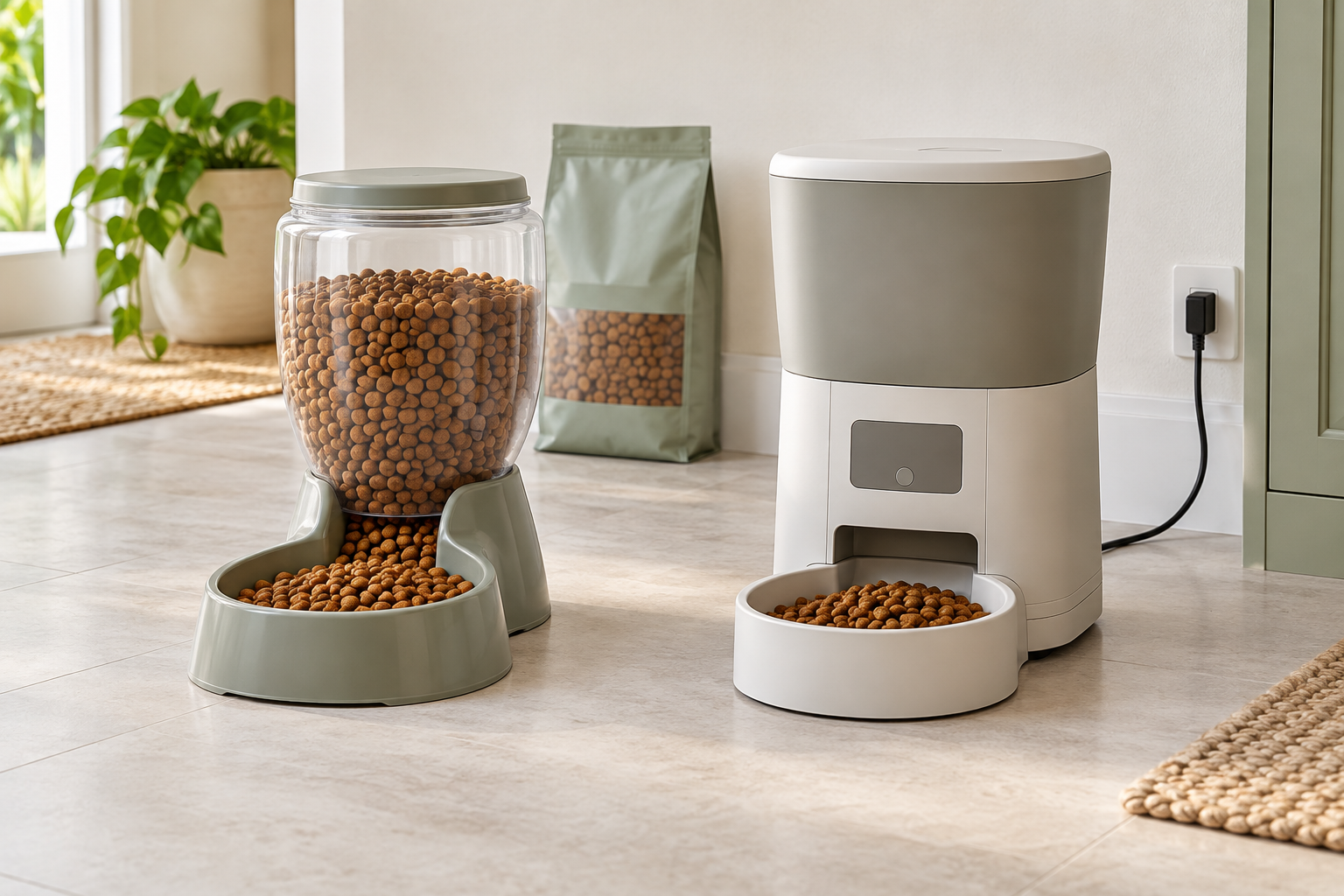
Quick Answer: Who Each Format Fits
A gravity feeder can fit a routine in which continual access to the established dry food is already appropriate, the pet does not empty or guard an available bowl, the exact food flows through the documented opening, and an owner will inspect the bowl and reservoir every day. Its appeal is mechanical simplicity: no clock, motor, app, or outlet. That simplicity does not provide meal timing or a dependable measured release.
A timed automatic feeder can fit an established dry-food schedule when timed releases solve a real household problem and the owner can verify the exact model's food compatibility, dispensing increments, controls, power behavior, cleaning steps, and daily output. Device “portions” are machine increments, not veterinary feeding recommendations.
Choose neither when a familiar bowl and a responsible person can serve and observe meals without adding a hopper. Also delay the purchase when appetite must be watched closely, pets compete for the same bowl, the pet can open or tip the unit, food compatibility is undocumented, or nobody can check whether food actually reached the bowl.
A Seven-Day Feeding-Workflow Worksheet
Complete this with the feeding plan you already follow. Do not use a feeder's capacity or programmed increments to create a new diet or portion. Record observations rather than estimates.
- Established plan: write down the food name, the source of the current feeding directions, and the normal serving times or access pattern. Keep the package and lot information.
- Actual food fit: record kibble shape, approximate range of piece sizes, crumbling, and any coating or mixed pieces. Compare those observations with the exact feeder manual.
- Daily presence: mark who will inspect the pet, water, bowl, outlet or chute, reservoir, and floor each day—including weekends.
- Access: note every pet that can reach the bowl, whether food is taken immediately or left behind, and any pushing, guarding, opening, chewing, or tipping attempts.
- Power and absence: list normal power, any documented backup, who receives alerts if applicable, and the named person who can serve the planned food manually.
- Cleaning cycle: record when the bowl, chute or outlet, hopper, lid, seals, and non-food-contact base will be cleaned and fully dried according to the manual.
- Stop triggers: write down the conditions that send you back to a familiar bowl or to a veterinarian: missed or extra dispensing, damaged parts, moisture, pests, refusal to eat, vomiting, pain, weakness, meaningful weight change, or another concerning change.
Labeled hypothetical example: an owner is home every morning and evening but wants a documented midday release. Their pet already eats scheduled dry meals, nobody else can reach the bowl, the selected timed model's manual covers the actual food size, and a nearby person can respond if a cycle fails. That workflow points toward comparing timed feeders. If the same household has two pets sharing the bowl or cannot check daily output, the worksheet does not support either open-access gravity feeding or an unattended timed dispenser. This example is a decision illustration, not an individual feeding plan.
Gravity vs Automatic: Practical Tradeoffs
- Dispensing control: gravity replaces food as space opens in the bowl. A timed model releases programmed device increments. Neither confirms that the intended animal ate the food.
- Power and failure modes: gravity has no clock, motor, app, battery, or power cord, but food can still bridge, jam, collect moisture, or stop moving. A timed feeder adds programming, moving parts, and power behavior that must be tested and rechecked.
- Portion visibility: a gravity bowl can remain topped up, making individual intake harder to observe. A timed release can make events easier to schedule, but only direct inspection establishes what arrived and what remained.
- Pet access: both formats usually present an open bowl. Neither separates pets unless the exact product has a distinct, documented access-control design. Competition, guarding, or food stealing needs a different setup and may require qualified help.
- Placement: gravity models need enough overhead room to remove and refill the reservoir. Timed models need that clearance plus safe cord routing or documented battery use. Both need a stable, level, washable location.
- Cleaning: both collect oils and crumbs in the bowl, outlet, hopper, lid, and seams. Timed feeders also have a mechanism and electronic base that usually require different care from removable food-contact parts.
- Noise and interaction: a gravity model may make food-shifting sounds; a timed unit may add motor tones or recorded prompts. Observe the pet during supervised trials rather than assuming either sound is acceptable.
- Cost and complexity: gravity is the simpler category, but it is not a low-cost substitute for controlled meal timing. Automatic models add features only when those features solve a documented routine problem.
Setup, Testing, and Maintenance
Retrieve the current manual for the exact model before filling it. Check the intended food type and documented piece-size range, usable hopper and bowl arrangement, assembly, lid and latch, placement limits, cleaning directions, power requirements, backup behavior, and warnings. Keep the food package rather than transferring away the manufacturer directions and lot information.
Wash and fully dry the allowed food-contact pieces before first use. Place the assembled feeder on a level washable surface where the pet cannot pull a cord, reach a loose battery, trap a collar, or tip the unit into water. Do not immerse an electronic base or improvise a cord cover, extension, replacement part, or cleaning method that the manufacturer does not approve.
Test with the actual dry food while you are present. For a gravity feeder, watch whether the outlet replenishes the bowl without bridging or releasing an unstable pile. For a timed feeder, run repeated supervised cycles and compare what reaches the bowl with the programmed device increment. Recheck after refilling, cleaning, moving the unit, changing food, changing a schedule, losing power, replacing batteries, reconnecting an app, or updating software.
Each day, look at the pet as well as the machine. Inspect remaining food, the outlet, bowl, reservoir, lid, seals, controls, cord, batteries, and surrounding floor. Remove damaged equipment from use. A camera, alert, log, or empty hopper reading is not proof that the pet ate or is well.
Who Should Skip Each Format?
Skip a gravity feeder when continuous access conflicts with the established feeding plan; intake needs close observation; another pet can take the food; the pet gulps, guards, opens, tips, or damages the unit; the food bridges or falls outside written compatibility; moisture or pests are a concern the placement cannot control; or a person cannot inspect it daily.
Skip a timed automatic feeder when the food is outside the model's written range; device increments cannot be reconciled with the established plan; local controls, clock retention, offline behavior, or backup power are unclear; the cord cannot be routed safely; nobody can respond to a missed or extra release; or app dependence and account requirements are unacceptable.
Skip both and use a familiar bowl with direct care when medication, treatment, appetite monitoring, a prescription diet, food handling, multi-pet conflict, or another individual need requires supervision. Contact a veterinarian about refusal to eat, repeated vomiting, pain, weakness, marked thirst changes, meaningful weight change, or another concerning change. A dispenser is a convenience appliance, not nutrition advice, treatment, or a substitute for appropriate in-person care.
What Current Primary Sources Establish
These sources set a narrow evidence boundary. They support product-specific operating and maintenance criteria and general package-retention practice; they do not establish that either format suits a particular animal or feeding plan.
- PetSafe Healthy Pet Simply Feed: the manufacturer's product page and linked documentation describe model-specific scheduling, supported food, device portion increments, battery or adapter operation, removable parts, and cleaning. Those details demonstrate what must be verified for one timed model—not category-wide performance or an appropriate amount for a pet.
- Petmate Replendish gravity feeder: Petmate lists a model-specific gravity feeder page. That page returned a rate-limit response during drafting on 2026-11-01, although it was retrieved successfully during editorial review later that day. The article does not use it for dimensions, capacity, materials, cleaning, or performance claims.
- U.S. Food and Drug Administration: the FDA's pet-food storage guidance recommends keeping food in its original container when possible and retaining the lot number, and says to follow storage instructions on the bag or container. It does not determine feeder choice or an individual feeding amount.
Documentation boundary: manufacturer pages can change, and category guidance cannot replace the current instructions for the exact model in hand. Before use, match the model identifier to its current manufacturer page or manual and confirm food compatibility, setup, cleaning, power requirements, and package directions. If those exact-model instructions or the food directions cannot be obtained, do not rely on the dispenser.
Next-Step and Pillar Links
If controlled timing is the confirmed need, compare automatic feeder mechanisms for scheduled dry meals, including basic hopper, rotating-tray, and connected formats. If selective access between pets is the actual problem, use the separate microchip feeder format guide rather than assuming timing will separate them. Build the surrounding routine with the low-mess feeding-station guide, then return to the new-pet essentials pillar for the wider bowl, storage, cleanup, and daily-care setup.
Bottom Line
Choose gravity only when continual access is already appropriate and passive refill fits a closely observed routine. Choose timed automatic dispensing when scheduled releases solve a real problem and the exact food, device increments, power behavior, cleaning, and fallback plan have all been verified. When intake or welfare needs close observation, the better answer is neither machine: use a familiar bowl and responsible in-person care.