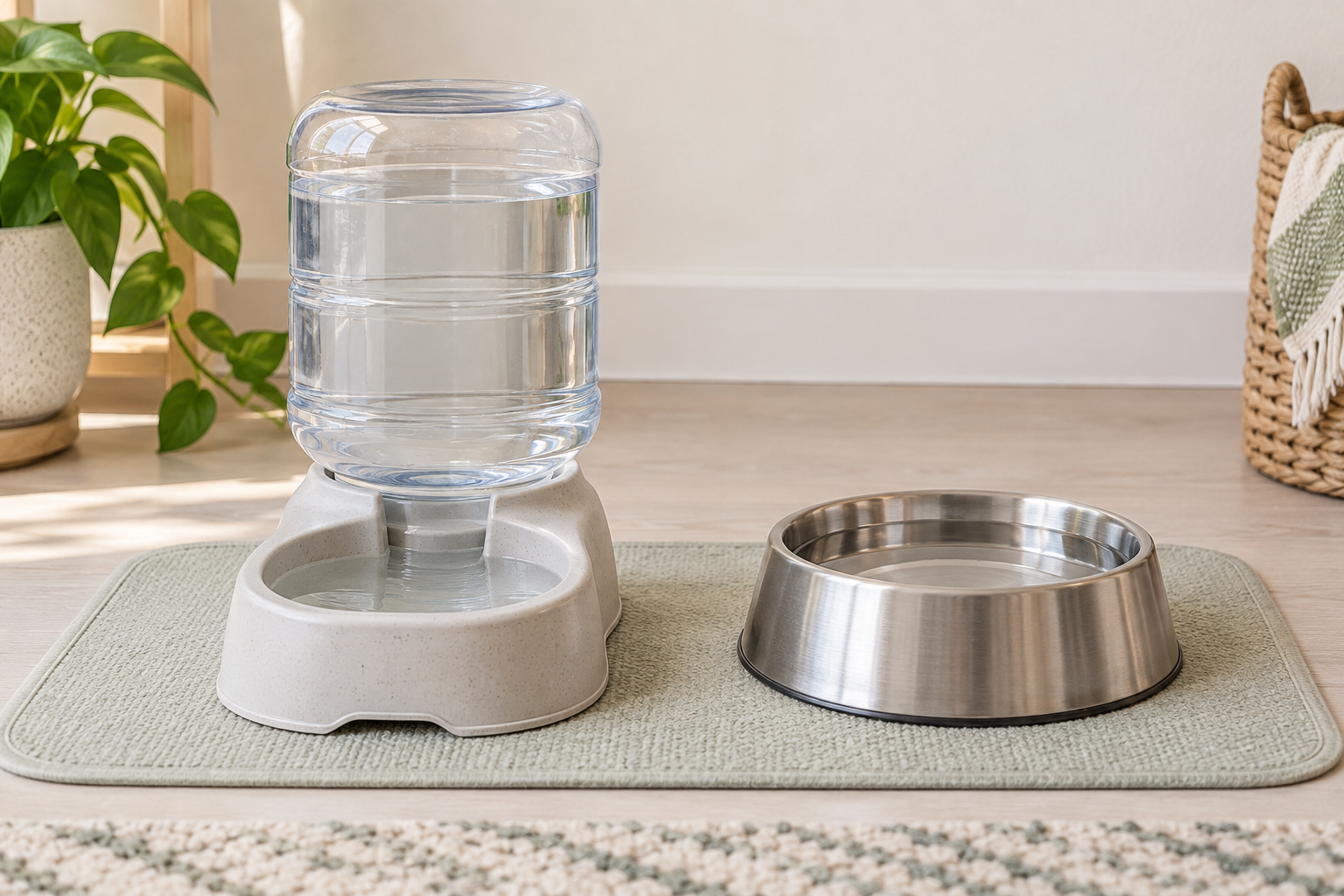
Both formats can hold drinking water, but neither is a health solution or a substitute for observation and routine care. A gravity model releases water from an inverted reservoir into an attached basin; it does not circulate or filter water. Contact a licensed veterinarian about a sudden or concerning change in drinking, appetite, urination, energy, or behavior instead of trying to solve it by changing equipment.
Quick Comparison
Gravity dispenser: more stored capacity and fewer ordinary top-ups, balanced against more filled weight, more parts, a larger footprint, and a longer wash-and-dry routine. Standard bowl: easier to see, carry, wash, dry, and place in several rooms, balanced against more frequent checks and refills when its usable capacity is smaller. Neither wins automatically: the better choice is the one your household can inspect, refresh, clean, and keep accessible every day.
When a Gravity Dispenser Fits Better
A dispenser fits when your current bowl needs repeated top-ups during normal household activity and a reservoir would remove meaningful friction without reducing how often you check the station. It also needs a level, low-traffic location with room for the full base and a sink or tub that accommodates every washable part.
Before buying, calculate how awkward the filled reservoir may be, not just how much it holds. Check the maker's filling and inversion method, intended handling points, reservoir opening, valve access, basin removal, and wash directions. A larger model is a poor fit if the person maintaining it cannot comfortably carry, seat, disassemble, or dry it as directed.
When a Standard Bowl Fits Better
A standard bowl fits when top-ups already align with a dependable routine and you value a clear view of the water and interior surface. One-piece bowls usually reduce the number of seams, valves, and enclosed areas to inspect. Several modest bowls can also provide separate access points without concentrating pets around one large station.
Compare usable diameter and depth rather than relying on labels such as “large.” A wide opening may make the water easier to see and reach, but confirm the bowl fits the pet, the available floor space, and your washing area. A heavy bowl may move less during normal use but is harder to lift; a light bowl is easier to handle but may shift. Treat nonslip and spill-related wording as manufacturer claims, not guarantees.
Tradeoffs That Should Decide the Purchase
- Refill routine: note actual top-ups for several ordinary days before paying for more capacity.
- Visibility: check whether water and interior surfaces remain easy to inspect under normal room lighting.
- Cleaning access: confirm that hands or maker-approved brushes reach the reservoir, valve, basin, rim, and seams.
- Drying: allow space and time for every washed component to dry as directed before reassembly.
- Filled handling: consider water weight, grip, inversion, and the route between the sink and feeding area.
- Footprint: measure the complete base plus comfortable approach space, door clearance, and walking paths.
- Floor care: match any mat to the floor and product base, keep it flat, and clean recurring drips promptly.
- Replacement path: stop using damaged, cracked, rough, unstable, or incorrectly operating equipment and follow the maker's support guidance.
Multi-Pet Access and Placement
A single high-capacity station is not necessarily a better multi-pet setup. Watch whether each pet can approach and leave without squeezing past another animal, furniture, or a busy doorway. Separate bowls in different appropriate locations may offer simpler access and make it easier to notice which station is being used.
Introduce a new format while a familiar water option remains available unless a veterinarian has given different instructions. Do not force use. Place either format away from steps, electrical cords, door swings, and areas where it is likely to be kicked. Inspect for chewing, pawing, crowding, or avoidance and adjust the setup rather than relying on capacity alone.
Who Should Skip Each Format?
Skip a gravity dispenser when ordinary bowls are already easy to maintain, the filled reservoir is difficult to lift, the parts are hard to reach, or the assembled unit crowds the room. Skip it when a large shared basin creates tension or poor access. Skip a small standard bowl when documented top-ups repeatedly interrupt the routine and an appropriately sized, equally maintainable bowl or second station would not solve the issue.
Delay either purchase when you cannot verify materials, measurements, care instructions, or damaged-part guidance. Equipment is also the wrong next step when a change in drinking or urination is the concern; contact a veterinarian promptly for advice appropriate to the individual pet.
Related Decisions
Use the new-pet essentials guide to keep a first setup focused on maintainable basics. If circulating water is the actual question, compare the added pump, filter, cord, and cleaning work in the pet water fountain worth-it guide. For recurring splash rather than refill frequency, compare no-spill bowl varieties without assuming any format eliminates mess.
Bottom Line
Choose a gravity dispenser for a real capacity need only when its filled weight, footprint, visibility, disassembly, cleaning, and drying all fit the household. Choose a standard bowl for straightforward inspection, washing, flexible placement, and multiple access points. Whichever format you use, keep checking and refreshing it as part of the daily routine.