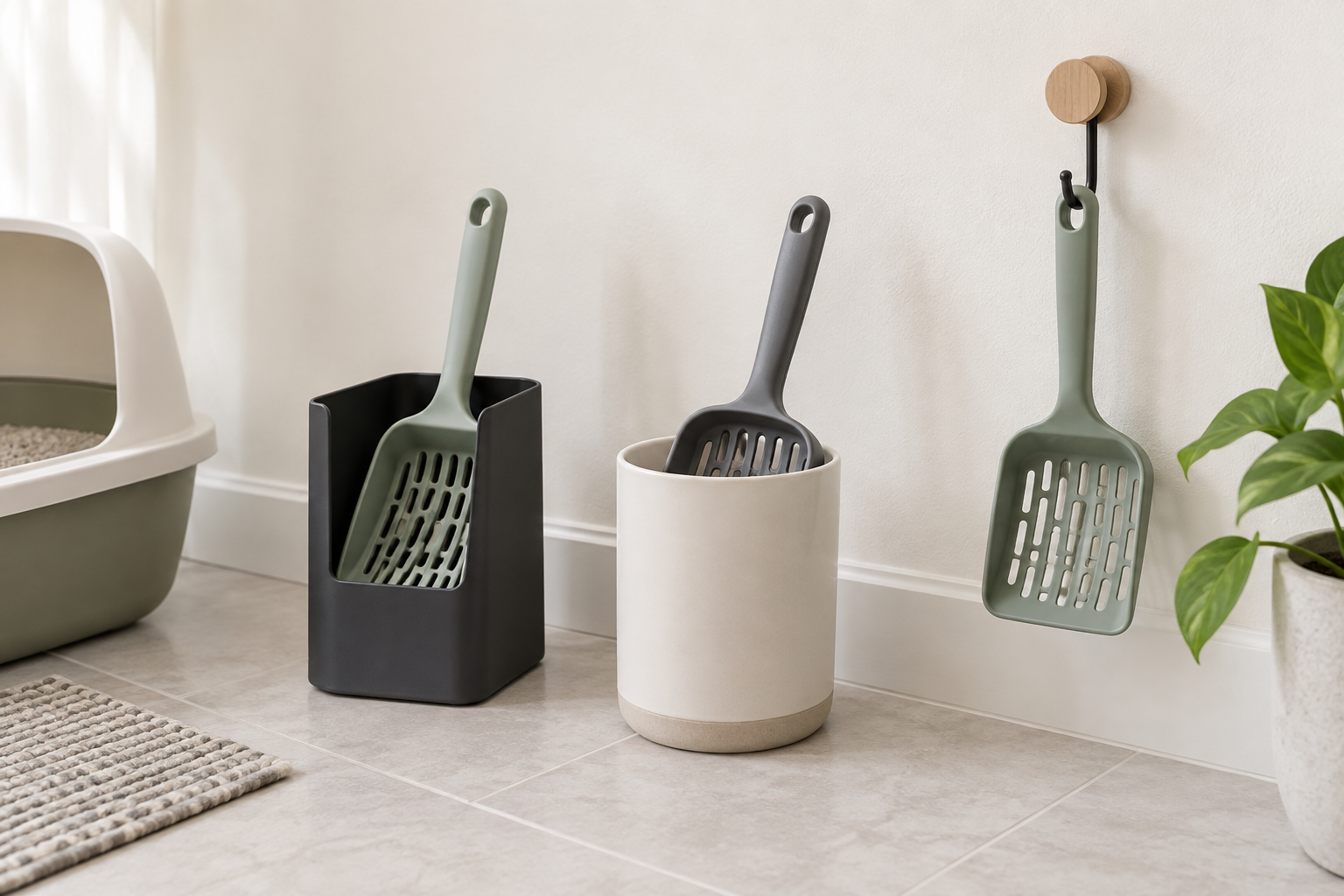
A holder is a storage convenience, not a hygiene or odor solution. Remove litter from the scoop, follow its cleaning directions, and let it dry before storage. Contact a licensed veterinarian promptly about straining, pain, blood, litter-box avoidance, or abrupt urine or stool changes rather than looking to an accessory for an answer.
Quick Decision: Buy, Repurpose, Mount, or Skip
Buy a dedicated holder when the scoop needs stable floor storage and a fitted caddy makes loose-granule cleanup simpler. Repurpose a washable container when one already fits the basket, stays upright, and is fully reachable for cleaning. Mount a hook when floor clearance matters and the scoop, wall, and mounting method are compatible. Skip when the scoop stores securely elsewhere or every option would obstruct the box or walking path.
The Six-Part Worth-It Test
- Scoop fit: Does the entire basket enter without scraping, wedging, or forcing the handle to lean?
- Stable footprint: Is the base broad enough for the scoop's weight and removal angle?
- Cleaning access: Can you remove an insert or reach every interior surface?
- Drying: Can the cleaned scoop and holder dry fully before they are put back together?
- Placement: Does the setup clear the litter-box lid, doorway, vacuum path, and normal foot traffic?
- Pet access: Can it stay away from chewing, play, food, water, and children's items?
Measure the Scoop Before the Holder
Measure the basket at its widest and deepest points, the handle length, and the total height when the scoop sits at its natural angle. Compare those figures with the holder's usable opening and interior—not only its outside dimensions. A narrow opening can catch a broad basket, while a shallow cup can leave a long handle top-heavy.
For a floor holder, measure the full base and the clearance needed to lift the scoop without striking a shelf or box lid. If the holder includes a drip tray or removable insert, confirm that you can pull it out without moving the litter box.
When a Washable Container Is Enough
A smooth, stable container you already own may do the same organizational job. It should be reserved for the litter area, wide enough that the basket does not wedge, heavy or broad enough to remain upright, and simple to empty and clean. Avoid containers with inaccessible seams, fragile materials, sharp damage, or a shape that traps the scoop while you lift it.
Repurposing is less appealing when the container tips, leaves much of the basket exposed over a busy path, or cannot be cleaned according to its material. Run the setup through several ordinary cleanup cycles before buying anything; repeated friction is better evidence than an imagined need.
When a Wall Hook Fits Better
A wall hook keeps the floor open, but only when the scoop has a suitable hanging hole and the chosen surface accepts the specified mounting method. Measure the handle opening, hook projection, scoop swing, and distance from the litter box. The hanging scoop should not block box access or brush against nearby supplies.
Follow the hook maker's surface preparation, load, and installation directions. Adhesive products may not suit every finish, and drilled hardware requires appropriate wall material and placement. Provide a suitable place for any remaining dry granules rather than assuming a hook contains them.
Cleaning and Placement Tradeoffs
An open holder makes debris visible and can be easier to reach. An enclosed shape hides more of the basket but may add corners and inserts to clean. Neither format is automatically more sanitary. The useful question is whether you can see residue, reach all surfaces, follow material care directions, and allow every part to dry.
Keep the holder on a level surface away from food preparation, pet bowls, children's items, and busy walking routes. Check plastic for cracks and metal or coated parts for damage. Stop using a holder or hook when wear makes support unreliable, and follow the maker's replacement guidance.
Who Should Skip a Dedicated Holder
Skip one if an existing washable container works without tipping, if a secure hook fits the space, or if the scoop already stores in a dedicated cleaning area. Also skip a floor holder when it narrows a tight route, an enclosed holder when the interior is difficult to inspect, and any model whose usable dimensions or care instructions are unclear.
The holder cannot fix a scoop that is poorly matched to the litter texture or box depth. Start with the litter scoop selection guide if the working tool is the real problem. For granules outside the box, compare whether a litter mat is worth it as a separate decision.
Bottom Line
A litter scoop holder is worth buying when a measured, stable, washable caddy solves a repeated storage and loose-granule problem better than equipment you already have. Test a suitable washable container first, consider a compatible wall hook when floor clearance matters, and skip the purchase when it merely adds another hard-to-clean object.
If you choose dedicated storage, compare a freestanding holder with a wall-mounted scoop hook by footprint, mounting permission, drip handling, and cleaning. The scoop-and-holder guide covers matched formats. Browse the cleanup and odor-control guide hub for the wider litter-area routine.