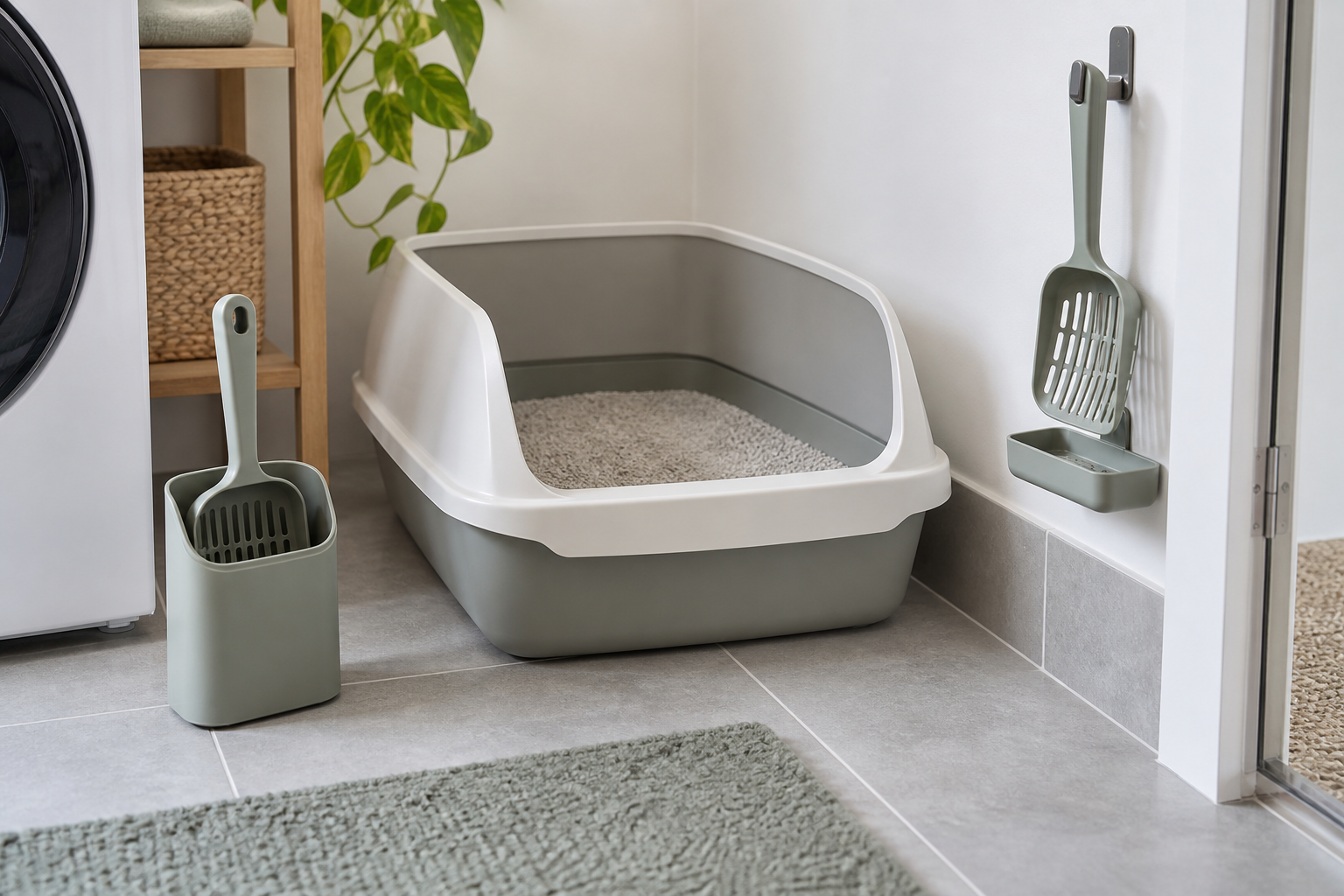
Quick Decision
- Choose a holder if a stable base fits beside the box and you prefer lifting the entire setup for cleaning.
- Choose a wall hook if floor clearance is scarce, mounting is allowed, and the scoop will not swing into the box or nearby supplies.
- Skip both if a washable container you already own fits securely in a dedicated cleaning area.
Floor Space vs Wall Permission
Measure the holder's exterior base, not just the scoop basket. Leave room to remove it without shifting the litter box. In a narrow space, check door swing, vacuum access, and the cat's route into and out of the box.
For a hook, identify the wall material and follow the maker's installation directions. Adhesive mounts may not suit every paint, tile, humidity level, or texture; drilled mounts require appropriate hardware and permission. Never guess at a load limit or mounting method.
Scoop Fit and Drip Handling
A holder should accept the scoop basket without forcing the handle to lean precariously. Compare the opening, internal depth, and base stability with the scoop you already use. An insert or tray is useful only if you can remove, inspect, wash, and dry it.
A hook must fit the handle opening and keep the scoop from rotating off. A small removable tray below it may catch dry granules, but a hook alone does not contain debris. Neither format makes a scoop sanitary or controls odor; both still require a routine based on product care directions.
Cleaning and Drying
Simple shapes with reachable corners are easier to inspect. Follow material-specific washing instructions, remove loose litter first, and allow every part to dry before reassembly. Do not mix litter tools with food-preparation or pet-feeding items.
A mounted setup also asks you to clean the hook, tray, and nearby wall without damaging the surface or loosening the mount. If that is awkward, a removable floor holder may be the more practical choice despite its footprint.
Pet Access and Placement
Keep either setup outside the litter-box entrance and away from food, water, children's items, and busy paths. A hanging scoop should not swing within easy chewing or pawing reach. Inspect hooks, adhesives, fasteners, holders, and scoop handles for cracks, looseness, or other damage.
Who Should Skip Each Format?
Skip a freestanding holder if it tips, blocks cleaning access, crowds the cat's route, or has inaccessible seams. Skip a wall hook if mounting is prohibited, the surface is unsuitable, the scoop handle cannot sit securely, or there is no sensible way to manage falling granules.
If the scoop itself is the problem, compare litter scoop basket and handle formats. If you want a matched set, the scoop-and-holder guide covers open, enclosed, and wall-mounted varieties.
Bottom Line
A freestanding litter scoop holder favors portability and containment at the cost of floor space and another container to wash. A wall-mounted hook favors floor clearance but adds surface, installation, load, and drip-management questions. The better choice is the one that fits your measured scoop and space, stays out of the cat's path, and remains genuinely easy to clean.
For the wider litter-area routine, browse the cleanup and odor-control hub.