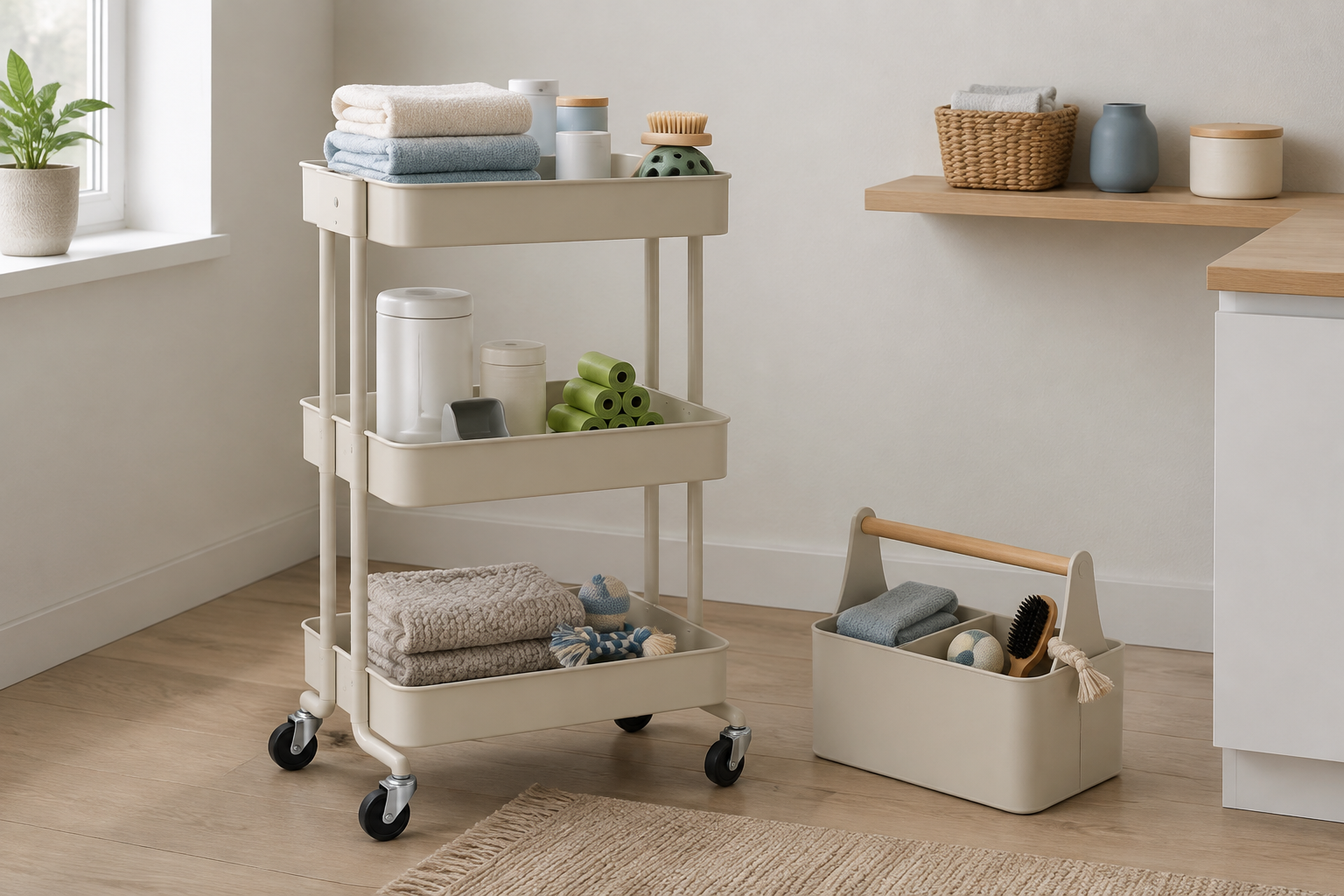
This is a storage and workflow decision, not a recommendation to keep every pet item in open reach. Store food, cleaners, medicines, sharp grooming tools, cords, and other restricted items according to their labels and away from pets and children.
Quick Decision: Buy, Skip, Delay, or Repurpose
Buy a cart when a stable group of ordinary supplies moves between rooms several times a week and the cart has a safe parking place. Choose a caddy when the moving kit is small enough to carry comfortably. Use fixed storage when routines happen in one place. Delay until you have measured the route. Repurpose an existing cart only after checking its wheels, fasteners, shelf edges, stated load, and suitability for the items.
The Six-Part Worth-It Test
- Repeated route: Do the same supplies genuinely move between two or more rooms?
- Clear footprint: Can the cart park without narrowing a walkway, doorway, or working area?
- Passable path: Does its widest point clear doors, corners, rugs, thresholds, and furniture?
- Stable storage: Do shelf lips, spacing, and the maker's stated load suit the planned items?
- Controlled access: Can anything unsuitable for open storage remain in secure closed storage?
- Maintainable setup: Can you remove items, wipe shelves, inspect casters, and avoid clutter buildup?
Measure the Cart at Rest and in Motion
Use the product's assembled width, depth, and height—not a photo—to mark the parking area with removable tape. Include handle projections and wheel sweep. Then measure the narrowest doorway, the tightest turn, and any threshold or rug edge on the proposed path.
Check the shelf's usable interior dimensions as well as the overall cart dimensions. Tall bottles, folded towels, brushes, and bins need enough vertical clearance without being balanced above the shelf edge. Follow the manufacturer's load and assembly directions rather than estimating capacity from appearance.
When a Caddy or Fixed Shelf Is Better
A handled caddy makes sense when the mobile kit is light and compact, especially if it can return to closed storage after use. The pet supply caddy guide compares rigid divided, washable tote, and lidded formats by routine.
Fixed shelves or cabinets are usually better when supplies belong to one station, floor space is scarce, or pets investigate open tiers. Wall-mounted storage requires the right wall, hardware, load guidance, and permission; a cabinet or existing closet may be the lower-effort answer.
Pet Access, Stability, and Clutter
Locking casters may help keep a parked cart from rolling, but they do not make it tip-proof or appropriate for every floor. Keep the load balanced, place heavier suitable items low, follow the maker's instructions, and inspect wheels and fasteners. Do not let a pet climb, pull objects from, or chew the cart.
Open tiers make supplies visible, which can improve routines and encourage overfilling at the same time. Give each shelf one job and leave enough space to remove items without disturbing the rest. If the cart cannot be wiped and reset easily, it is probably storing too much.
Cost and Skip Criteria
A cart adds wheels, frame hardware, assembly, and permanent floor use. Those features are poor value when a basket you already own handles the route, when the cart would stay in one room, or when there is no safe parking place. Skip any option that lacks clear assembled dimensions, load guidance, or care instructions.
For a broader essentials audit, use the starter pet supply guide to prioritize routines before adding storage. For compact items that do not need to move daily, compare under-bed pet supply storage.
Bottom Line
A pet supply cart is worth it in a small home when it replaces repeated armfuls, passes through a measured route, parks without stealing useful circulation space, and keeps appropriate items orderly. Choose a caddy for a smaller moving kit and fixed storage for one-room routines. If a compact bathroom is the parking spot, compare narrow cart formats by exact footprint and shelf clearance.