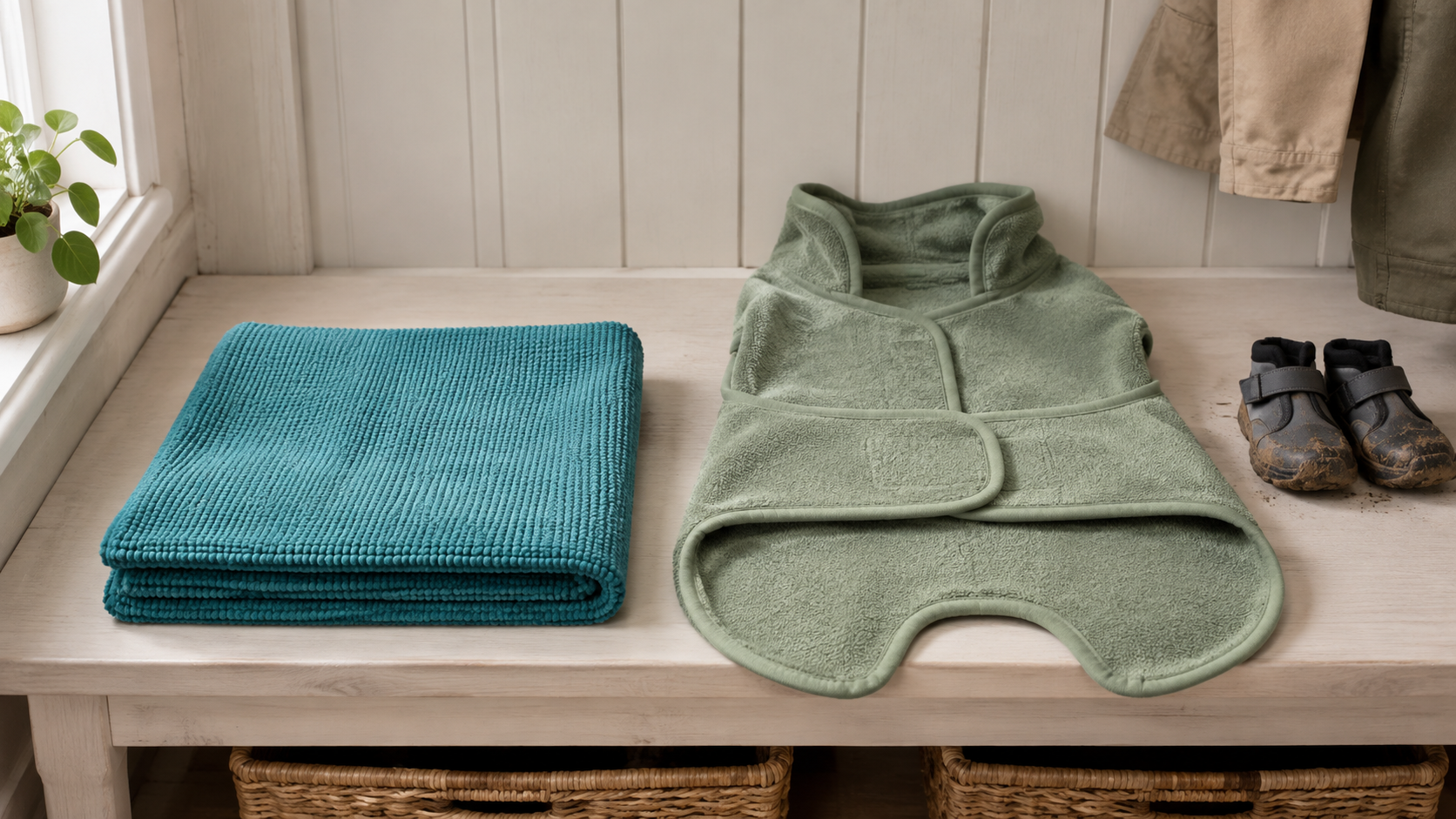
Neither format guarantees a dry coat, protects furniture by itself, or replaces checking the paws and skin. A robe is a convenience garment, not a health product, and a wet dog should not be left unattended in one. Stop if the dog freezes, paws at the fabric, chews a closure, overheats, or shows discomfort.
Quick Comparison
Choose a microfiber towel when you want the lowest-fuss option, need to dry paws and underside precisely, have more than one dog shape to handle, or want compact storage.
Choose a towel robe when the dog readily accepts clothing, the measured size leaves comfortable movement, and you want coverage while you finish putting away wet gear.
Use both when a towel handles the paws, belly, and initial water, then a robe catches some remaining dampness from the body. The robe should go onto a towel-dried—not dripping—dog.
Skip the robe if clothing causes stress, the fit is uncertain, closures invite chewing, or a regular towel already completes the job.
Microfiber Towel: Flexible and Easy to Aim
A rectangular towel can move from paws to legs, belly, chest, and back in the order the mess demands. It has no neck opening or belly strap to size, and one appropriately sized towel may work across dogs in a household. Hand-pocket versions can make the grip more predictable, but pocket placement also fixes where your hands sit.
Where a towel fits best
- Quick wet-walk cleanup at the door.
- Targeted drying around paws and the underside.
- Dogs that dislike garments or fastening sounds.
- Small storage spaces and travel bags.
- Homes that can rotate two towels while one dries.
Towel tradeoffs
Drying is an active job, so a restless dog may walk away before you finish. A towel can become saturated, spread grit from one area to another, or be too small for a larger or thick-coated dog. Compare usable dimensions and fabric weight, and keep a clean section for the face rather than wiping it after muddy paws.
Towel Robe: More Coverage, More Fit Questions
A robe stays around the back and sides through a neck opening, wrap, belt, or belly panel. That can be convenient after the first towel pass, but coverage varies: many robes do not reach lower legs, paws, underside, ears, or tail. You still need a towel for those areas.
Where a robe may fit
- The dog remains relaxed while clothing is put on, worn briefly, and removed.
- The size chart matches measured neck, chest or girth, and back length.
- Closures sit flat without pressing, gaping, trailing, or blocking movement.
- You can supervise the whole wearing period and remove the damp robe promptly.
- The extra laundry and drying space fit the routine.
Robe tradeoffs
A generic size label is not enough. Too-small neck or chest openings can be restrictive; loose straps can shift or invite chewing. Thick wet fabric can also feel heavy. Do not use a robe to warm a dog, manage a skin problem, or decide whether a dog is medically comfortable—ask a licensed veterinarian when temperature, skin, pain, mobility, or persistent shivering is a concern.
Measure Before Choosing a Robe
- Back length: Follow the brand's named start and end points rather than assuming every maker measures the same way.
- Neck: Check the finished opening and whether it pulls over the head or fastens around the neck.
- Chest or girth: Measure where the maker specifies and account for the dog's coat without adding an arbitrary amount.
- Belly and leg clearance: Confirm panels and straps will not interfere with normal standing or walking.
- Closure position: Look for smooth placement away from areas the dog can easily mouth.
Fabric, Laundry, and Storage
“Microfiber” describes a broad material category, not a guarantee of absorbency, drying speed, softness, or durability. Check the current material label and care instructions. Avoid fabric softener, heat, bleach, or machine drying only when the maker says to; there is no single care rule for every towel or robe.
Shake off dry grit outdoors when appropriate, wash soiled pieces according to their labels, and dry every layer fully before storage. Robes with overlapping panels, binding, and closures may take longer than a flat towel. Inspect seams, loops, hook-and-loop tabs, snaps, and elastic before each use, and retire damaged pieces that can shed or expose loose parts.
Dog Tolerance and Supervision
Introduce any wearable item calmly and briefly. Do not force a robe onto a dog that backs away, stiffens, hides, mouths the fabric, or struggles during fitting. A towel may also be uncomfortable when rubbing is vigorous, so blot and press as appropriate for the coat rather than scrubbing sensitive areas.
Persistent skin redness, soreness, odor, hair loss, wounds, limping, repeated paw licking, or distress during ordinary handling warrants a licensed veterinarian. A qualified force-free trainer can help when handling or clothing reliably causes fear, but a product purchase should not be presented as behavior treatment.
Who Should Skip a Dedicated Drying Product?
Skip a new purchase if clean household towels already handle occasional rain, there is no place to dry another bulky item, or the dog rarely comes home wet. Skip a robe specifically when fit cannot be confirmed, the dog does not tolerate clothing, or supervision is not realistic. The useful choice is the simplest setup that dries the dog comfortably without adding a new struggle.
Bottom Line
A large microfiber towel is the more versatile starting point for most wet paws, baths, and quick cleanup because it is easy to aim, share, store, and remove. A towel robe earns its extra fit and laundry work when a measured, clothing-tolerant dog stays damp across the body after the first towel pass. Compare actual dimensions, closures, care directions, and drying space—not marketing shorthand.
For robe-specific formats and a current named-product starting point, continue to the dog towel robe buying guide. For the complete entry routine, use the pet doorway cleanup station guide.