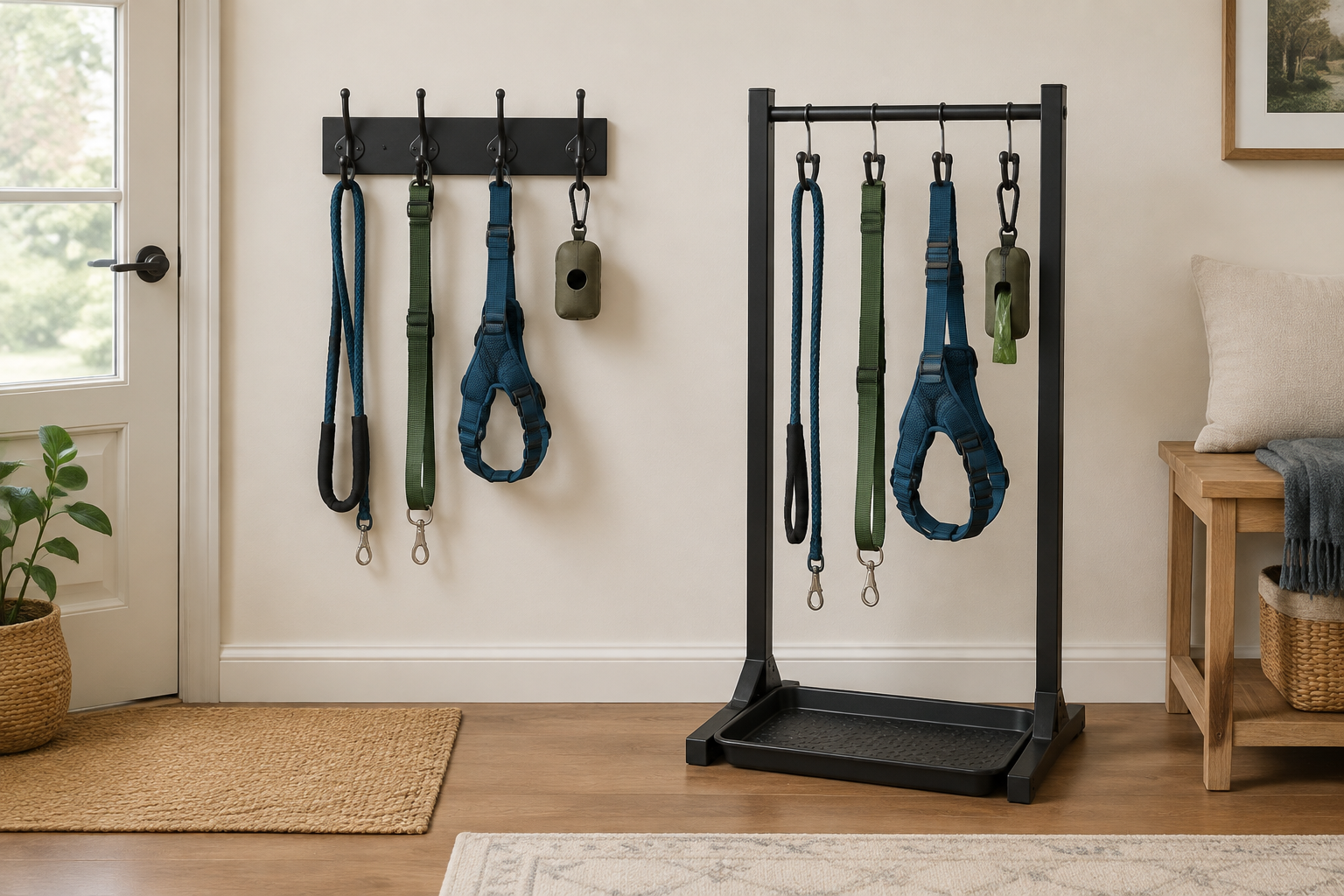
This is a storage-format comparison, not a claim that either rack makes walking gear safer or extends its life. Never tether a pet to storage hardware. Follow each leash or harness maker's inspection and care directions, and replace damaged walking gear as directed.
Quick Comparison
Choose wall hooks when floor space is scarce, you have a suitable mounting surface, and the station can stay in one place.
Choose a freestanding rack when drilling is not allowed, the layout changes, and a stable measured base can sit outside the walking path.
Add a separate drip tray when damp leashes are common and the tray can be removed and cleaned without making the rack unstable.
Skip both when an existing cabinet or securely installed household hook already keeps gear accessible, dry, and away from pets.
Wall Hooks: Small Footprint, More Installation Work
A wall rail or spaced individual hooks can use an otherwise empty vertical strip. The floor stays open for shoes, a washable mat, or normal foot traffic. Hook height and spacing are easy to tailor when several leashes and a bulky harness need separate positions.
The tradeoff is the wall. Drywall, masonry, wood, tile, and hollow doors need different hardware and may have different load limits. Confirm the rack maker's mounting directions and the lease or property rules before drilling. Adhesive hooks are still surface-dependent and can fail or damage paint, so they are not automatically a risk-free renter option.
Freestanding Rack: Flexible Placement, Real Floor Cost
A freestanding rack can move between an entryway and mudroom and avoids permanent holes. It may be useful when a household expects to move or cannot identify a suitable wall. Its total footprint includes the base, the sway of hanging straps, and the room needed to reach each hook—not just the upright frame.
Check the assembled height, base width and depth, product weight, stated load, and leveling or assembly directions. Place heavier gear low only when the maker permits it. A narrow decorative stand that tips when one leash is pulled sideways is a poor substitute for purpose-fit storage.
Measure the Setup, Not Just the Rack
- Wall or floor zone: Record usable width, base depth, trim, switches, outlets, door swing, and walking clearance.
- Longest loop: Hang the longest leash or harness from a temporary point and measure its drop so clips stay off the floor.
- Hook spacing: Allow bulky harnesses and damp straps to hang without becoming one dense bundle.
- Working reach: Check that adults can remove daily gear without pulling across other hooks or leaning over an unstable base.
- Pet access: Keep loops, clips, bag rolls, and the rack itself away from chewing, pawing, and entanglement.
Wet Gear, Drips, and Cleaning
Neither format manages water by itself. Damp webbing needs the spacing and care specified by its manufacturer, while drips need a floor-safe cleanup plan. With wall hooks, confirm that wet gear will not rest against paint or trim. With a freestanding rack, a removable shallow tray can define the drip zone only if it fits fully beneath the gear and does not interfere with the base.
Wipe the surrounding floor promptly and clean the hooks, base, and tray according to their material instructions. Do not claim corrosion resistance, floor protection, or faster drying unless the current product information supports it. The leash drying rack guide is the better next step when airflow and repeated wet-weather use are the central problem.
Who Should Skip These Racks?
Skip exposed storage when a pet pulls hanging straps, chews hardware, or can become caught in loops. Closed storage may be more appropriate. Skip wall hooks when the mounting surface or permission is uncertain, and skip a freestanding rack when its base would narrow an exit, catch feet, block a door, or invite climbing.
You also do not need dedicated pet storage simply because it is labeled for pets. A compatible, securely installed household hook or closed cabinet may handle the same inventory. If walking involves bolting, lunging, escape, or handling that feels unsafe, an organizer will not solve it; ask a certified trainer or another qualified professional about the walking setup.
Bottom Line
Wall leash hooks are usually the cleaner fit for a tight entry when permanent mounting is allowed and the surface is understood. A freestanding leash rack is more flexible for renters and changing layouts, but only when its broad measured base stays stable and clear of traffic. Choose from the room outward: inventory the gear, measure its hanging drop, protect the walking path, and keep every loop beyond pet reach.
For the wider routine, use the walking, travel, and outing gear hub and the doorway cleanup station guide.