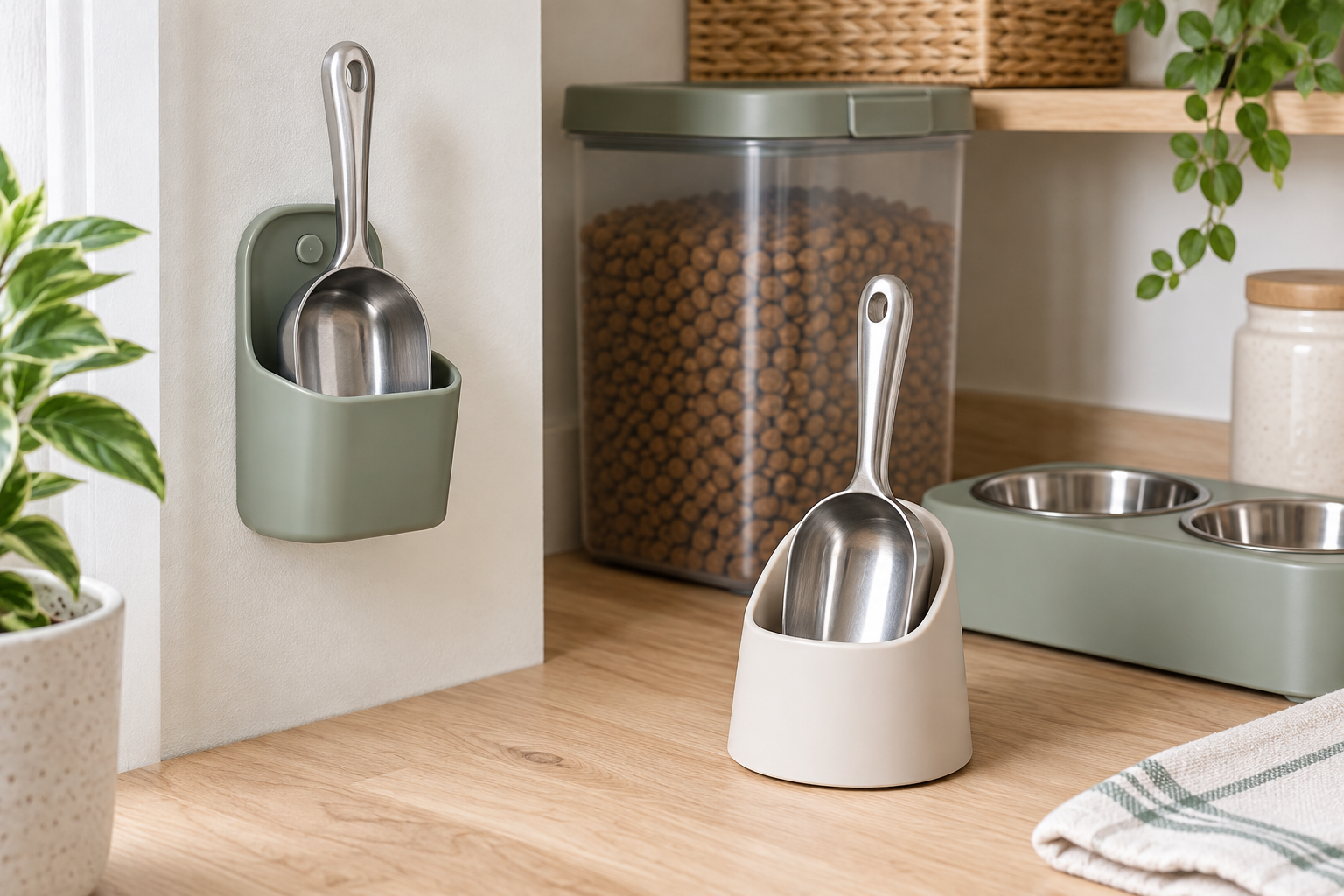
The Quick Answer
A wall-mounted holder trades installation and surface compatibility for a clear counter. A countertop holder trades counter space for simple placement and portability. Neither format is automatically cleaner: the practical choice is the one you can reach, remove, inspect, wash, and dry without placing the scoop near litter tools, cleaning chemicals, or dirty dishes.
Measure Before Choosing
- Scoop fit: measure the widest part of the scoop bowl, handle width, total length, and any hanging opening.
- Holder opening: confirm the scoop can enter and leave without scraping, wedging, or leaning out.
- Loaded clearance: allow room above to lift the scoop and around it so the handle does not hit a shelf or cabinet.
- Wall or counter space: check mount dimensions and projection, or trace the countertop base and the space needed to lift it.
- Cleaning access: prefer a holder whose interior and seams are reachable and whose care directions fit your routine.
- Pet reach: keep the scoop and holder away from curious noses, paws, chewing, spills, and busy walkways.
When a Wall-Mounted Holder Fits
A mounted holder fits when counters are crowded and a permitted wall or cabinet surface sits close to the food-preparation area. Check whether the mounting plate and holder separate so the food-contact tool can be moved away before the surrounding surface is cleaned.
The tradeoffs are installation, fixed placement, and compatibility. Adhesive mounts may not suit textured, damp, painted, or heat-exposed surfaces; drilled mounts need suitable hardware and permission. Follow the holder maker's surface preparation, load, curing, and removal instructions. Do not guess that an attachment will hold because the scoop feels light.
When a Countertop Holder Fits
A freestanding holder fits when you rent, move the feeding setup, or want to carry the holder to the sink without detaching hardware. Look for a base that remains stable with your actual scoop and a shape that does not hide residue in deep seams.
The tradeoffs are footprint and movement. Measure with the scoop inserted, since a long handle can make a narrow base easier to tip. Keep the holder away from the counter edge and leave enough space to clean behind and beneath it. A heavy base may feel stable but can be awkward to wash.
Setup, Cleaning, and Maintenance
Store only a clean scoop that has dried fully according to its care directions. Empty any crumbs from the holder, wash it as directed, reach the bottom and seams, and let every part dry before returning the scoop. Clean the wall or counter around it without soaking or loosening the mount.
Inspect the holder for cracks, rough edges, trapped residue, loose fasteners, peeling adhesive, or a base that rocks. Replace or relocate it when it no longer supports the scoop predictably. Keep pet food preparation tools separate from litter, waste, household-cleaning, and human-food tools.
Follow the food label or veterinarian-provided portion instructions. A scoop holder is an organization accessory; it does not establish a serving amount or change the food's storage requirements.
Who Should Skip Each Format?
Skip a wall-mounted holder when mounting is prohibited, the surface is unsuitable, the scoop cannot lift out cleanly, or the holder is difficult to remove for washing. Skip a countertop holder when it crowds food preparation, tips with the scoop inserted, blocks a cabinet, or sits within easy pet reach.
Skip both when a clean measuring cup or scoop already has a dry, protected, easy-to-clean storage place. If you have not chosen a tool yet, use the pet food scoop worth-it test. For the wider feeding area, the new-pet essentials guide and low-mess feeding-station guide cover storage, bowls, mats, and cleanup together.
Bottom Line
Choose a wall-mounted holder to preserve counter space only when the mount, surface, clearance, and removal routine all work. Choose a countertop holder when tool-free placement and portability justify the footprint. Measure the actual scoop, keep it clean and fully dry, maintain the holder and surrounding surface, and skip the purchase when existing storage already does the job.