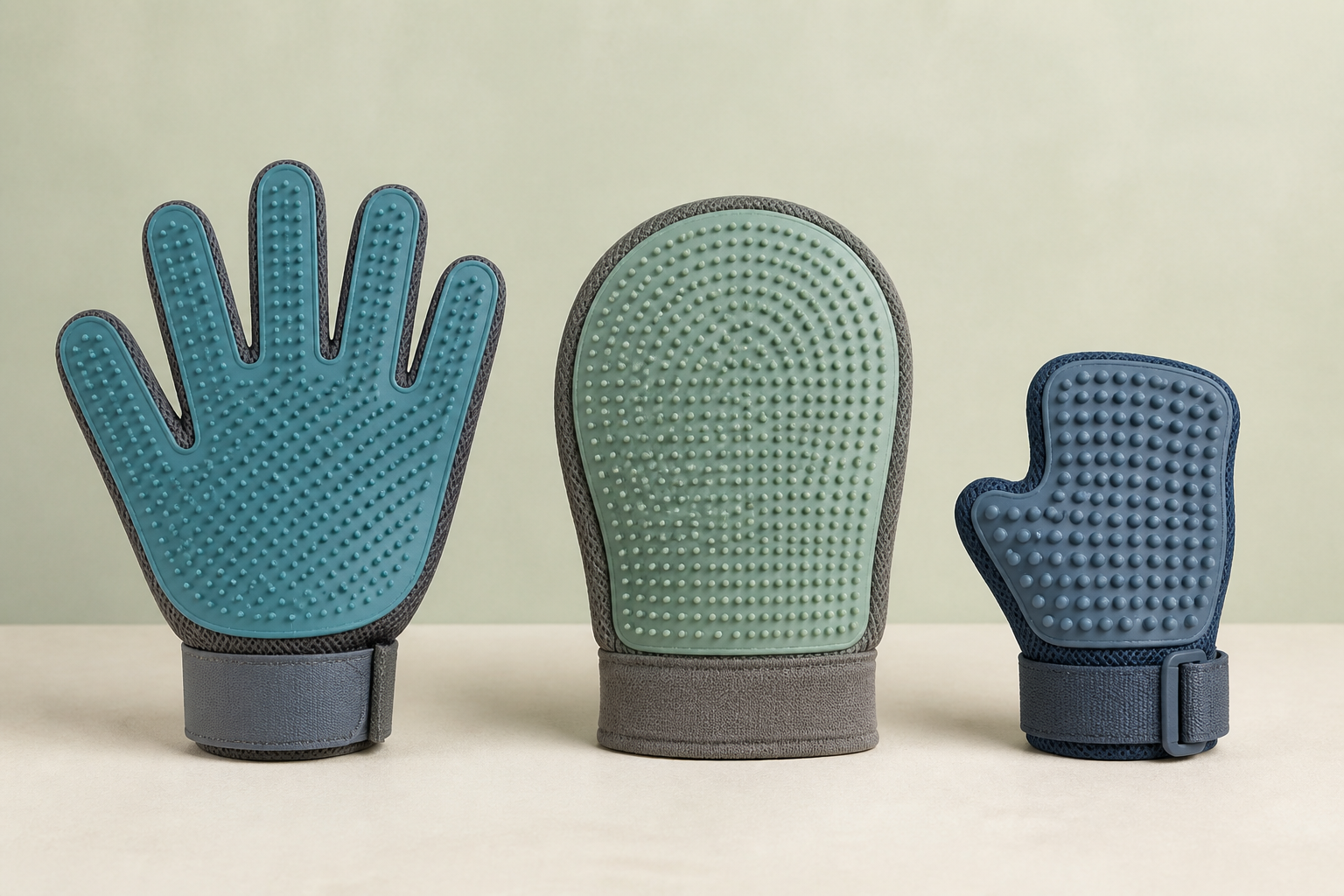
This guide is a buying framework for gentle routine contact on a healthy, comfortable coat. It does not teach mat removal, treat skin or coat problems, guarantee that a pet will become calm, or replace advice from a veterinarian or qualified groomer.
Quick Comparison: Which Glove Format Fits?
Five-finger gloves: for more hand articulation
A five-finger glove can follow shoulders and broad body contours while letting you move individual fingers. The tradeoff is fit: fingers that are too long can fold, a loose palm can twist, and a weak cuff can make pressure less predictable. Compare the actual hand-size range rather than relying on a one-size label.
Broad mitts: for a simpler shape and wider contact
A mitt has fewer seams and no separate finger channels, which may make it easier to put on, rinse, and store. Its broad contact area can also be too much for a small or touch-sensitive pet. Choose a manageable mitt size and use the pet’s response—not a “massage” claim—to judge whether the contact is welcome.
Compact adjustable-cuff gloves: for secure wrist fit
A smaller glove or palm pad with an adjustable cuff may suit owners who want less material moving around the hand. Check whether the closure stays flat, whether edges rub, and whether the contact area still gives controlled coverage. A tight cuff should not compensate for a badly sized glove.
Selection Criteria That Matter
- Hand fit: Check palm width, finger length, handedness, and cuff range. Loose folds make pressure and movement harder to control.
- Nub design: Compare nub height, spacing, flexibility, and edge finish. More or firmer nubs are not automatically more useful.
- Pressure control: Choose a glove that lets you feel how much contact you are applying instead of relying on thick padding or aggressive claims.
- Pet tolerance: Pause if your pet moves away, stiffens, hides, vocalizes, guards an area, swats, mouths, or repeatedly tries to end the interaction.
- Hair release: Look for realistic cleaning instructions. A peel-away hair layer may work only after enough loose hair collects.
- Wet or dry use: Follow the listing and care label. Do not assume a mesh-backed glove is designed for bathing or will dry quickly.
- Cleaning and drying: Check whether the glove can be rinsed, machine washed, or only wiped. Dry it fully before closed storage.
- Construction: Inspect seams, hook-and-loop closures, buckles, cracks, and loose pieces before use, and keep the glove out of chewing reach.
A Practical Comparison Framework
Start with the contact your pet already accepts. If ordinary petting is comfortable, compare a soft, flexible glove with secure hand fit and a modest contact area. Then check the stated species and coat guidance, cleaning routine, and return policy. Features such as dual-sided surfaces or hair-release ridges come after fit and control.
Grooming gloves mainly collect loose surface hair during a routine. They are not a low-skill way to pull through tangles or mats. If the glove catches, drags, or requires repeated pressure, stop rather than pushing through resistance.
Who Should Skip a Grooming Glove?
Skip home grooming when your pet is fearful of handling, may bite or scratch, has tight mats, or shows pain. Contact a veterinarian about sudden coat changes, bald areas, inflamed or broken skin, sores, swelling, parasites, persistent itching, or pain. Those are not glove-selection problems.
Also skip a new glove if your pet already accepts a simple brush that fits the coat and routine. A wearable tool is a convenience, not a behavior solution, health product, or required upgrade.
How Grooming Gloves Differ From Deshedding Tools
Grooming gloves emphasize broad, flexible hand contact and surface-hair collection. Undercoat rakes and fine-tooth tools have more specific coat-depth and edge-design considerations. If your decision is about a conventional tool rather than a wearable one, use the deshedding brush comparison. Store either format clean and dry using the criteria in our pet grooming organizer guide.
The Bottom Line
Choose a five-finger glove for articulation, a broad mitt for a simple shape, or a compact adjustable-cuff glove for secure fit. Hand sizing, flexible contact, pressure control, cleaning, and your pet’s willing participation matter more than exaggerated hair-removal or calming claims. When fear, mats, skin changes, or pain enter the picture, stop and ask a veterinarian or qualified groomer.
Once you know which routine tools your pet tolerates, keep gloves, brushes, towels, and closed supplies separated with a small-bathroom grooming organizer chosen for drying, cleaning, sharp-tool containment, and pet access.