Best Replacement Shoulder Straps for Soft Pet Carriers
A replacement strap is sensible only when the carrier itself is sound and the new clips fit its intended attachment points exactly. Start with a wide padded adjustable strap for routine hand-to-shoulder carrying, compare a slimmer strap when hardware clearance is tight, or a long sliding pad when the pad must stay under your shoulder across a wider adjustment range.
As an Amazon Associate, The Good Petly earns from qualifying purchases.
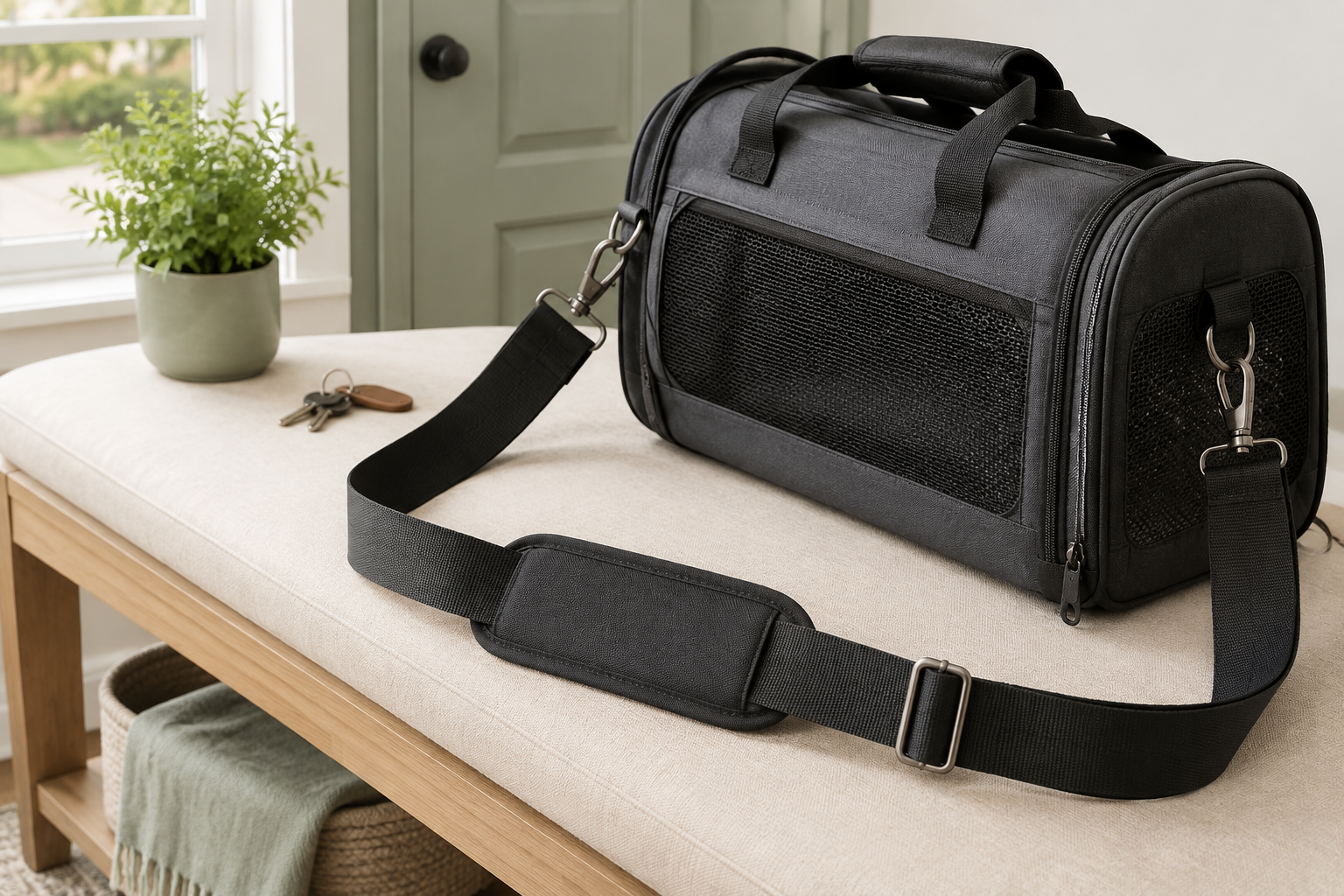
Best starting variety for routine carrying
Compare a wide padded adjustable strap first
A wider webbing-and-pad combination can spread contact over more of the shoulder, but only if the clips close fully on the carrier’s intact rings and the adjusted pad sits where you need it. A strap does not raise the carrier’s load rating or repair a worn anchor.
Three replacement strap varieties to compare
These are defined varieties, not named winners. Generic straps are not universal: measure the existing strap, both carrier rings, and the space around each ring before opening a current listing.
Wide padded adjustable strapsCompare when the clip geometry fits and you want a broad movable contact area for routine carrying.
Category route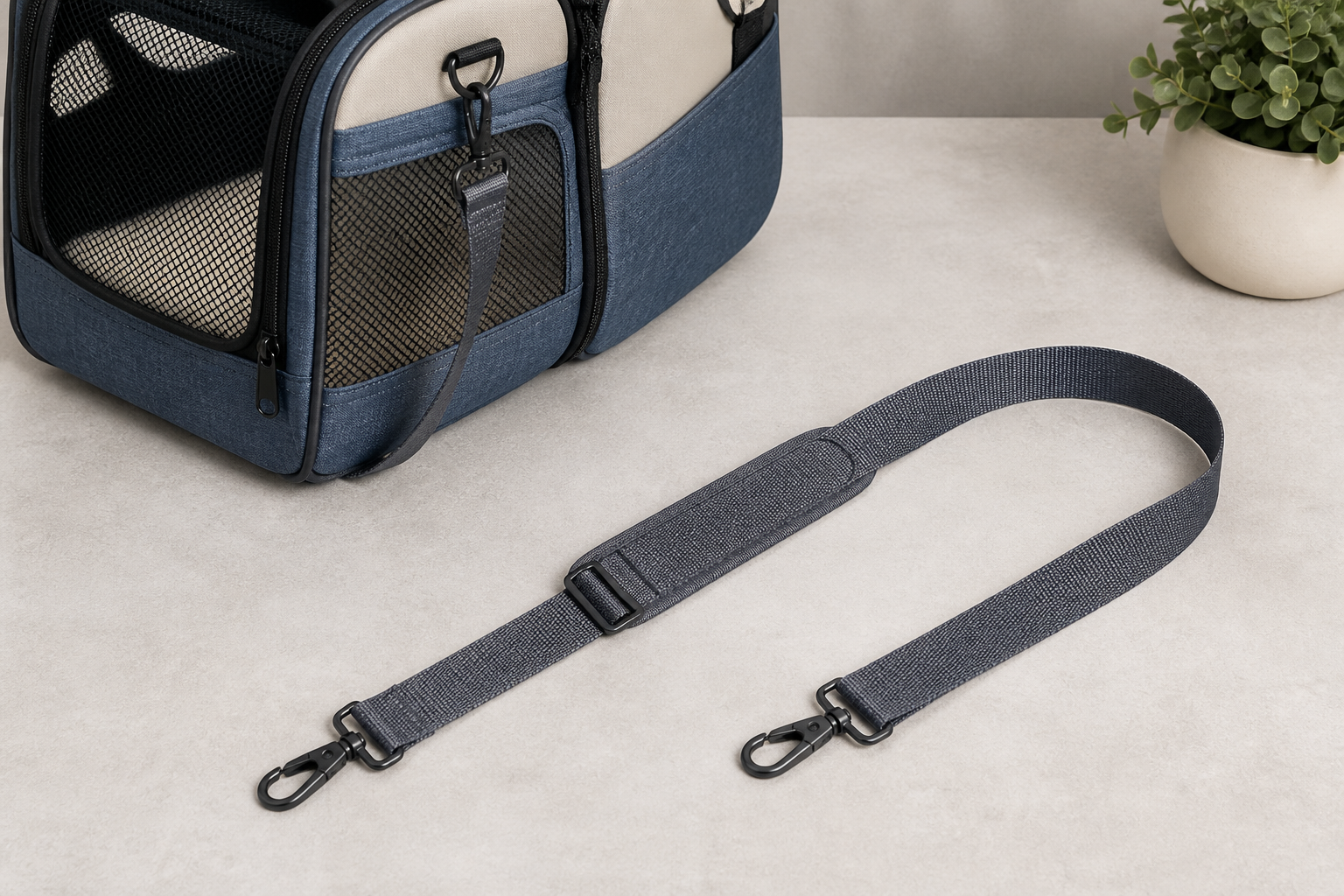 Slim adjustable strapsCompare when the carrier has smaller rings or limited clip clearance, while still requiring complete clip closure.
Category route
Slim adjustable strapsCompare when the carrier has smaller rings or limited clip clearance, while still requiring complete clip closure.
Category route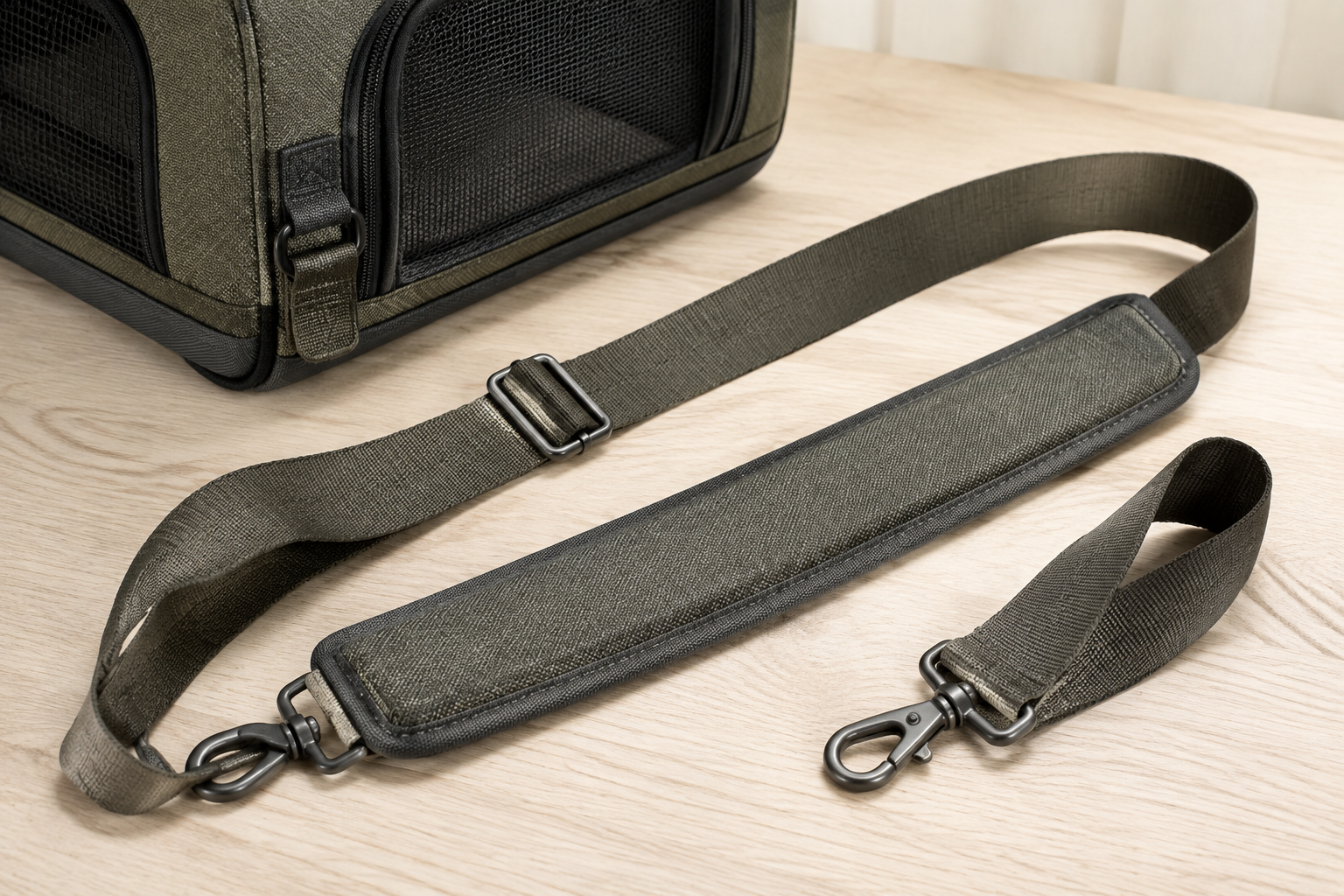 Long sliding-pad strapsCompare when several people share the carrier or the length changes enough that a short pad would shift off the shoulder.
Inspect the carrier before replacing only the strap
Remove the old strap and examine the carrier in bright light. Check the D-rings or loops, the fabric and stitching around them, handles, seams, mesh, zippers, frame, and base. Stop using the carrier if an attachment point is bent, loose, torn, sharply worn, or pulling away from the body. A stronger-looking strap transfers force to those same anchors; it cannot restore them.
Look for the carrier maker’s replacement-part guidance first. A maker-supplied strap is the clearest compatibility route when one exists. If the instructions prohibit substitute hardware or the intended attachment method is unclear, do not improvise.
Measure the clips and attachment points
- Ring stock thickness: measure the thickest part the clip must pass around, not just the empty center of the ring.
- Clip opening: the gate must open far enough to enter the ring without forcing, twisting, or prying.
- Closed clearance: after attachment, the gate should close completely and the hook should rotate without pressing into fabric or mesh.
- Clip-to-clip length: measure the old strap at a comfortable setting, including the hardware at both ends.
- Webbing width: compare the new webbing with the adjuster and with any storage sleeve or keeper on the carrier.
Do a fit check with the carrier empty first. Confirm that each clip is fully closed, the webbing lies flat, the adjuster holds its position, and the carrier stays reasonably level when lifted by the strap. Then follow the carrier maker’s instructions for any further check; do not exceed the carrier’s stated limits.
How the three varieties differ
Wide padded straps are the practical first comparison when the attachment rings have ample clearance. Check that the pad can slide to the actual shoulder position and that its edges do not bunch the webbing.
Slim adjustable straps may fit smaller hardware and pack with less bulk. The tradeoff is a narrower contact area, so compare the full adjusted setup rather than assuming “lightweight” means comfortable.
Long sliding-pad straps suit households where strap length changes often. Measure the pad as well as the full strap: a long pad can interfere with the adjuster or sit awkwardly when the strap is shortened.
Materials, hardware, and maintenance
Listings commonly describe woven synthetic webbing, foam or mesh padding, and metal or plastic hardware. Treat those as construction descriptions, not proof of durability. Look for clear dimensions, care directions, and maker-stated use. Avoid relying on a vague load claim, especially when it does not address the carrier’s anchors.
After use, wipe hardware and follow the strap maker’s cleaning directions. Let the strap dry fully before storage. Regularly inspect for frayed webbing, cuts, stretched stitching, a slider that creeps, cracks, corrosion, sharp edges, a sticky gate, or a swivel that binds. Retire a damaged strap rather than knotting, taping, or sewing around failed hardware.
Who should skip a generic replacement strap?
Skip it when the carrier has damaged anchors, seams, handles, zippers, mesh, frame, or base; when the manufacturer requires a specific part; when the ring geometry cannot be matched; or when a new strap would encourage use beyond the carrier’s stated limits. Replacing the whole carrier may be the more sensible route when several components are worn.
Also skip shoulder carrying if the carrier cannot remain level, the pet lacks suitable space and ventilation, or the loaded setup is difficult for the handler to lift and control. For a pet with mobility, breathing, pain, or travel-distress concerns, ask a veterinarian about the trip and handling plan rather than treating a strap as a solution.
A five-minute compatibility checklist
- Inspect the entire carrier and stop if any structural component is damaged.
- Check whether the carrier maker offers or specifies a replacement strap.
- Measure both attachment points, the needed clip opening, strap width, and clip-to-clip length.
- Compare those measurements with the current listing and reject vague or incomplete specifications.
- Attach and lift the empty carrier first, then follow all carrier and strap instructions without changing the carrier’s load limits.
Continue the carrier decision
If the carrier itself needs replacing, use our pet carrier guide for routine appointments and short trips. If it is sound but awkward to store, compare soft-sided carrier structures and measured fit. A correctly fitted carrier liner can simplify routine cleanup, but it also must not block ventilation, restraint openings, or usable space.
The practical answer
Start with a wide padded adjustable strap when the carrier’s intact rings provide enough clearance. Choose a slimmer strap for genuinely smaller hardware, or a long sliding pad when length changes move a short pad out of position. The best replacement is not the heaviest-looking strap; it is the one explicitly compatible with the carrier, fully measurable, easy to inspect, and used within the original carrier’s instructions.