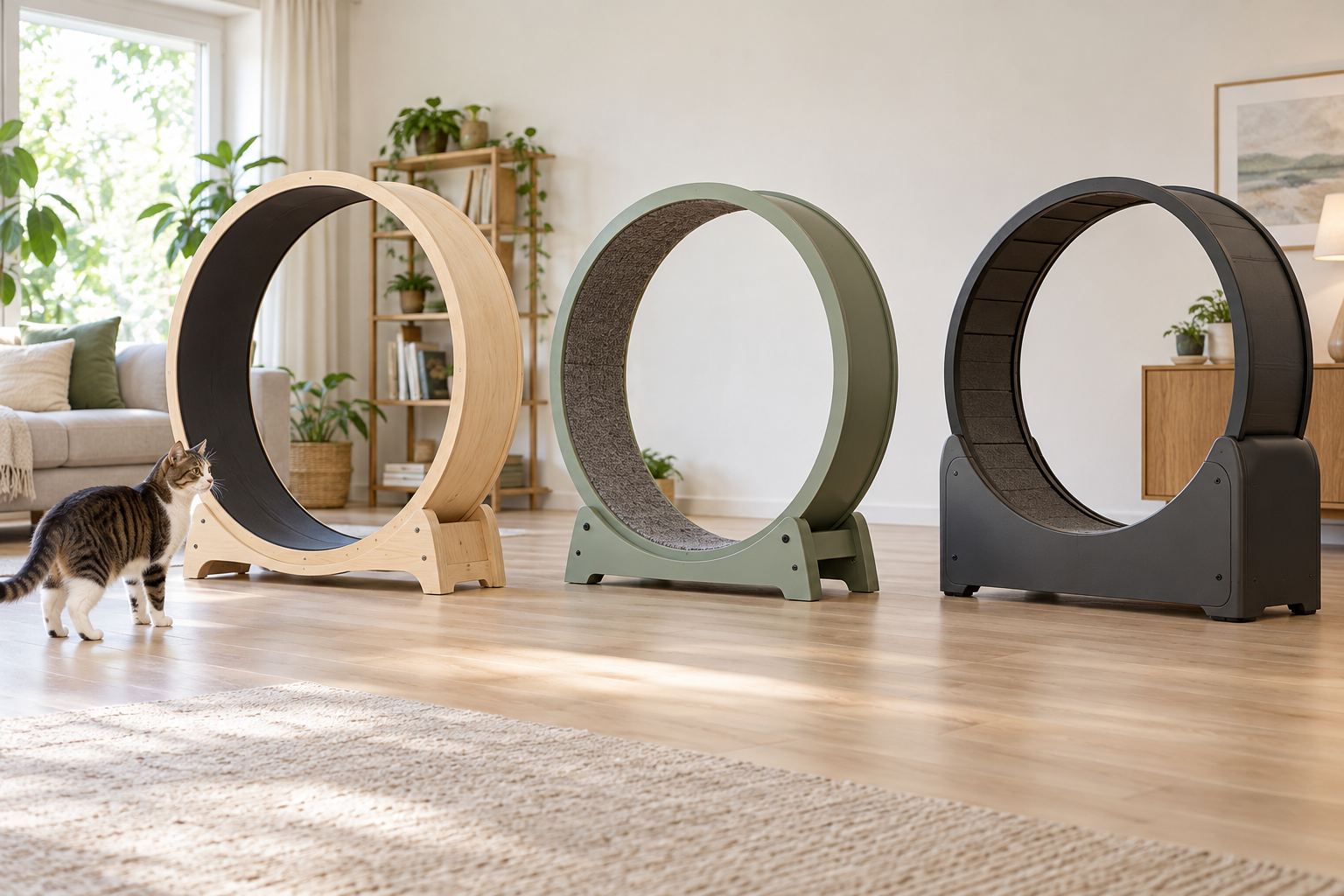
Quick Verdict: Buy, Delay, Choose an Alternative, Escalate, or Skip
Buy only after a specific wheel passes the maker's current cat-fit, assembled-footprint, floor, clearance, assembly, inspection, and care requirements—and only if your seven-day notes show that your cat repeatedly chooses active play without being forced.
Delay when you have not measured the full base and moving rim, return conditions are unclear, the household cannot supervise initial access, or you are hoping the product will create interest that you have not observed.
Choose a smaller alternative when a wand-toy session, tunnel, climbing route, scratcher, food puzzle approved for the cat, or rotating existing toys fits the cat's preferences and your room more realistically.
Ask a veterinarian first when the decision is connected to pain, limping, weakness, balance, breathing, weight, a recent procedure, mobility limits, or a sudden change in activity. A wheel is equipment, not a diagnosis, treatment, or prescribed activity plan.
Skip when there is no safe permanent location, the cost would crowd out routine care, the cat avoids moving or noisy objects, children or other pets cannot be kept clear, or you would need to hold, lure, confine, or train through distress to make the wheel get used.
The Seven-Day Observation Before You Shop
For seven ordinary days, offer the cat's existing appropriate play options at the times you already use them. Do not add a wheel or change several parts of the routine at once. Record what the cat chooses; this is a household decision aid, not a behavioral assessment.
| Record once per play opportunity | What it helps you decide |
|---|---|
| Date, time, and option offered | Whether active play is repeatable or only occasional |
| Approached, engaged, watched, or left | Whether the cat voluntarily chooses moving play |
| Floor movement, climbing, hiding, chasing, or food-based activity | Which smaller format already matches the cat's preference |
| Any hesitation, startle, conflict, or difficulty moving | Whether to stop and seek qualified guidance |
| Minutes you could supervise without multitasking | Whether the household can support an introduction and inspection routine |
A pattern of choosing chase or running does not prove that a wheel will be accepted. It only gives you better evidence than buying from a photo. If the cat consistently chooses other forms of play, respect that no-buy answer.
Room-and-Routine Worksheet
Copy the current maker's assembled width, depth, height, inner diameter, track width, base footprint, required clearances, approved floor types, and cat-size guidance into one column. In the other, record your available measurements and routine constraints. Do not substitute an outer diameter or an “XL” label for usable dimensions.
- Permanent location: available width × depth × height, plus doors, baseboards, vents, curtains, cords, furniture, exits, and walkways.
- Delivery and assembly: package size and weight, doorway turns, tools, adult help, final assembly location, and packaging storage through the return window.
- Cat fit: use only the maker's current stated guidance for the exact model. If the guidance is absent or ambiguous, delay.
- Household control: a way to prevent unsupervised initial access and keep children and other animals away from moving areas.
- Return path: return deadline, disassembly terms, restocking or return-shipping conditions, and who can move the packed unit.
Labeled hypothetical example: a household finds a 48-inch-wide wall area, but a 6-inch baseboard heater exclusion and 8-inch door-swing overlap leave only 34 inches of usable width. A listing photo cannot resolve that conflict; the household should compare the exact full footprint and required clearance or skip that location. These numbers are an illustration, not product measurements.
Cost, Setup, and Maintenance Tradeoffs
The real cost is more than checkout. Count delivery, assembly time, possible two-person handling, floor space kept permanently clear, cleaning supplies permitted by the maker, replacement track or parts if offered, and the effort of a return. Do not assume replacement pieces will remain available; verify the exact-model route before purchase.
At setup, follow the manual rather than adding a rug, shim, brace, lubricant, wall anchor, or altered part unless the maker authorizes it. Before access, inspect alignment, fasteners, base contact, moving rim, track edges, gaps, guards, and clearance. Stop access if the wheel shifts, rubs, wobbles, develops resistance, exposes a sharp edge, lifts a track section, or makes a new sound.
Cleaning can involve a wide running surface, seams, base, rollers, and removable textile sections. Confirm which pieces detach, which cleaners are allowed, and how parts must dry. A design that is hard for your household to inspect and maintain is not worth buying even if it fits the room.
Red Flags That Change the Answer
- The listing gives only an outer diameter or lifestyle photo, not a complete assembled footprint and usable track dimensions.
- Cat-size guidance, floor requirements, clearance, assembly, cleaning, inspection, replacement parts, or returns cannot be found in current maker material.
- “Quiet,” “safe,” “stable,” “exercise,” “weight,” or behavior language is presented without limits that you can evaluate. Do not turn marketing wording into a guarantee.
- The plan depends on forcing the cat onto the equipment, blocking the exit, holding the cat near it, or leaving food where the cat must remain on a moving surface to reach it.
- The household expects unattended use or cannot separate other pets and children during setup and early access.
- A change in movement, breathing, willingness to play, or general behavior is the reason for shopping. Pause and contact a veterinarian instead.
Who Should Skip a Cat Exercise Wheel?
Skip it if you rent and cannot accommodate the footprint or delivery, move often, lack a level maker-approved location, cannot manage assembly or a bulky return, or would resent the wheel if it became unused furniture. Skip it when smaller existing play options already work and there is no specific unmet routine problem.
A wheel also makes little sense as a promised weight-management, anxiety, boredom, sleep, or behavior solution. Those are not outcomes this page can guarantee. Cats with pain, mobility, breathing, balance, recent-procedure, or weight concerns need individualized veterinary guidance before activity equipment is considered.
Smaller Alternatives and the Next Step
Use the site's supervised enrichment buying framework to compare lower-footprint options by supervision, parts, cleaning, and cat fit. For non-food movement, see the cat wand-toy format guide or the small-apartment cat tunnel decision. If the wheel passes the necessity test, compare solid-track, carpet-track, and guarded-base wheel formats.
Source Scope
The decision framework uses Herron and Buffington's 2010 article Environmental Enrichment for Indoor Cats. It describes appropriate outlets for play as part of enrichment, discusses rotating toy options, and recommends evaluating the individual cat and environment; it does not evaluate exercise wheels. The current One Fast Cat maker page was retrieved on October 28, 2026 to confirm that model-specific dimensions, assembly, surface, parts, and returns are details readers must check at the maker level. Neither source establishes that a wheel is necessary or suitable for every cat. Exact requirements vary by model; consult the current manual and manufacturer before purchase.
Bottom Line
A cat exercise wheel can be worth it for a household with observed voluntary interest, enough measured permanent space, realistic supervision, manageable cleaning and inspection, a tolerable return risk, and room in the budget after routine care. Delay when instructions or fit are uncertain, choose smaller enrichment when it solves the same owner task, and skip rather than trying to force adoption.